


Page 319 - Williams Hematology ( PDFDrive )
P. 319
294            Part IV:  Molecular and Cellular Hematology                                                                                                                                 Chapter 20:  Innate Immunity            295


                TABLE 20–1.  Comparisons between Innate and           killing, complement, and antimicrobial peptides) are covered in other
                                                                      chapters. Our understanding of innate immune responses has improved
                Adaptive Immunity
                                                                      dramatically as forward and reverse genetic methods have been used
                              Innate Immunity     Adaptive Immunity   to dissect the signaling pathways that permit host recognition of
                Sensing       TLRs, NK receptors; NLRs,  Immunoglobulins,   microbes. The initial interactions between molecules of microbes and
                mechanism     RLHs, fMLP receptor  T-cell receptors   molecules of the host that trigger an innate immune response have
                                                                      been studied in great detail over the past decade. The afferent pathways
                Cellular      Macrophages, dendritic   T cells, B cells
                components    cells, granulocytes, mast               are each capable of activating responses that partly overlap with one
                              cells, NK cells                         another.
                Efferent      Cytokine production,   Antibody produc-
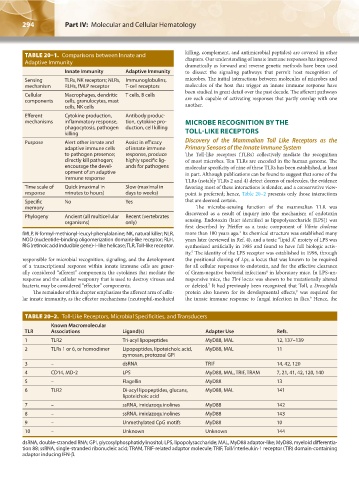
                mechanisms    inflammatory response,   tion, cytokine pro-  MICROBE RECOGNITION BY THE
                              phagocytosis, pathogen   duction, cell killing
                              killing                                 TOLL-LIKE RECEPTORS
                Purpose       Alert other innate and   Assist in efficacy   Discovery of the Mammalian Toll Like Receptors as the
                              adaptive immune cells   of innate immune   Primary Sensors of the Innate Immune System
                              to pathogen presence;   response, produce   The Toll-like receptors (TLRs) collectively mediate the recognition
                              directly kill pathogen;   highly specific lig-  of most microbes. Ten TLRs are encoded in the human genome. The
                              encourage the devel-  ands for pathogens  molecular specificity of nine of these TLRs has been established, at least
                              opment of an adaptive                   in part. Although publications can be found to suggest that some of the
                              immune response
                                                                      TLRs (notably TLRs 2 and 4) detect dozens of molecules, the evidence
                Time scale of   Quick (maximal in    Slow (maximal in   favoring most of these interactions is slender, and a conservative view-
                response      minutes to hours)   days to weeks)      point is preferred; hence, Table 20–2 presents only those interactions
                Specific      No                  Yes                 that are deemed certain.
                memory                                                    The microbe-sensing function of the mammalian TLR was
                                                                      discovered as a result of inquiry into the mechanism of endotoxin
                Phylogeny     Ancient (all multicellular   Recent (vertebrates
                              organisms)          only)               sensing. Endotoxin (later identified as lipopolysaccharide [LPS]) was
                                                                      first described by Pfeiffer as a toxic component of  Vibrio cholerae
                                                                                        3
               fMLP, N-formyl-methionyl-leucyl-phenylalanine; NK, natural killer; NLR,   more than 100 years ago.  Its chemical structure was established many
               NOD (nucleotide-binding oligomerization domain)-like receptor; RLH,   years later (reviewed in Ref. 4), and a toxic “lipid A” moiety of LPS was
               RIG (retinoic acid inducible gene)-I–like helicase; TLR, Toll-like receptor.  synthesized artificially in 1985 and found to have full biologic activ-
                                                                        5
                                                                      ity.  The identity of the LPS receptor was established in 1998, through
               responsible for microbial recognition, signaling, and the development   the positional cloning of Lps, a locus that was known to be required
               of a transcriptional response within innate immune cells are gener-  for all cellular responses to endotoxin, and for the effective clearance
                                                                                                 6
               ally considered “afferent” components; the cytokines that mediate the   of Gram-negative bacterial infections  in laboratory mice. In LPS-un-
               response and the cellular weaponry that is used to destroy viruses and   responsive mice, the Tlr4 locus was shown to be mutationally altered
               bacteria may be considered “effector” components.      or deleted.  It had previously been recognized that Toll, a Drosophila
                                                                              7
                   The remainder of this chapter emphasizes the afferent arm of cellu-  protein also known for its developmental effects,  was required for
                                                                                                           8
                                                                                                                9
               lar innate immunity, as the effector mechanisms (neutrophil-mediated   the innate immune response to fungal infection in flies.  Hence, the
                TABLE 20–2.  Toll-Like Receptors, Microbial Specificities, and Transducers
                         Known Macromolecular
                TLR      Associations            Ligand(s)                   Adapter Use             Refs.
                1        TLR2                    Tri-acyl lipopeptides       MyD88, MAL              12, 137–139
                2        TLRs 1 or 6, or homodimer  Lipopeptides, lipoteichoic acid,   MyD88, MAL    11
                                                 zymosan, protozoal GPI
                3        –                       dsRNA                       TRIF                    14, 42, 120
                4        CD14, MD-2              LPS                         MyD88, MAL, TRIF, TRAM  7, 21, 41, 42, 120, 140
                5        –                       Flagellin                   MyD88                   13
                6        TLR2                    Di-acyl lipopeptides, glucans,    MyD88, MAL        141
                                                 lipoteichoic acid
                7        –                       ssRNA, imidazoquinolines    MyD88                   142
                8        –                       ssRNA, imidazoquinolines    MyD88                   143
                9        –                       Unmethylated CpG motifs     MyD88                   10
                10       –                       Unknown                     Unknown                 144
               dsRNA, double-stranded RNA; GPI, glycosylphosphatidylinositol; LPS, lipopolysaccharide; MAL, MyD88 adaptor-like; MyD88, myeloid differentia-
               tion 88; ssRNA, single-stranded ribonucleic acid; TRAM, TRIF-related adaptor molecule; TRIF, Toll/interleukin-1 receptor (TIR) domain-containing
               adaptor inducing IFN-β.


          Kaushansky_chapter 20_p0293-0306.indd   294                                                                   9/17/15   5:51 PM

