


Page 322 - Williams Hematology ( PDFDrive )
P. 322
296  Part IV:  Molecular and Cellular Hematology                              Chapter 20:  Innate Immunity            297


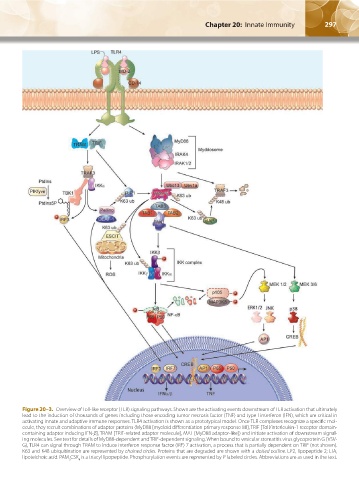
                  Figure 20–3.  Overview of Toll-like receptor (TLR) signaling pathways. Shown are the activating events downstream of TLR activation that ultimately
                  lead to the induction of thousands of genes including those encoding tumor necrosis factor (TNF) and type I interferon (IFN), which are critical in
                  activating innate and adaptive immune responses. TLR4 activation is shown as a prototypical model. Once TLR complexes recognize a specific mol-
                  ecule, they recruit combinations of adaptor proteins (MyD88 [myeloid differentiation primary response 88], TRIF [Toll/interleukin-1 receptor domain-
                  containing adaptor inducing IFN-β], TRAM [TRIF-related adaptor molecule], MAL [MyD88 adaptor-like]) and initiate activation of downstream signal-
                  ing molecules. See text for details of MyD88-dependent and TRIF-dependent signaling. When bound to vesicular stomatitis virus glycoprotein G (VSV-
                  G), TLR4 can signal through TRAM to induce interferon response factor (IRF) 7 activation, a process that is partially dependent on TRIF (not shown).
                  K63 and K48 ubiquitination are represented by chained circles. Proteins that are degraded are shown with a dotted outline. LP2, lipopeptide 2; LTA,
                  lipoteichoic acid. PAM CSK  is a triacyl lipopeptide. Phosphorylation events are represented by P-labeled circles. Abbreviations are as used in the text.
                                 3   4


          Kaushansky_chapter 20_p0293-0306.indd   297                                                                   9/17/15   5:52 PM

