


Page 320 - Williams Hematology ( PDFDrive )
P. 320
294  Part IV:  Molecular and Cellular Hematology                              Chapter 20:  Innate Immunity            295


                  discovery of an LPS-sensing function for TLR4, a homologue of Toll,   Structure of the Toll-Like Receptors
                  made evolutionary sense.                              The TLRs are single-spanning transmembrane proteins with leucine-rich
                     Other molecules of microbial origin (for example, di- and tri-   repeat (LRR) motifs in their extracellular domains and a characteris-
                  acylated lipopeptides  and lipoproteins, lipoteichoic acid, unmethy-  tic TIR (Toll/interleukin [IL]-1 receptor) motif in their cytoplasmic
                  lated DNA bearing CpG dinucleotides in a particular context, flagellin,   domains. The TIR domain is based on an ancient protein fold  evident
                                                                                                                     25
                  and double-stranded RNA [dsRNA]) were known to elicit responses   in cytosolic plant disease resistance proteins (where it often is repre-
                  qualitatively similar to those elicited by LPS. The other TLR paralogs   sented together with a nucleotide binding sequence [NBS] and/or LRR
                  seemed excellent candidate receptors for these molecules. Reverse   motifs), in proteins of the IL-1 and IL-18 receptor family, in the adapter
                  genetic methods established that each of these molecules is indeed rec-  proteins that carry signals from TLRs, and in the TLRs themselves.
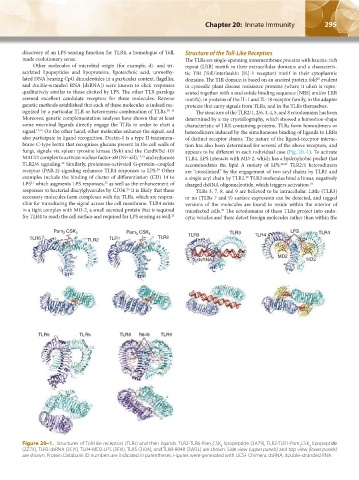
                  ognized by a particular TLR or heteromeric combination of TLRs. 10–14    The structure of the TLR2/1, 2/6, 3, 4, 5, and 8 ectodomains has been
                  Moreover, genetic complementation analyses have shown that at least   determined by x-ray crystallography, which showed a horseshoe-shape
                  some microbial ligands directly engage the TLRs in order to elicit a    characteristic of LRR-containing proteins. TLRs form homodimers or
                  signal. 15,16  On the other hand, other molecules enhance the signal, and   heterodimers induced by the simultaneous binding of ligands to LRRs
                  also participate in ligand recognition. Dectin-1 is a type II transmem-  of distinct receptor chains. The nature of the ligand-receptor interac-
                  brane C-type lectin that recognizes glucans present in the cell walls of   tion has also been determined for several of the above receptors, and
                  fungi, signals via spleen tyrosine kinase (Syk) and the Card9/Bcl-10/  appears to be different in each individual case (Fig. 20–1). To activate
                  MALT1 complex to activate nuclear factor-κB (NF-κB), 17,18  and enhances   TLR4, LPS interacts with MD-2, which has a hydrophobic pocket that
                               19
                  TLR2/6 signaling.  Similarly, proteinase-activated G-protein–coupled   accommodates the lipid A moiety of LPS. 26,27  TLR2/1 heterodimers
                                                               20
                  receptor (PAR-2) signaling enhances TLR4 responses to LPS.  Other   are “crosslinked” by the engagement of two acyl chains by TLR1 and
                  examples include the binding of cluster of differentiation (CD) 14 to   a single acyl chain by TLR2.  TLR3 molecules bind a linear, negatively
                                                                                             28
                                             22
                  LPS  which augments LPS responses,  as well as the enhancement of   charged dsRNA oligonucleotide, which triggers activation. 29
                     21
                  responses to bacterial diacylglycerides by CD36.  It is likely that these   TLRs 3, 7, 8, and 9 are believed to be intracellular. Little (TLR3)
                                                     23
                  accessory molecules form complexes with the TLRs, which are respon-  or no (TLRs 7 and 9) surface expression can be detected, and tagged
                  sible for transducing the signal across the cell membrane. TLR4 exists   versions of the molecules are found to reside within the interior of
                  in a tight complex with MD-2, a small secreted protein that is required   transfected cells.  The ectodomains of these TLRs project into endo-
                                                                                    30
                  for TLR4 to reach the cell surface and required for LPS sensing as well. 24  cytic vesicles and there detect foreign molecules rather than within the
                            Pam 2  CSK 4             Pam 3  CSK 4                      TLR3                 LPS      TLR4
                    TLR6                TLR2   TLR1            TLR2      TLR3                   TLR4
                                                                                                       MD2
                                                                             dsRNA                               MD2


                       TLR5          TLR5         TLR8   R848   TLR8


                  Figure 20–1.  Structures of Toll-like receptors (TLRs) and their ligands. TLR2-TLR6-Pam CSK  lipopeptide (3A79), TLR2-TLR1-Pam CSK  lipopeptide
                                                                                                                  4
                                                                                                               3
                                                                                 2
                                                                                    4
                  (2Z7X), TLR3-dsRNA (3CIY), TLR4-MD2-LPS (3FXI), TLR5 (3J0A), and TLR8-R848 (3W3L) are shown. Side view (upper panels) and top view (lower panels)
                  are shown. Protein Databank ID numbers are indicated in parentheses. Figures were generated with UCSF Chimera. dsRNA, double-stranded RNA.


          Kaushansky_chapter 20_p0293-0306.indd   295                                                                   9/17/15   5:51 PM

