


Page 321 - Williams Hematology ( PDFDrive )
P. 321
296            Part IV:  Molecular and Cellular Hematology                                                                                                                                 Chapter 20:  Innate Immunity            297


               extracellular space. TLRs 3, 7, 8, and 9 are trafficked from the endo-  adaptor protein complex 3 (AP-3), which directs subcellular trafficking
               plasmic reticulum (ER) to endosomal compartments via the secretory   through the secretory pathway, and the peptide/histidine transporter 1
               pathway, and depend on the aid of chaperones to do so. For example,   (PHT1) are necessary for TLR7 and TLR9 trafficking to lysosome-re-
               UNC93B1, a 12-transmembrane spanning ER protein, directly binds   lated organelles.
               and is necessary for TLRs 3, 7, and 9 to gain access to the endosomal
               compartment.  UNC93B1 is believed to escort these molecules, and   Toll/Interleukin-1 Receptor Adapter Signaling
                          31
                                                 32
               perhaps others, to their destination in the cell.  PRAT4A (encoded by   The signaling events initiated by the TLRs are increasingly complex and
               TNRC5) serves a critical role in chaperoning multiple TLRs to their des-  have been studied in great detail [reviewed in Refs. 39 and 40]. Figure
                      33
               tination,  while the ER chaperone protein, gp96 (also called GRP94 or   20-3 illustrates the pathways as they are presently understood. It must
               HSP90B1) is critical for all TLR maturation (Fig. 20–2).  Proteolysis   be recognized that not all TLRs operate within the same cells, nor are
                                                         34
               of TLR7 and 9 is known to occur in the endolysosome, and at least for   all cells equivalent in their responses to TLR ligation. Notably, macro-
               TLR9, this cleavage increases ligand binding and is necessary for acti-  phages and conventional (myeloid) dendritic cells respond to different
               vating downstream signaling pathways. 35,36  In plasmacytoid dendritic   stimuli than do lymphoid cells, or plasmacytoid dendritic cells (which
               cells,  TLR7  and  TLR9  are  further  trafficked  from  endosomes  to  lys-  are specialized for type I IFN production). Moreover, some cells not
               osome-related organelles; this trafficking is necessary for the abundant   usually regarded as “professional” components of the innate immune
               production of type I IFN for which these cells are specialized. 37,38  The   system are capable of responding to TLR ligands in one way or another.


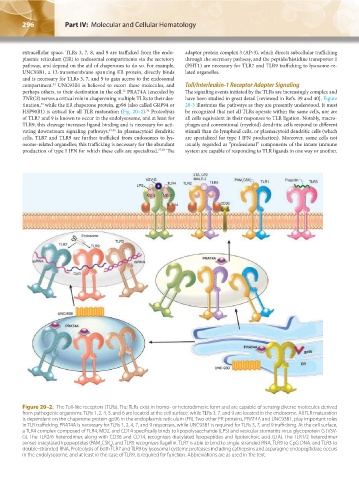
               Figure 20–2.  The Toll-like receptors (TLRs). The TLRs exist in homo- or heterodimeric form and are capable of sensing diverse molecules derived
               from pathogenic organisms. TLRs 1, 2, 4, 5, and 6 are located at the cell surface, while TLRs 3, 7, and 9 are located in the endosome. All TLR maturation
               is dependent on the chaperone protein gp96 in the endoplasmic reticulum (ER). Two other ER proteins, PRAT4A and UNC93B1, play important roles
               in TLR trafficking. PRAT4A is necessary for TLRs 1, 2, 4, 7, and 9 responses, while UNC93B1 is required for TLRs 3, 7, and 9 trafficking. At the cell surface,
               a TLR4 complex composed of TLR4, MD2, and CD14 specifically binds to lipopolysaccharide (LPS) and vesicular stomatitis virus glycoprotein G (VSV-
               G). The TLR2/6 heterodimer, along with CD36 and CD14, recognizes diacylated lipopeptides and lipoteichoic acid (LTA). The TLR1/2 heterodimer
               senses triacylated lipopeptides (PAM CSK ), and TLR5 recognizes flagellin. TLR7 is able to bind to single-stranded RNA, TLR9 to CpG DNA, and TLR3 to
                                         3
                                             4
               double-stranded RNA. Proteolysis of both TLR7 and TLR9 by lysosomal cysteine proteases including cathepsins and asparagine endopeptidase occurs
               in the endolysosome, and at least in the case of TLR9, is required for function. Abbreviations are as used in the text.


          Kaushansky_chapter 20_p0293-0306.indd   296                                                                   9/17/15   5:52 PM

