


Page 325 - Williams Hematology ( PDFDrive )
P. 325
300            Part IV:  Molecular and Cellular Hematology                                                                                                                                 Chapter 20:  Innate Immunity            301


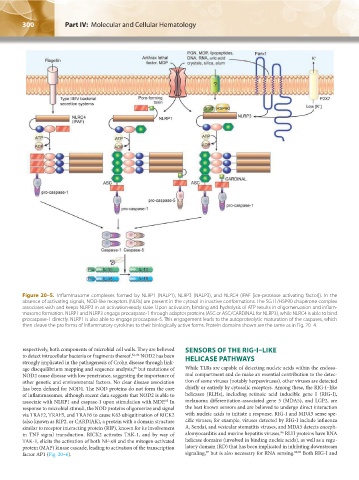
               Figure 20–5.  Inflammasome  complexes formed by NLRP1 (NALP1), NLRP3 (NALP3), and NLRC4 (IPAF [ice-protease activating factor]). In the
               absence of activating signals, NOD-like receptors (NLRs) are present in the cytosol in inactive conformations. The SGT1/HSP90 chaperone complex
               associates with and keeps NLRP3 in an activation-ready state. Upon activation, binding and hydrolysis of ATP results in oligomerization and inflam-
               masome formation. NLRP1 and NLRP3 engage procaspase-1 through adaptor proteins (ASC or ASC/CARDINAL for NLRP3), while NLRC4 is able to bind
               procaspase-1 directly. NLRP1 is also able to engage procaspase-5. This engagement leads to the autoproteolytic maturation of the caspases, which
               then cleave the pro forms of inflammatory cytokines to their biologically active forms. Protein domains shown are the same as in Fig. 20–4.


               respectively, both components of microbial cell walls. They are believed   SENSORS OF THE RIG-I–LIKE
               to detect intracellular bacteria or fragments thereof. 82–84  NOD2 has been   HELICASE PATHWAYS
               strongly implicated in the pathogenesis of Crohn disease through link-
               age disequilibrium mapping and sequence analysis,  but mutations of   While TLRs are capable of detecting nucleic acids within the endoso-
                                                     66
               NOD2 cause disease with low penetrance, suggesting the importance of   mal compartment and do make an essential contribution to the detec-
               other genetic and environmental factors. No clear disease association   tion of some viruses (notably herpesviruses), other viruses are detected
               has been defined for NOD1. The NOD proteins do not form the core   chiefly or entirely by cytosolic receptors. Among these, the RIG-I–like
               of inflammasomes, although recent data suggests that NOD2 is able to   helicases (RLHs), including retinoic acid inducible gene I (RIG-I),
               associate with NLRP1 and caspase-1 upon stimulation with MDP.  In   melanoma differentiation-associated gene 5 (MDA5), and LGP2, are
                                                               85
               response to microbial stimuli, the NOD proteins oligomerize and signal   the best known sensors and are believed to undergo direct interaction
               via TRAF2, TRAF5, and TRAF6 to cause K63 ubiquitination of RICK2   with nucleic acids to initiate a response. RIG-I and MDA5 sense spe-
               (also known as RIP2, or CARDIAK), a protein with a domain structure   cific viruses; for example, viruses detected by RIG-I include influenza
               similar to receptor interacting protein (RIP), known for its involvement   A, Sendai, and vesicular stomatitis viruses, and MDA5 detects enceph-
                                                                                                      86
               in TNF signal transduction. RICK2 activates TAK-1, and by way of   alomyocarditis and murine hepatitis viruses.  RLH proteins have RNA
               TAK-1, elicits the activation of both NF-κB and the mitogen-activated   helicase domains (involved in binding nucleic acids), as well as a regu-
               protein (MAP) kinase cascade, leading to activation of the transcription   latory domain (RD) that has been implicated in inhibiting downstream
                                                                             87
               factor AP1 (Fig. 20–6).                                signaling,  but is also necessary for RNA sensing. 88,89  Both RIG-I and


          Kaushansky_chapter 20_p0293-0306.indd   300                                                                   9/17/15   5:52 PM

