


Page 42 - Williams Hematology ( PDFDrive )
P. 42
18             Part I:  Clinical Evaluation of the Patient                                                                                                                        Chapter 2:  Examination of Blood Cells            19


               production of platelets from circulatory destruction or removal as a   The platelet and absolute neutrophil counts are lower in individuals of
               cause of thrombocytopenia, in an analogous fashion to the use of the   African ethnic origin.  American men and women of African descent
                                                                                      68
               reticulocyte count. The percentage of reticulated platelets is increased in   have lower hemoglobin concentrations than do men and women of
               destructive thrombocytopenias, but remains within the reference range   European descent, a difference that is reduced by half, but still signifi-
               in hypoproductive states.  Reticulated platelet number or RNA content   cant, when subjects with iron deficiency, thalassemia, sickle trait, and
                                 82
                                                             83
                                                                                           90
               correlates with imminent platelet recovery after chemotherapy.  Retic-  renal disease are excluded.  Important clinical consequences may
               ulated platelet number is correlated with risk of death in patients with   result from these differences; for instance, reduced neutrophil counts
                                          85
               acute coronary syndrome  and DIC,  and with hyporesponsiveness to   in Americans of African descent result in lower-dose intensity of treat-
                                  84
               platelet function inhibitors  or aspirin. 87           ment in early stage breast cancer, which may be related to survival out-
                                   86
                                                                      come disparities.  Beutler and West  summarize the situation well:
                                                                                  91
                                                                                                 90
               REFERENCE RANGES                                       “The problem cannot be solved by simply establishing different ranges
                                                                      for different ethnic groups, especially since all represent some degree of
               The use of reference ranges for quantitative hematology measurements   admixture. Thus, it is basically information that the physician must pos-
               deserves some additional comment. The physiologic variation of certain   sess that becomes one of the many factors that we designate as clinical
               blood cell counts is notably higher than usually found in blood chemistry   judgment.” With these caveats in mind, reference ranges for children,
               analytes. This is a reflection of the adaptive responsiveness of the mar-  and African American, Hispanic, and white adults are presented in
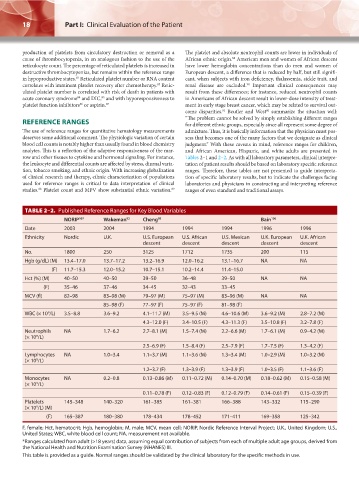
               row and other tissues to cytokine and hormonal signaling. For instance,   Tables  2–1 and 2–2. As with all laboratory parameters, clinical interpre-
               the leukocyte and differential counts are affected by stress, diurnal varia-  tation of patient results should be based on laboratory specific reference
               tion, tobacco smoking, and ethnic origin. With increasing globalization   ranges. Therefore, these tables are not presented to guide interpreta-
               of clinical research and therapy, ethnic characterization of populations   tion of specific laboratory results, but to indicate the challenges facing
               used for reference ranges is critical to data interpretation of clinical   laboratories and physicians in constructing and interpreting reference
               studies.  Platelet count and MPV show substantial ethnic variation.     ranges of even standard and traditional assays.
                                                                 89
                     88
                TABLE 2–2.  Published Reference Ranges for Key Blood Variables
                             NORIP 107     Wakeman 92   Cheng 93                               Bain 106
                Date         2003          2004         1994         1994         1994         1996          1996
                Ethnicity    Nordic        U.K.         U.S. European   U.S. African   U.S. Mexican   U.K. European   U.K. African
                                                        descent      descent      descent      descent       descent
                No.          1800          250          3125         1712         1735         200           115
                Hgb (g/dL) (M)  13.4–17.0  13.7–17.2    13.2–16.9    12.0–16.2    13.1–16.7    NA            NA
                         (F)  11.7–15.3    12.0–15.2    10.7–15.1    10.2–14.4    11.4–15.0
                Hct (%) (M)  40–50         40–50        39–50        36–48        39–50        NA            NA
                      (F)    35–46         37–46        34–45        32–43        33–45
                MCV (fl)     82–98         83–98 (M)    79–97 (M)    75–97 (M)    83–96 (M)    NA            NA
                                           85–98 (F)    77–97 (F)    75–97 (F)    81–98 (F)
                WBC (× 10 /L)  3.5–8.8     3.6–9.2      4.1–11.7 (M)  3.5–9.5 (M)  4.6–10.6 (M)  3.6–9.2 (M)  2.8–7.2 (M)
                        9
                                                        4.3–12.0 (F)  3.4–10.5 (F)  4.3–11.3 (F)  3.5–10.8 (F)  3.2–7.8 (F)
                Neutrophils    NA          1.7–6.2      2.7–8.1 (M)  1.5–7.4 (M)  2.2–6.6 (M)  1.7–6.1 (M)   0.9–4.2 (M)
                (× 10 /L)
                    9
                                                        2.5–6.9 (F)  1.5–8.4 (F)  2.5–7.9 (F)  1.7–7.5 (F)   1.3–4.2 (F)
                Lymphocytes    NA          1.0–3.4      1.1–3.7 (M)  1.1–3.6 (M)  1.3–3.4 (M)  1.0–2.9 (M)   1.0–3.2 (M)
                (× 10 /L)
                    9
                                                        1.2–3.7 (F)  1.3–3.9 (F)  1.3–3.9 (F)  1.0–3.5 (F)   1.1–3.6 (F)
                Monocytes    NA            0.2–0.8      0.13–0.86 (M)  0.11–0.72 (M)  0.14–0.70 (M)  0.18–0.62 (M)  0.15–0.58 (M)
                (× 10 /L)
                    9
                                                        0.11–0.78 (F)  0.12–0.83 (F)  0.12–0.79 (F)  0.14–0.61 (F)  0.15–0.39 (F)
                Platelets    145–348       140–320      161–385      161–381      166–388      143–332       115–290
                    9
                (× 10 /L) (M)
                       (F)   165–387       180–380      178–434      178–452      171–411      169–358       125–342
               F, female; Hct, hematocrit; Hgb, hemoglobin; M, male; MCV, mean cell; NORIP, Nordic Reference Interval Project; U.K., United Kingdom; U.S.,
               United States; WBC, white blood cell count; NA, measurement not available.
               *Ranges calculated from adult (>18 years) data, assuming equal contribution of subjects from each of multiple adult age groups, derived from
               the National Health and Nutrition Examination Survey (NHANES) III.
               This table is provided as a guide. Normal ranges should be validated by the clinical laboratory for the specific methods in use.


          Kaushansky_chapter 02_p0011-0026.indd   18                                                                    17/09/15   5:34 pm

