


Page 43 - Williams Hematology ( PDFDrive )
P. 43
18  Part I:  Clinical Evaluation of the Patient                       Chapter 2:  Examination of Blood Cells            19


                                1


                              Men


                            Subject no.  12

                               13


                              Women


                               24

                                   1.0  3.0  5.0  7.0   12   14  16   18   80   90  100  110   100  200  300  400  500
                                                9
                                                                                                            9
                                    Granulocytes (10 /L)  Hemoglobin (g/dL)     MCV (fL)           Platelets (10 /L)
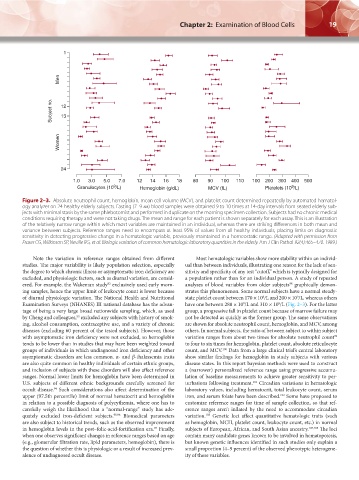
                  Figure 2–3.  Absolute neutrophil count, hemoglobin, mean cell volume (MCV), and platelet count determined repeatedly by automated hematol-
                  ogy analyzer on 24 healthy elderly subjects. Fasting (7–9 am) blood samples were obtained 9 to 10 times at 14-day intervals from seated elderly sub-
                  jects with minimal stasis by the same phlebotomist and performed in duplicate on the morning specimen collection. Subjects had no chronic medical
                  conditions requiring therapy and were not taking drugs. The mean and range for each patient is shown separately for each assay. This is an illustration
                  of the relatively narrow range within which most variables are maintained in an individual, whereas there are striking differences in both mean and
                  variance between subjects. Reference ranges need to encompass at least 95% of values from all healthy individuals, placing limits on diagnostic
                  sensitivity in detecting progressive change in a hematologic variable, previously maintained in a homeostatic range. (Adapted with permission from
                  Fraser CG, Wilkinson SP, Neville RG, et al: Biologic variation of common hematologic laboratory quantities in the elderly. Am J Clin Pathol 92(4):465–470. 1989.)


                     Note the variation in reference ranges obtained from different   Most hematologic variables show more stability within an individ-
                  studies. The major variability is likely population selection, especially   ual than between individuals, illustrating one reason for the lack of sen-
                  the degree to which chronic illness or asymptomatic iron deficiency are   sitivity and specificity of any test “cutoff,” which is typically designed for
                  excluded, and physiologic factors, such as diurnal variation, are consid-  a population rather than for an individual person. A study of repeated
                  ered. For example, the Wakeman study  exclusively used early morn-  analyses of blood variables from older subjects  graphically demon-
                                                                                                           98
                                              92
                  ing samples, hence the upper limit of leukocyte count is lower because   strates this phenomenon. Some normal subjects have a normal steady-
                  of diurnal physiologic variation. The National Health and Nutritional   state platelet count between 170 × 10 /L and 200 × 10 /L, whereas others
                                                                                                              9
                                                                                                  9
                  Examination Surveys (NHANES) III national database has the advan-  have one between 280 × 10 /L and 310 × 10 /L (Fig. 2–3). For the latter
                                                                                            9
                                                                                                        9
                  tage of being a very large broad nationwide sampling, which, as used   group, a progressive fall in platelet count because of marrow failure may
                  by Cheng and colleagues,  excluded any subjects with history of smok-  not be detected as quickly as the former group. The same observations
                                    93
                  ing, alcohol consumption, contraceptive use, and a variety of chronic   are shown for absolute neutrophil count, hemoglobin, and MCV, among
                  diseases (excluding 60 percent of the tested subjects). However, those   others. In normal subjects, the ratio of between subject to within subject
                  with asymptomatic iron deficiency were not excluded, so hemoglobin   variation ranges from about two times for absolute neutrophil count
                                                                                                                          99
                  tends to be lower than in studies that may have been weighted toward   to four to six times for hemoglobin, platelet count, absolute reticulocyte
                  groups of individuals in which undiagnosed iron deficiency and other   count, and MCV.  Data from a large clinical trial’s central laboratory
                                                                                     100
                  asymptomatic disorders are less common. α- and β-thalassemia traits   show similar findings for hemoglobin in study subjects with various
                  are also quite common in healthy individuals of certain ethnic groups,   disease states. In this report bayesian methods were used to construct
                  and inclusion of subjects with these disorders will also affect reference   a (narrower) personalized reference range using progressive accumu-
                  ranges. Normal lower limits for hemoglobin have been determined in   lation of baseline measurements to achieve greater sensitivity to per-
                  U.S.  subjects  of  different  ethnic  backgrounds  carefully  screened  for   turbations following treatment.  Circadian variations in hematologic
                                                                                               101
                  occult disease.  Such considerations also affect determination of the   laboratory values, including hematocrit, total leukocyte count, serum
                            94
                  upper (97.5th percentile) limit of normal hematocrit and hemoglobin   iron, and serum folate have been described.  Some have proposed to
                                                                                                        102
                  in relation to a possible diagnosis of polycythemia, where one has to   customize reference ranges for time of sample collection, so that ref-
                  carefully weigh the likelihood that a “normal-range” study has ade-  erence ranges aren’t inflated by the need to accommodate circadian
                  quately excluded iron-deficient subjects. 95,96  Biomedical parameters   variation.  Genetic loci affect quantitative hematologic traits (such
                                                                               103
                  are also subject to historical trends, such as the observed improvement   as hemoglobin, MCH, platelet count, leukocyte count, etc.) in normal
                  in hemoglobin levels in the post–folic-acid-fortification era.  Finally,   subjects of European, African, and South Asian ancestry. 104,105  The loci
                                                              97
                  when one observes significant changes in reference ranges based on age   contain many candidate genes known to be involved in hematopoiesis,
                  (e.g., glomerular filtration rate, lipid parameters, hemoglobin), there is   but known genetic influences identified in such studies only explain a
                  the question of whether this is physiologic or a result of increased prev-  small proportion (4–9 percent) of the observed phenotypic heterogene-
                  alence of undiagnosed occult disease.                 ity of these variables.


          Kaushansky_chapter 02_p0011-0026.indd   19                                                                    17/09/15   5:34 pm

