


Page 448 - Williams Hematology ( PDFDrive )
P. 448
422  Part V:  Therapeutic Principles                                           Chapter 27:  Vaccine Therapy           423


                   TABLE 27–2.  Monitoring of Human Immune Responses      100                           Idiotype-KLH + GM-CSF
                   Type of Response   Representative Assay                                            Days 1–4  20,000 units
                                                                                                                10,000 units
                                                                                                         SC
                   CD4+ T cells       Cytokine induction                                                        ldiotype-KLH
                                                                           80                                   alone
                                      Cytokine ELISPOT (IFN-γ)                                              Control idiotype-KLH
                                      Intracellular cytokine               60                                Mantel-Cox P-values
                                      Proliferation                       % Survival                            vs.  0.15
                   CD8+ T cells       Cytotoxicity                                                              vs.  0.01
                                      Limiting dilution analysis           40
                                      Tetramer
                                                                           20
                                      Cytokine ELISPOT (IFN-γ)
                                      Intracellular cytokine
                                                                            0
                   Antibody           ELISA                                 10       20      30       40
                                      Flow cytometry                               Days posttumor challenge
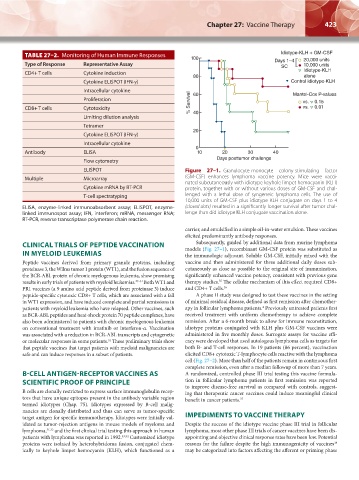
                                      ELISPOT                           Figure  27–1.  Granulocyte-monocyte colony-stimulating factor
                   Multiple           Microarray                        (GM-CSF)  enhances  lymphoma  vaccine  potency. Mice  were  vacci-
                                                                        nated subcutaneously with idiotype keyhole limpet hemocyanin (KLH)
                                      Cytokine mRNA by RT-PCR           protein, together with or without various doses of GM-CSF and chal-
                                      T-cell spectratyping              lenged with a lethal dose of syngeneic lymphoma cells. The use of
                                                                        10,000 units of GM-CSF plus idiotype KLH conjugate on days 1 to 4
                  ELISA, enzyme-linked immunoabsorbent assay; ELISPOT, enzyme-  (closed dots) resulted in a significantly longer survival after tumor chal-
                  linked immunospot assay; IFN, interferon; mRNA, messenger RNA;   lenge than did idiotype KLH conjugate vaccination alone.
                  RT-PCR, reverse transcriptase polymerase chain reaction.
                                                                        carrier, and emulsified in a simple oil-in-water emulsion. These vaccines
                                                                        elicited predominantly antibody responses.
                                                                            Subsequently, guided by additional data from murine lymphoma
                  CLINICAL TRIALS OF PEPTIDE VACCINATION                models (Fig. 27–1), recombinant GM-CSF protein was substituted as
                  IN MYELOID LEUKEMIAS                                  the immunologic adjuvant. Soluble GM-CSF, initially mixed with the
                  Peptide vaccines derived from primary granule proteins, including     vaccine and then administered for three additional daily doses sub-
                  proteinase 3, the Wilms tumor 1 protein (WT1), and the fusion sequence of   cutaneously as close as possible to the original site of immunization,
                  the BCR-ABL protein of chronic myelogenous leukemia, show promising   significantly enhanced vaccine potency, consistent with previous gene
                  results in early trials of patients with myeloid leukemias. 27–31  Both WT1 and   therapy studies.  The cellular mechanism of this effect required CD8+
                                                                                    35
                  PR1 vaccines (a 9 amino acid peptide derived from proteinase 3) induce   and CD4+ T cells. 36
                  peptide-specific cytotoxic CD8+ T cells, which are associated with a fall   A phase II study was designed to test these vaccines in the setting
                  in WT1 expression, and have induced complete and partial remissions in   of minimal residual disease, defined as first remission after chemother-
                  patients with myeloid leukemia who have relapsed. Other vaccines, such   apy in follicular lymphoma patients.  Previously untreated patients first
                                                                                                  4
                  as BCR-ABL peptides and heat-shock protein 70 peptide complexes, have   received treatment with uniform chemotherapy to achieve complete
                  also been administered to patients with chronic myelogenous leukemia   remission. After a 6-month break to allow for immune reconstitution,
                  on conventional treatment with imatinib or interferon-α.  Vaccination   idiotype proteins conjugated with KLH plus GM-CSF vaccines were
                  was associated with a reduction in BCR-ABL transcripts and cytogenetic   administered in five monthly doses. Surrogate assays for vaccine effi-
                  or molecular responses in some patients.  These preliminary trials show   cacy were developed that used autologous lymphoma cells as targets for
                                               31
                  that peptide vaccines that target patients with myeloid malignancies are   both B- and T-cell responses. In 19 patients (86 percent), vaccination
                  safe and can induce responses in a subset of patients.  elicited CD8+ cytotoxic T-lymphocyte cells reactive with the lymphoma
                                                                        cell (Fig. 27–2). More than half of the patients remain in continuous first
                                                                        complete remission, even after a median followup of more than 7 years.
                  B-CELL ANTIGEN-RECEPTOR VACCINES AS                   A randomized, controlled phase III trial testing this vaccine formula-
                  SCIENTIFIC PROOF OF PRINCIPLE                         tion in follicular lymphoma patients in first remission was reported
                                                                        to improve disease-free survival as compared with controls, suggest-
                  B cells are clonally restricted to express surface immunoglobulin recep-  ing that therapeutic cancer vaccines could induce meaningful clinical
                  tors that have unique epitopes present in the antibody variable region   benefit in cancer patients. 37
                  termed idiotypes (Chap. 75). Idiotypes expressed by B-cell malig-
                  nancies are clonally distributed and thus can serve as tumor-specific
                  target antigen for specific immunotherapy. Idiotypes were initially val-  IMPEDIMENTS TO VACCINE THERAPY
                  idated as tumor-rejection antigens in mouse models of myeloma and     Despite the success of the idiotype vaccine phase III trial in follicular
                  lymphoma, 31,32  and the first clinical trial testing this approach in human   lymphoma, most other phase III trials of cancer vaccines have been dis-
                  patients with lymphoma was reported in 1992. 33,34  Customized idiotype   appointing and objective clinical response rates have been low. Potential
                                                                                                                          38
                  proteins were isolated by heterohybridoma fusion, conjugated chem-  reasons for the failure despite the high immunogenicity of vaccines
                  ically to keyhole limpet hemocyanin (KLH), which functioned as a   may be categorized into factors affecting the afferent or priming phase


          Kaushansky_chapter 27_p0421-0426.indd   423                                                                   9/17/15   6:02 PM

