


Page 529 - Williams Hematology ( PDFDrive )
P. 529
504            Part VI:  The Erythrocyte                                                                                                  Chapter 34:  Clinical Manifestations and Classification of Erythrocyte Disorders         505


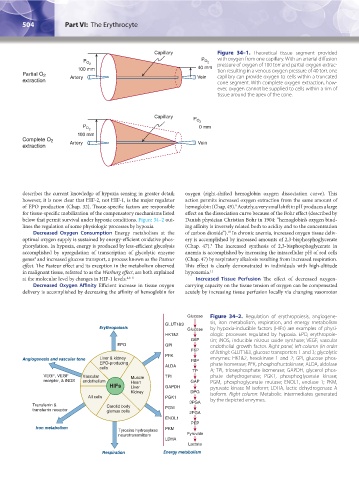
                                                            Capillary            Figure  34–1.  Theoretical  tissue  segment  provided
                                    P O 2                                  P O 2  with oxygen from one capillary. With an arterial diffusion
                                                                                 pressure of oxygen of 100 torr and partial oxygen extrac-
                                  100 mm                                  40 mm  tion resulting in a venous oxygen pressure of 40 torr, one
               Partial O 2                                                Vein   capillary can provide oxygen to cells within a truncated
               extraction      Artery                                            cone segment. With complete oxygen extraction, how-
                                                                                 ever, oxygen cannot be supplied to cells within a rim of
                                                                                 tissue around the apex of the cone.


                                                            Capillary    P O 2
                                    P O                                    0 mm
                                      2
                                  100 mm
               Complete O 2    Artery                                     Vein
               extraction


               describes the current knowledge of hypoxia sensing in greater detail;   oxygen (right-shifted hemoglobin oxygen dissociation curve). This
               however, it is now clear that HIF-2, not HIF-1, is the major regulator   action permits increased oxygen extraction from the same amount of
               of EPO production (Chap. 32). Tissue-specific factors are responsible   hemoglobin (Chap. 49).  Acutely, a very small shift in pH produces a large
                                                                                       9
               for tissue-specific mobilization of the compensatory mechanisms listed   effect on the dissociation curve because of the Bohr effect (described by
               below that permit survival under hypoxic conditions. Figure 34–2 out-  Danish physician Christian Bohr in 1904: “hemoglobin’s oxygen bind-
               lines the regulation of some physiologic processes by hypoxia.  ing affinity is inversely related both to acidity and to the concentration
                   Decreased  Oxygen  Consumption  Energy metabolism at the   of carbon dioxide”).  In chronic anemia, increased oxygen tissue deliv-
                                                                                    10
               optimal oxygen supply is sustained by energy-efficient oxidative phos-  ery is accomplished by increased amounts of 2,3-bisphosphoglycerate
               phorylation. In hypoxia, energy is produced by less-efficient glycolysis   (Chap. 47).  The increased synthesis of 2,3-bisphosphoglycerate  in
                                                                               9
               accomplished by upregulation of transcription of glycolytic enzyme   anemia is accomplished by increasing the intracellular pH of red cells
               genes  and increased glucose transport, a process known as the Pasteur   (Chap. 47) by respiratory alkalosis resulting from increased respiration.
                   4
               effect. The Pasteur effect and its exception in the metabolism observed   This effect is clearly demonstrated in individuals with high-altitude
               in malignant tissue, referred to as the Warburg effect, are both explained   hypoxemia. 11
               at the molecular level by changes in HIF-1 levels. 4,6–8   Increased Tissue  Perfusion  The effect of decreased oxygen-
                   Decreased Oxygen Affinity  Efficient  increase  in  tissue  oxygen   carrying capacity on the tissue tension of oxygen can be compensated
               delivery is accomplished by decreasing the affinity of hemoglobin for   acutely by increasing tissue perfusion locally via changing vasomotor


                                                                       Glucose  Figure 34–2.  Regulation of erythropoiesis, angiogene-
                                                               GLUT1&3        sis, iron metabolism, respiration, and energy metabolism
                                         Erythropoiesis                Glucose  by hypoxia-inducible factors (HIFs) are examples of physi-
                                                               HK1&2          ologic processes regulated by hypoxia. EPO, erythropoie-
                                                                        G6P   tin; iNOS, inducible nitrous oxide synthase; VEGF, vascular
                                               EPO             GPI            endothelial growth factor. Right panel, left column (in order
                                                                        F6P   of listing): GLUT1&3, glucose transporters 1 and 3; glycolytic
                                                               PFK
               Angiogenesis and vascular tone  Liver & kidney           FBP   enzymes: HK1&2, hexokinase 1 and 2; GPI, glucose phos-
                                         EPO-producing                        phate isomerase; PFK, phosphofructokinase; ALDA, aldolase
                                         cells                 ALDA
                                                                        TP    A; TPI,  triosephosphate  isomerase;  GAPDH,  glycerol  phos-
                      VEGF, VEGF    Vascular        Muscle     TPI            phate  dehydrogenase;  PGK1,  phosphoglycerate  kinase;
                      receptor, & iNOS  endothelium  Heart              GAP   PGM, phosphoglycerate mutase; ENOL1, enolase 1; PKM,
                                             HIFs   Liver      GAPDH          pyruvate kinase M isoform; LDHA, lactic dehydrogenase A
                                                    Kidney              DPG   isoform. Right column: Metabolic intermediates generated
                                     All cells                 PGK1           by the depicted enzymes.
                                                                       3PGA
                   Transferrin &            Carotid body
                   transferrin receptor     glomus cells       PGM     2PGA
                                                               ENOL1
                                                                        PEP
                    Iron metabolism                            PKM
                                                Tyrosine hydroxylase
                                                neurotransmitters      Pyruvate
                                                               LDHA
                                                                       Lactate
                                          Respiration          Energy metabolism


          Kaushansky_chapter 34_p0503-0512.indd   504                                                                   9/17/15   6:12 PM

