


Page 544 - Williams Hematology ( PDFDrive )
P. 544
518  Part VI:  The Erythrocyte                         Chapter 35:  Aplastic Anemia: Acquired and Inherited           519


                     Antineoplastic  drugs  such  as  alkylating  agents,  antimetabolites,   40,000/μL (40 × 10 /L). Macrocytes may be present in the blood film
                                                                                      9
                  and certain cytotoxic antibiotics have the potential for producing mar-  and the mean cell volume (MCV) increased. The absolute neutrophil
                  row aplasia. In general, this is transient, is an extension of their phar-  and monocyte count are low. An absolute neutrophil count fewer than
                                                                                     9
                  macologic  action, and resolves within several weeks of completing   500/μL (0.5 × 10 /L) along with a platelet count fewer than 30,000/μL
                                                                              9
                  chemotherapy. Although unusual, severe marrow aplasia can follow use   (30 × 10 /L) is indicative of severe disease, and a neutrophil count below
                  of the alkylating agent, busulfan, and may persist indefinitely. Patients   200/μL (0.2 × 10 /L) denotes very severe disease (see Table  35–1). Lym-
                                                                                    9
                  may develop marrow aplasia 2 to 5 years after discontinuation of alky-  phocyte production is thought to be normal, but patients may have
                  lating agent therapy. These cases often evolve into hypoplastic myelo-  mild lymphopenia. Platelets function normally. Significant qualitative
                  dysplastic syndromes.                                 changes of red cell, leukocyte, or platelet morphology on the blood film
                                                                        are not features of classical acquired aplastic anemia. On occasion, only
                  Stromal Microenvironment and Growth Factors           one cell line is depressed initially, which may lead to an early diagnosis
                  Short-term clonal assays for marrow stromal cells have shown variable   of pure red cell aplasia or amegakaryocytic thrombocytopenia. In such
                  defects in stromal cell function in patients with aplastic anemia. Serum   patients, other cell lines will fail shortly thereafter (days to weeks) and
                  levels of stem cell factor (SCF) have been either moderately low or nor-  permit a definitive diagnosis. Table 35–4 is a plan for the initial labora-
                  mal in several studies of aplastic anemia. 123,124  Although SCF augments   tory investigation.
                  the  growth  of  hematopoietic  colonies  from  aplastic  anemia  patient’s
                  marrows, its use in patients has not led to clinical remissions. Another   Plasma Findings
                  early acting growth factor, FLT-3 ligand, is 30- to 100-fold elevated in   The  plasma  contains  high  levels  of  hematopoietic  growth  factors,
                  the serum of patients with aplastic anemia, although the pathobiologic   including erythropoietin, TPO, and myeloid colony-stimulating factors.
                                        125
                  effect of this change is unclear.  Fibroblasts grown from patients with   Growth factor levels need not be measured, however, for clinical care.
                                                                                                       59
                  severe aplastic anemia have subnormal cytokine production. However,   Plasma iron values are usually high, and  Fe clearance is prolonged,
                                                                   127
                                                       126
                  serum levels of granulocyte colony-stimulating factor,  erythropoietin,    with decreased incorporation into red cells.
                  and thrombopoietin (TPO)  are usually high. Synthesis of IL-1, an
                                      128
                  early stimulator of hematopoiesis, is decreased in mononuclear cells   Marrow Findings
                  from patients with aplastic anemia.  Studies of the microenvironment   Morphology The marrow aspirate typically contains numerous spic-
                                           129
                  have shown relatively normal stromal cell proliferation and growth fac-  ules with empty, fat-filled spaces, and relatively few hematopoietic
                  tor production.  These findings, coupled with the limited response of   cells. Lymphocytes, plasma cells, macrophages, and mast cells may be
                             130
                  patients with aplastic anemia to growth factors, suggest that cytokine   present. On occasion, occasional spicules are cellular or even hyper-
                  deficiency is not the etiologic problem in most cases. The most compel-  cellular (“hot spots”), but megakaryocytes usually are reduced. These
                  ling argument is that most patients transplanted for aplastic anemia are   focal areas of residual hematopoiesis do not appear to be of prognostic
                  cured with allogeneic donor stem cells and autologous stroma. 131  significance. Residual granulocytic cells generally appear normal, but
                     A rare exception to the negligible pathogenetic role of hematopoi-  it is not unusual to see mild macronormoblastic erythropoiesis, pre-
                  etic growth factors in the etiology of aplastic anemia is the homozygous   sumably as a result of the high levels of erythropoietin. Marrow biopsy
                  or mixed heterozygous mutation of the TPO receptor gene, MPL, which   is essential to confirm the overall hypocellularity (Fig. 35–2), as a poor
                  can cause amegakaryocytic thrombocytopenia that evolves, later, into
                  aplastic anemia (Chap. 117). Furthermore, eltrombopag, a TPO recep-
                  tor agonist, can stimulate mono, or in some patients, bilineage or tri-
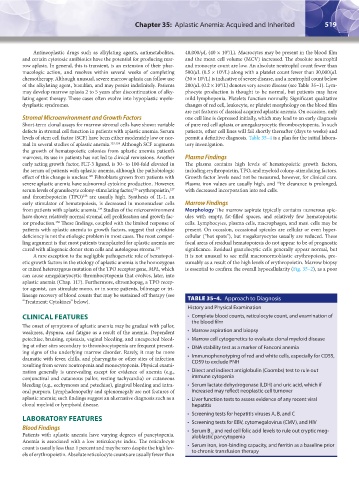
                  lineage recovery of blood counts that may be sustained off therapy (see   TABLE 35–4.  Approach to Diagnosis
                  “Treatment: Cytokines” below).
                                                                         History and Physical Examination
                  CLINICAL FEATURES                                      •   Complete blood counts, reticulocyte count, and examination of
                  The onset of symptoms of aplastic anemia may be gradual with pallor,   the blood film
                  weakness, dyspnea, and fatigue as a result of the anemia. Dependent   •  Marrow aspiration and biopsy
                  petechiae, bruising, epistaxis, vaginal bleeding, and unexpected bleed-  •  Marrow cell cytogenetics to evaluate clonal myeloid disease
                  ing at other sites secondary to thrombocytopenia are frequent present-  •  DNA stability test as a marker of Fanconi anemia
                  ing signs of the underlying marrow disorder. Rarely, it may be more
                  dramatic with fever, chills, and pharyngitis or other sites of infection   •   Immunophenotyping of red and white cells, especially for CD55,
                  resulting from severe neutropenia and monocytopenia. Physical exami-  CD59 to exclude PNH
                  nation generally is unrevealing except for evidence of anemia (e.g.,   •   Direct and indirect antiglobulin (Coombs) test to rule out
                  conjunctival and cutaneous pallor, resting tachycardia) or cutaneous   immune cytopenia
                  bleeding (e.g., ecchymoses and petechiae), gingival bleeding and intra-  •   Serum lactate dehydrogenase (LDH) and uric acid, which if
                  oral purpura. Lymphadenopathy and splenomegaly are not features of   increased may reflect neoplastic cell turnover
                  aplastic anemia; such findings suggest an alternative diagnosis such as a   •   Liver function tests to assess evidence of any recent viral
                  clonal myeloid or lymphoid disease.                      hepatitis
                                                                         •   Screening tests for hepatitis viruses A, B, and C
                  LABORATORY FEATURES                                    •   Screening tests for EBV, cytomegalovirus (CMV), and HIV
                  Blood Findings                                         •   Serum B  and red cell folic acid levels to rule out cryptic meg-
                                                                                 12
                  Patients with aplastic anemia have varying degrees of pancytopenia.   aloblastic pancytopenia
                  Anemia is associated with a low reticulocyte index. The reticulocyte

                  count is usually less than 1 percent and may be zero despite the high lev-  •   Serum iron, iron-binding capacity, and ferritin as a baseline prior
                                                                           to chronic transfusion therapy
                  els of erythropoietin. Absolute reticulocyte counts are usually fewer than


          Kaushansky_chapter 35_p0513-0538.indd   519                                                                   9/19/15   12:24 AM

