


Page 541 - Williams Hematology ( PDFDrive )
P. 541
516            Part VI:  The Erythrocyte                                                                                                                           Chapter 35:  Aplastic Anemia: Acquired and Inherited            517


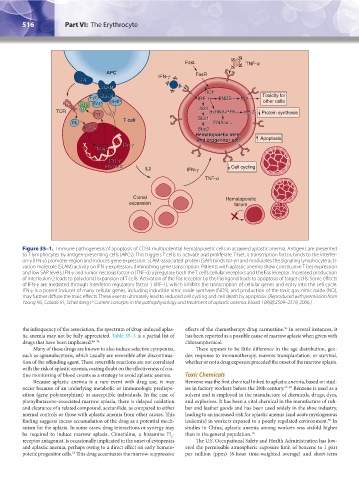
               Figure 35–1.  Immune pathogenesis of apoptosis of CD34 multipotential hematopoietic cells in acquired aplastic anemia. Antigens are presented
               to T lymphocytes by antigen-presenting cells (APCs). This triggers T cells to activate and proliferate. T-bet, a transcription factor, binds to the interfer-
               on-γ (IFN-γ) promoter region and induces gene expression. SLAM-associated protein (SAP) binds to Fyn and modulates the signaling lymphocyte acti-
               vation molecule (SLAM) activity on IFN-γ expression, diminishing gene transcription. Patients with aplastic anemia show constitutive T-bet expression
               and low SAP levels. IFN-γ and tumor necrosis factor-α (TNF-α) upregulate both the T cell’s cellular receptors and the Fas receptor. Increased production
               of interleukin-2 leads to polyclonal expansion of T cells. Activation of the Fas receptor by the Fas ligand leads to apoptosis of target cells. Some effects
               of IFN-γ are mediated through interferon regulatory factor 1 (IRF-1), which inhibits the transcription of cellular genes and entry into the cell cycle.
               IFN-γ is a potent inducer of many cellular genes, including inducible nitric oxide synthase (NOS), and production of the toxic gas, nitric oxide (NO),
               may further diffuse the toxic effects. These events ultimately lead to reduced cell cycling and cell death by apoptosis. (Reproduced with permission from
               Young NS, Calado RT, Scheinberg P: Current concepts in the pathophysiology and treatment of aplastic anemia. Blood 108(8):2509–2519, 2006.)


               the infrequency of the association, the spectrum of drug-induced aplas-  effects of the chemotherapy drug carmustine.  In several instances, it
                                                                                                       56
               tic anemia may not be fully appreciated. Table 35–3 is a partial list of   has been reported as a possible cause of marrow aplasia when given with
               drugs that have been implicated. 46–54                 chloramphenicol.
                   Many of these drugs are known to also induce selective cytopenias,   There appears to be little difference in the age distribution, gen-
               such as agranulocytosis, which usually are reversible after discontinua-  der, response to immunotherapy, marrow transplantation, or survival,
               tion of the offending agent. These reversible reactions are not correlated   whether or not a drug exposure preceded the onset of the marrow aplasia.
               with the risk of aplastic anemia, casting doubt on the effectiveness of rou-
               tine monitoring of blood counts as a strategy to avoid aplastic anemia.  Toxic Chemicals
                   Because aplastic anemia is a rare event with drug use, it may   Benzene was the first chemical linked to aplastic anemia, based on stud-
               occur because of an underlying metabolic or immunologic predispo-  ies in factory workers before the 20th century. 57–59  Benzene is used as a
               sition (gene polymorphism) in susceptible individuals. In the case of   solvent and is employed in the manufacture of chemicals, drugs, dyes,
               phenylbutazone-associated marrow aplasia, there is delayed oxidation   and explosives. It has been a vital chemical in the manufacture of rub-
               and clearance of a related compound, acetanilide, as compared to either   ber and leather goods and has been used widely in the shoe industry,
               normal controls or those with aplastic anemia from other causes. This   leading to an increased risk for aplastic anemia (and acute myelogenous
               finding suggests excess accumulation of the drug as a potential mech-  leukemia) in workers exposed to a poorly regulated environment.  In
                                                                                                                      59
               anism for the aplasia. In some cases, drug interactions or synergy may   studies in China, aplastic anemia among workers was sixfold higher
               be required to induce marrow aplasia. Cimetidine, a histamine H -   than in the general population. 18
                                                                 2
               receptor antagonist, is occasionally implicated in the onset of cytopenias   The U.S. Occupational Safety and Health Administration has low-
               and aplastic anemia, perhaps owing to a direct effect on early hemato-  ered the permissible atmospheric exposure limit of benzene to 1 part
               poietic progenitor cells.  This drug accentuates the marrow-suppressive   per million (ppm) (8-hour time-weighted average) and short-term
                                55


          Kaushansky_chapter 35_p0513-0538.indd   516                                                                   9/19/15   12:23 AM

