


Page 546 - Williams Hematology ( PDFDrive )
P. 546
520  Part VI:  The Erythrocyte                         Chapter 35:  Aplastic Anemia: Acquired and Inherited           521


                  or flow cytometry will uncover a population of leukemic lymphoblasts.   The relationship of PNH  to aplastic  anemia remains enigmatic.
                  In other cases, the acute leukemia may appear later. Hairy-cell leuke-  Because hematopoietic stem cells lacking the phosphatidylinositol-
                  mia, Hodgkin disease, or another lymphoma subtype, rarely, may be   anchored proteins are present in many or all normal persons in very
                  preceded by a period of marrow hypoplasia. Immunophenotyping   small numbers,  it is not surprising that more than 50 percent of
                                                                                    143
                  of marrow and blood cells by flow cytometry for CD25 may uncover   patients with aplastic anemia may have a PNH cell population as
                                                                                                 134
                  the presence of hairy cells. Other clinical features may be distinctive   detected  by  immunophenotyping.   The  probability  of  patients  with
                  (Chap.  93). Organomegaly such as lymphadenopathy, hepatomegaly,   aplastic anemia developing a clinical syndrome consistent with PNH is
                  or splenomegaly are inconsistent with the atrophic (hypoproliferative)   10 to 20 percent, and this is not a consequence of immunosuppressive
                                                                                137
                  features of aplastic anemia. Large granular lymphocytic leukemia has   treatment.  Patients also may present with the hemolytic anemia of
                  also been associated with aplastic anemia. Rare cases of typical acquired   PNH and later develop progressive marrow failure so that any pathoge-
                  aplastic anemia have been followed by t(9;22)-positive acute lympho-  netic explanation should consider both types of development of aplastic
                  cytic leukemia (ALL) or chronic myelogenous leukemia (CML). 136  marrows in PNH. The PIG-A mutation may confer either a prolifera-
                                                                        tive or survival advantage to PNH cells. 144,145  A survival advantage could
                  RELATIONSHIP AMONG APLASTIC                           result if the anchor protein or one of its ligands served as an epitope
                  ANEMIA, PAROXYSMAL NOCTURNAL                          for the T-lymphocyte cytotoxicity, which induces the marrow aplasia.
                                                                        In this case, the presenting event could either reflect cytopenias or the
                  HEMOGLOBINURIA, AND CLONAL MYELOID                    sensitivity of red cells to complement lysis and hemolysis, depending on
                  DISEASES                                              the intrinsic proliferative potential of the PNH clone.
                  In addition to the diagnostic difficulties occasionally presented by   Within our current state of knowledge, aplastic anemia is an
                  patients with hypoplastic myelodysplastic syndromes, hypoplastic   autoimmune process, and any residual hematopoiesis is presumably
                  acute myelogenous leukemia (AML), or PNH with hypocellular mar-  polyclonal. This is a critical distinction from hypoplastic leukemia and
                  rows, there may be a more fundamental relationship among these   PNH, which are clonal (neoplastic) diseases. The environment of the
                  three diseases and aplastic anemia. The development of clonal cytoge-  aplastic marrow, however, may favor the eventual evolution of a mutant
                  netic abnormalities such as monosomy 7 or trisomy 8 in a patient with   (malignant) clone, especially if immunotherapy is used, whereas
                  aplastic anemia portends the evolution of a myelodysplastic syndrome   hematopoietic stem cell transplantation may either ablate threatening
                  or acute leukemia. Occasionally, these cytogenetic markers have been   minor clones or establish more robust hematopoiesis, an environment
                  transient, and in cases with disappearance of monosomy 7, hematologic   less conducive to clonal evolution.
                                           137
                  improvement has occurred as well.  Persistent monosomy 7 carries a
                  poor prognosis as compared to trisomy 8. 138,139      TREATMENT
                     As many as 20 percent of patients with aplastic anemia have a
                  5-year probability of developing myelodysplasia.  If one excludes   Approach to Therapy
                                                       137
                  any transformation to a clonal myeloid disorder that occurs up to     Severe anemia, bleeding from thrombocytopenia, and, uncommonly
                  6 months after treatment to avoid misdiagnosis among the hypoplastic   at the time of diagnosis, infection secondary to granulocytopenia
                  clonal myeloid diseases, the frequency of a clonal disorder was nearly   and monocytopenia require prompt attention to remove potential
                  15 times greater in patients treated with immunosuppression as com-  life-threatening conditions and improve patient comfort (Table 35–5).
                  pared to those treated with marrow transplantation after 39 months of   More specific treatment of the marrow aplasia involves two principal
                           140
                  observation.  This finding suggests either that immune suppression by   options: (1) syngeneic or allogeneic hematopoietic stem cell transplan-
                  anti–T-cell therapy enhances the evolution of a neoplastic clone or that   tation or (2) combination immunosuppressive therapy with ATG and
                  it does not suppress the intrinsic tendency of aplastic anemia to evolve   cyclosporine. The selection of the specific mode of treatment depends
                  to a clonal disease, but provides the increased longevity of the patient
                  required to express that potential. The latter interpretation is more likely
                  as patients successfully treated solely with androgens develop clonal dis-
                  ease as frequently as those treated with immunosuppression.  Trans-
                                                              141
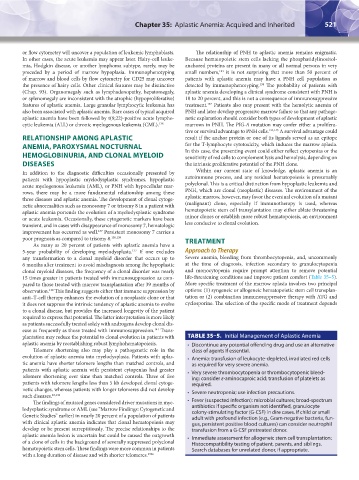
                  plantation may reduce the potential to clonal evolution in patients with   TABLE 35–5.  Initial Management of Aplastic Anemia
                  aplastic anemia by reestablishing robust lymphohematopoiesis.  •   Discontinue any potential offending drug and use an alternative
                     Telomere shortening also may play a pathogenetic role in the   class of agents if essential.
                  evolution of aplastic anemia into myelodysplasia. Patients with aplas-  •   Anemia: transfusion of leukocyte-depleted, irradiated red cells
                  tic anemia have shorter telomere lengths than matched controls, and   as required for very severe anemia.
                  patients with aplastic  anemia with persistent cytopenias had greater   •   Very severe thrombocytopenia or thrombocytopenic bleed-
                  telomere  shortening  over  time  than  matched controls.  Three  of  five   ing: consider ε-aminocaproic acid; transfusion of platelets as
                  patients with telomere lengths less than 5 kb developed clonal cytoge-  required.
                  netic changes, whereas patients with longer telomeres did not develop   •   Severe neutropenia; use infection precautions.
                  such diseases. 23,142
                     The findings of mutated genes considered driver mutations in mye-  •   Fever (suspected infection): microbial cultures; broad-spectrum
                  lodysplastic syndrome or AML (see “Marrow Findings: Cytogenetic and   antibiotics if specific organism not identified, granulocyte
                                                                           colony-stimulating factor (G-CSF) in dire cases. If child or small
                  Genetic Studies” earlier) in nearly 20 percent of a population of patients   adult with profound infection (e.g., Gram-negative bacteria, fun-
                  with clinical aplastic anemia indicates that clonal hematopoiesis may   gus, persistent positive blood cultures) can consider neutrophil
                  develop or be present surreptitiously. The precise relationships to the   transfusion from a G-CSF pretreated donor.
                  aplastic anemia lesion is uncertain but could be caused the outgrowth   •   Immediate assessment for allogeneic stem cell transplantation:
                  of a clone of cells in the background of severally suppressed polyclonal   Histocompatibility testing of patient, parents, and siblings.
                  hematopoietic stem cells. These findings were more common in patients   Search databases for unrelated donor, if appropriate.
                  with a long duration of disease and with shorter telomeres. 132a


          Kaushansky_chapter 35_p0513-0538.indd   521                                                                   9/19/15   12:24 AM

