


Page 545 - Williams Hematology ( PDFDrive )
P. 545
520            Part VI:  The Erythrocyte                                                                                                                           Chapter 35:  Aplastic Anemia: Acquired and Inherited            521


                    A                                                B

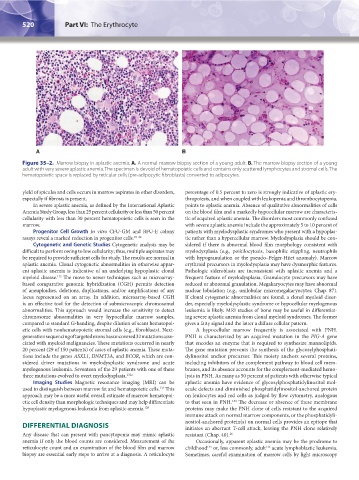
               Figure 35–2.  Marrow biopsy in aplastic anemia. A. A normal marrow biopsy section of a young adult. B. The marrow biopsy section of a young
               adult with very severe aplastic anemia. The specimen is devoid of hematopoietic cells and contains only scattered lymphocytes and stromal cells. The
               hematopoietic space is replaced by reticular cells (pre-adipocytic fibroblasts) converted to adipocytes.


               yield of spicules and cells occurs in marrow aspirates in other disorders,   percentage of 0.5 percent to zero is strongly indicative of aplastic ery-
               especially if fibrosis is present.                     thropoiesis, and when coupled with leukopenia and thrombocytopenia,
                   In severe aplastic anemia, as defined by the International Aplastic   points to aplastic anemia. Absence of qualitative abnormalities of cells
               Anemia Study Group, less than 25 percent cellularity or less than 50 percent   on the blood film and a markedly hypocellular marrow are characteris-
               cellularity with less than 30 percent hematopoietic cells is seen in the   tic of acquired aplastic anemia. The disorders most commonly confused
               marrow.                                                with severe aplastic anemia include the approximately 5 to 10 percent of
                   Progenitor  Cell Growth  In vitro CFU-GM and BFU-E colony   patients with myelodysplastic syndromes who present with a hypoplas-
               assays reveal a marked reduction in progenitor cells. 19–22  tic rather than a hypercellular marrow. Myelodysplasia should be con-
                   Cytogenetic and Genetic Studies Cytogenetic analysis may be   sidered if there is abnormal blood film morphology consistent with
               difficult to perform owing to low cellularity; thus, multiple aspirates may   myelodysplasia (e.g., poikilocytosis, basophilic stippling, neutrophils
               be required to provide sufficient cells for study. The results are normal in   with hypogranulation or the pseudo–Pelger-Hüet anomaly). Marrow
               aplastic anemia. Clonal cytogenetic abnormalities in otherwise appar-  erythroid precursors in myelodysplasia may have dysmorphic features.
               ent aplastic anemia is indicative of an underlying hypoplastic clonal   Pathologic  sideroblasts  are  inconsistent  with aplastic  anemia and a
               myeloid disease.  The move to newer techniques such as microarray-   frequent feature of myelodysplasia. Granulocyte precursors may have
                           132
               based comparative genomic hybridization (CGH) permits detection   reduced or abnormal granulation. Megakaryocytes may have abnormal
               of aneuploidies, deletions, duplications, and/or amplifications of any   nuclear lobulation (e.g., unilobular micromegakaryocytes; Chap. 87).
               locus represented on an array. In addition, microarray-based CGH   If clonal cytogenetic abnormalities are found, a clonal myeloid disor-
               is an effective tool for the detection of submicroscopic chromosomal   der, especially myelodysplastic syndrome or hypocellular myelogenous
               abnormalities. This approach would increase the sensitivity to detect   leukemia is likely. MRI studies of bone may be useful in differentiat-
               chromosome abnormalities in very hypocellular marrow samples,   ing severe aplastic anemia from clonal myeloid syndromes. The former
               compared to standard G-banding, despite dilution of scant hematopoi-  gives a fatty signal and the latter a diffuse cellular pattern.
               etic cells with nonhematopoietic stromal cells (e.g., fibroblasts). Next-   A hypocellular marrow frequently is associated with PNH.
               generation sequencing of targeted exons has uncovered 32 mutations asso-  PNH  is  characterized  by  an  acquired  mutation  in  the  PIG-A  gene
               ciated with myeloid malignancies. These mutations occurred in nearly     that encodes an enzyme that is required to synthesize mannolipids.
               20 percent (29 of 150 patients) of cases of aplastic anemia. These muta-  The gene mutation prevents the synthesis of the glycosylphosphati-
               tions include the genes ASXL1, DNMT3A, and BCOR, which are con-  dylinositol anchor precursor. This moiety anchors several proteins,
               sidered driver mutations in myelodysplastic syndrome and acute   including inhibitors of the complement pathway to blood cell mem-
               myelogenous leukemia. Seventeen of the 29 patients with one of these   branes, and its absence accounts for the complement-mediated hemo-
               three mutations evolved to overt myelodysplasia. 132a  lysis in PNH. As many as 50 percent of patients with otherwise typical
                   Imaging Studies  Magnetic resonance imaging (MRI) can be   aplastic anemia have evidence of glycosylphosphatidylinositol mol-
                                                             133
               used to distinguish between marrow fat and hematopoietic cells.  This   ecule defects and diminished phosphatidylinositol-anchored protein
               approach may be a more useful overall estimate of marrow hematopoi-  on leukocytes and red cells as judged by flow cytometry, analogous
               etic cell density than morphologic techniques and may help differentiate   to that seen in PNH.  The decrease or absence of these membrane
                                                                                      134
               hypoplastic myelogenous leukemia from aplastic anemia. 128  proteins may make the PNH clone of cells resistant to the acquired
                                                                      immune attack on normal marrow components, or the phosphatidyli-
               DIFFERENTIAL DIAGNOSIS                                 nositol-anchored protein(s) on normal cells provides an epitope that
                                                                      initiates an aberrant T-cell attack, leaving the PNH clone relatively
               Any  disease  that  can  present with  pancytopenia  may  mimic  aplastic   resistant (Chap. 40). 26
               anemia if only the blood counts are considered. Measurement of the   Occasionally, apparent aplastic anemia may be the prodrome to
               reticulocyte count and an examination of the blood film and marrow   childhood  or, less commonly, adult  acute lymphoblastic leukemia.
                                                                                                 136
                                                                             135
               biopsy are essential early steps to arrive at a diagnosis. A reticulocyte   Sometimes, careful examination of marrow cells by light microscopy


          Kaushansky_chapter 35_p0513-0538.indd   520                                                                   9/19/15   12:24 AM

