


Page 598 - Williams Hematology ( PDFDrive )
P. 598
572  Part VI:  The Erythrocyte                          Chapter 40:  Paroxysmal Nocturnal Hemoglobinuria              573


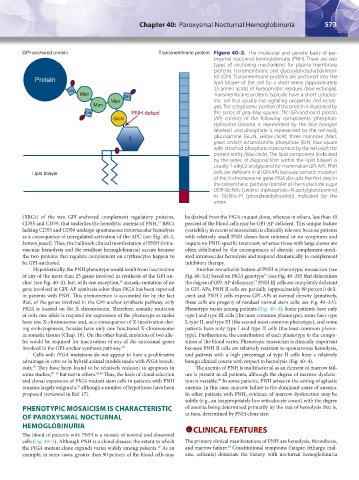
                  GPI-anchored protein                          Transmembrane protein Figure 40–2.  The molecular and genetic basis of par-
                                                                                  oxysmal nocturnal hemoglobinuria (PNH). There are two
                                                                                  types of anchoring mechanisms for plasma membrane
                                                                                  proteins: transmembrane and glycosylphosphatidylinosi-
                      Protein                                                     tol (GPI). Transmembrane proteins are anchored into the
                                                                                  lipid bilayer of the cell by a short series (approximately
                                                                                  25 amino acids) of hydrophobic residues (blue rectangle).
                                 EtN
                                     Man            EtN                           Transmembrane proteins typically have a short cytoplas-
                                               Man                                mic tail that usually has signaling properties (red rectan-
                                          Man                                     gle). The ectoplasmic portion of the protein is illustrated by
                                       EtN            PNH defect                  the series of gray-blue squares. The GPI-anchored protein
                                                GlcN                              (AP) consists of the following components: phosphati-
                                                                                  dylinositol (inositol is represented by the  blue hexagon
                                                                                  labeled I and phosphate is represented by the red oval);
                                                      I                           glucosamine (GLcN,  yellow  circle); three mannose (Man,
                                                                                  green circles); ethanolamine phosphate (EtN,  blue square
                                                                                  with attached phosphate represented by the red oval); the
                                                                                  protein entity (blue circle). The lipid component (indicated
                                                                                  by the series of diagonal lines within the lipid bilayer) is
                                                                                  usually 1-alkyl,2-acylglycerol for mammalian GPI-APs. PNH
                     Lipid bilayer                                                cells are deficient in all GPI-APs because somatic mutation
                                                                                  of the X-chromosome gene PIGA disrupts the first step in
                                                                                  the biosynthetic pathway (transfer of the nucleotide sugar
                                                                                  UDP-GlcNAc [uridine diphosphate–N-acetylglucosamine]
                                                                                  to GlcNAc-PI [phosphatidylinositol]) indicated by the
                                                                                  arrow.

                  (RBCs) of the two GPI-anchored complement regulatory proteins,   be derived from the PIGA-mutant clone, whereas in others, less than 10
                  CD55 and CD59, that underlies the hemolytic anemia of PNH.  RBCs   percent of the blood cells may be GPI-AP deficient. This unique feature
                                                               17
                  lacking CD55 and CD59 undergo spontaneous intravascular hemolysis   (variability in extent of mosaicism) is clinically relevant because patients
                  as a consequence of unregulated activation of the APC (see Fig. 40–1,   with relatively small PNH clones have minimal or no symptoms and
                  bottom panel). Thus, the hallmark clinical manifestation of PNH (intra-  require no PNH-specific treatment, whereas those with large clones are
                  vascular hemolysis and the resultant hemoglobinuria) occurs because   often debilitated by the consequences of chronic complement-medi-
                  the two proteins that regulate complement on erythrocytes happen to   ated intravascular hemolysis and respond dramatically to complement
                  be GPI-anchored.                                      inhibitory therapy.
                     Hypothetically, the PNH phenotype would result from inactivation   Another remarkable feature of PNH is phenotypic mosaicism (see
                  of any of the more than 25 genes involved in synthesis of the GPI-an-  Fig. 40–3A) based on PIGA genotype  (see Fig. 40–3B) that determines
                                                                                                   27
                  chor (see Fig. 40–2), but, with one exception,  somatic mutation of no   the degree of GPI-AP deficiency.  PNH III cells are completely deficient
                                                  18
                                                                                                17
                  gene involved in GPI-AP synthesis other than PIGA has been reported   in GPI-APs, PNH II cells are partially (approximately 90 percent) defi-
                  in patients with PNH. This phenomenon is accounted for by the fact   cient and PNH I cells express GPI-APs at normal density (putatively,
                  that, of the genes involved in the GPI-anchor synthesis pathway, only   these cells are progeny of residual normal stem cells; see Fig. 40–3A).
                  PIGA is located on the X-chromosome. Therefore, somatic mutation   Phenotype varies among patients (Fig. 40–4). Some patients have only
                  of only one allele is required for expression of the phenotype as males   type I and type III cells (the most common phenotype), some have type
                  have one X-chromosome and, as a consequence of X-inactivation dur-  I, type II, and type III (the second most common phenotype), and some
                  ing embryogenesis, females have only one functional X-chromosome   patients have only type I and type II cells (the least-common pheno-
                  in somatic tissues (Chap. 10). On the other hand, mutation of two alle-  type). Furthermore, the contribution of each phenotype to the compo-
                  les would be required for inactivation of any of the autosomal genes   sition of the blood varies. Phenotypic mosaicism is clinically important
                  involved in the GPI-anchor synthesis pathway. 18      because PNH II cells are relatively resistant to spontaneous hemolysis,
                     Cells with PIGA mutations do not appear to have a proliferative   and patients with a high percentage of type II cells have a relatively
                  advantage in vitro or in hybrid animal models made with PIGA knock-  benign clinical course with respect to hemolysis (Fig. 40–4).
                  outs.  They have been found to be relatively resistant to apoptosis in   The anemia of PNH is multifactorial as an element of marrow fail-
                     19
                  some studies, 20–23  but not in others. 24,25  Thus, the basis of clonal selection   ure is present in all patients, although the degree of marrow dysfunc-
                  and clonal expansion of PIGA mutant stem cells in patients with PNH   tion is variable.  In some patients, PNH arises in the setting of aplastic
                                                                                   28
                  remains largely enigmatic  although a number of hypotheses have been   anemia. In this case, marrow failure is the dominant cause of anemia.
                                    26
                  proposed (reviewed in Ref. 17).                       In other patients with PNH, evidence of marrow dysfunction may be
                                                                        subtle (e.g., an inappropriately low reticulocyte count) with the degree
                  PHENOTYPIC MOSAICISM IS CHARACTERISTIC                of anemia being determined primarily by the rate of hemolysis that is,
                  OF PAROXYSMAL NOCTURNAL                               in turn, determined by PNH clone size.
                  HEMOGLOBINURIA                                           CLINICAL FEATURES

                  The blood of patients with PNH is a mosaic of normal and abnormal
                  cells (Fig. 40–3). Although PNH is a clonal disease, the extent to which   The primary clinical manifestations of PNH are hemolysis, thrombosis,
                                                                                       28
                  the PIGA-mutant clone expands varies widely among patients.  As an   and marrow failure.  Constitutional symptoms (fatigue, lethargy, mal-
                                                               17
                  example, in some cases, greater than 90 percent of the blood cells may   aise, asthenia) dominate the history, with nocturnal hemoglobinuria


          Kaushansky_chapter 40_p0571-0582.indd   573                                                                   9/17/15   6:22 PM

