


Page 597 - Williams Hematology ( PDFDrive )
P. 597
572            Part VI:  The Erythrocyte                                                                                                                            Chapter 40:  Paroxysmal Nocturnal Hemoglobinuria               573


               cells, and the extent of the mosaicism varies widely among patients   Alternative Pathway of Complement
               (see “Phenotypic Mosaicism is Characteristic of Paroxysmal Nocturnal             Eculizumab
               Hemoglobinuria” below). Patients with small PNH clones have few or                        Membrane Attack Complex
               no symptoms related to hemolysis. Thus an argument can be made that   C3 convertase  C3a  C5 convertase  C5  C5a
               asymptomatic patients with small clones do not have clinically signifi-  C3bBbP  C3bBbC3bP  C5b-9 n
               cant PNH and should be excluded from prevalence estimates. Others,
               however, may argue that any patient with flow cytometric evidence of   CD55  CD55          CD59
               a  population  of  GPI-AP–deficient  cells,  regardless of  clone  size,  has
               PNH and should be included in prevalence estimates. Well-designed,   Complement Activation
               rigorous studies of prevalence that address the issue of disease het-                 LDH
               erogeneity are needed, but, by any definition, PNH is a rare disease.          LDH      LDH
                                                                                             LDH
               The prevalence of clinically significant PNH (i.e., classic PNH) plus         LDH
               patients with relatively large clones that arise in the setting of another             LDH
               marrow failure syndrome, (see  “Clinical Features” and Table   40–2   Normal RBC  PNH RBC
               below) is likely in the order of less than 1 case per 200,000 population,
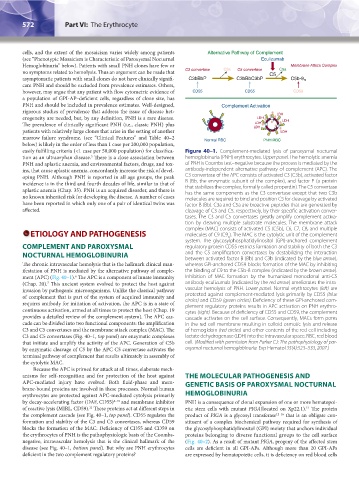
               easily fulfilling criteria (<1 case per 50,000 population) for classifica-  Figure 40–1.  Complement-mediated lysis of paroxysmal nocturnal
                                      5
               tion as an ultraorphan disease.  There is a close association between   hemoglobinuria (PNH) erythrocytes. Upper panel. The hemolytic anemia
               PNH and aplastic anemia, and environmental factors, drugs, and tox-  of PNH is Coombs test–negative because the process is mediated by the
               ins, that cause aplastic anemia, concordantly increase the risk of devel-  antibody-independent alternative pathway of complement (APC). The
               oping PNH. Although PNH is reported in all age groups, the peak   C3 convertase of the APC consists of activated C3 (C3b), activated factor
               incidence is in the third and fourth decades of life, similar to that of   B (Bb, the enzymatic subunit of the complex), and factor P (a protein
                                                                      that stabilizes the complex, formally called properdin). The C5 convertase
               aplastic anemia (Chap. 35). PNH is an acquired disorder, and there is   has the same components as the C3 convertase except that two C3b
               no known inherited risk for developing the disease. A number of cases   molecules are required to bind and position C5 for cleavage by activated
               have been reported in which only one of a pair of identical twins was   factor B (Bb). C3a and C5a are bioactive peptides that are generated by
               affected.                                              cleavage of C3 and C5, respectively, by their specific activation conver-
                                                                      tases. The C3 and C5 convertases greatly amplify complement activa-
                                                                      tion by cleaving multiple substrate molecules. The membrane attack
                                                                      complex (MAC) consists of activated C5 (C5b), C6, C7, C8, and multiple
                  ETIOLOGY AND PATHOGENESIS                           molecules of C9 (C9 ). The MAC is the cytolytic unit of the complement
                                                                                    n
                                                                      system.  The glycosylphosphatidylinositol (GPI)-anchored complement
               COMPLEMENT AND PAROXYSMAL                              regulatory protein CD55 restricts formation and stability of both the C3
               NOCTURNAL HEMOGLOBINURIA                               and the C5 amplification convertases by destabilizing the interaction
                                                                      between activated factor B (Bb) and C3b (indicated by the blue arrow),
               The chronic intravascular hemolysis that is the hallmark clinical man-  whereas GPI-anchored CD59 blocks formation of the MAC by inhibiting
               ifestation of PNH is mediated by the alternative pathway of comple-  the binding of C9 to the C5b-8 complex (indicated by the brown arrow).
               ment (APC) (Fig. 40–1).  The APC is a component of innate immunity   Inhibition of MAC formation by the humanized monoclonal anti-C5
                                 6
                        7
               (Chap. 20).  This ancient system evolved to protect the host against   antibody eculizumab (indicated by the red arrow) ameliorates the intra-
               invasion by pathogenic microorganisms. Unlike the classical pathway   vascular hemolysis of PNH. Lower panel. Normal erythrocytes (left) are
               of complement that is part of the system of acquired immunity and   protected against complement-mediated lysis primarily by CD55 (blue
                                                                      circles) and CD59 (green circles). Deficiency of these GPI-anchored com-
               requires antibody for initiation of activation, the APC is in a state of   plement regulatory proteins results in APC activation on PNH erythro-
               continuous activation, armed at all times to protect the host (Chap. 19   cytes (right). Because of deficiency of CD55 and CD59, the complement
               provides a detailed review of the complement system). The APC cas-  cascade activates on the cell surface. Consequently, MACs form pores
               cade can be divided into two functional components: the amplification   in the red cell membrane resulting in colloid osmotic lysis and release
               C3 and C5 convertases and the membrane attack complex (MAC). The   of hemoglobin (red circles) and other contents of the red cell including
               C3 and C5 convertases (Fig. 40–1, top panel) are enzymatic complexes   lactate dehydrogenase (LDH) into the intravascular space. RBC, red blood
               that initiate and amplify the activity of the APC. Generation of C5b   cell. (Modified with permission from Parker CJ: The pathophysiology of par-
               by enzymatic cleavage of C5 by the APC C5 convertase activates the   oxysmal nocturnal hemoglobinuria. Exp Hematol 35(4):523–533, 2007.)
               terminal pathway of complement that results ultimately in assembly of
               the cytolytic MAC.
                   Because the APC is primed for attack at all times, elaborate mech-
               anisms for self-recognition  and  for  protection  of  the host  against   THE MOLECULAR PATHOGENESIS AND
               APC-mediated injury have evolved. Both fluid-phase and mem-  GENETIC BASIS OF PAROXYSMAL NOCTURNAL
               brane-bound proteins are involved in these processes. Normal human
               erythrocytes are protected against APC-mediated cytolysis primarily   HEMOGLOBINURIA
               by decay-accelerating factor (DAF, CD55) 8–10  and membrane inhibitor   PNH is a consequence of clonal expansion of one or more hematopoi-
               of reactive lysis (MIRL, CD59).  These proteins act at different steps in   etic  stem  cells with mutant  PIGA(located on  Xp22.1).  The  protein
                                      11
                                                                                                               12
               the complement cascade (see Fig. 40–1, top panel). CD55 regulates the   product of PIGA is a glycosyl transferase 12–16  that is an obligate con-
               formation and stability of the C3 and C5 convertases, whereas CD59   stituent  of  a  complex  biochemical  pathway  required  for  synthesis  of
               blocks the formation of the MAC. Deficiency of CD55 and CD59 on   the glycosylphosphatidylinositol (GPI) moiety that anchors individual
               the erythrocytes of PNH is the pathophysiologic basis of the Coombs-   proteins belonging to diverse functional groups to the cell surface
               negative, intravascular hemolysis that is the clinical hallmark of the   (Fig. 40–2). As a result of mutant PIGA, progeny of the affected stem
               disease (see Fig. 40–1, bottom panel). But why are PNH erythrocytes   cells are deficient in all GPI-APs. Although more than 20 GPI-APs
               deficient in the two complement regulatory proteins?   are expressed by hematopoietic cells, it is deficiency on red blood cells


          Kaushansky_chapter 40_p0571-0582.indd   572                                                                   9/17/15   6:22 PM

