


Page 610 - Williams Hematology ( PDFDrive )
P. 610
584  Part VI:  The Erythrocyte                  Chapter 41:  Folate, Cobalamin, and Megaloblastic Anemias             585


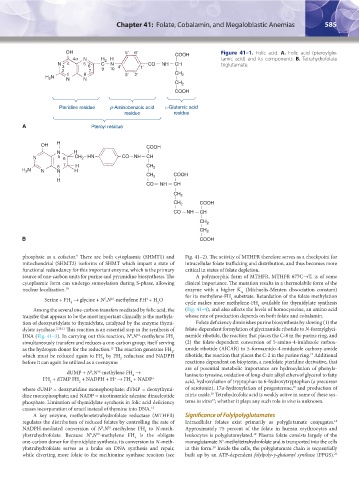
                                                                                    Figure 41–1.  Folic acid.  A. Folic acid (pteroylglu-
                                                                                    tamic acid) and its components.  B. Tetrahydrofolate
                                                                                    triglutamate.


                  phosphate as a cofactor.  There are both cytoplasmic (SHMT1) and   Fig. 41–2). The activity of MTHFR therefore serves as a checkpoint for
                                    9
                  mitochondrial (SHMT2) isoforms of SHMT which impart a state of   intracellular folate trafficking and distribution, and thus becomes more
                  functional redundancy for this important enzyme, which is the primary   critical in states of folate depletion.
                  source of one-carbon units for purine and pyrimidine biosynthesis. The   A polymorphic form of MTHFR, MTHFR 677C→T, is of some
                  cytoplasmic form can undergo sumoylation during S-phase, allowing   clinical importance. The mutation results in a thermolabile form of the
                  nuclear localization. 10                              enzyme with a higher K  (Michaelis-Menten dissociation constant)
                                                                                           m
                                                                        for its methylene-FH  substrate. Retardation of the folate methylation
                         Serine + FH  → glycine + N ,N -methylene FH  + H O             4
                                               10
                                             5
                                                           4
                                  4                            2        cycle makes more methylene-FH  available for thymidylate synthesis
                                                                                                 4
                     Among the several one-carbon transfers mediated by folic acid, the   (Fig. 41–4), and also affects the levels of homocysteine, an amino acid
                  transfer that appears to be the most important clinically is the methyla-  whose rate of production depends on both folate and cobalamin.
                  tion of deoxyuridylate to thymidylate, catalyzed by the enzyme thymi-  Folate deficiency diminishes purine biosynthesis by slowing (1) the
                  dylate synthase. 2,10,11  This reaction is an essential step in the synthesis of   folate-dependent formylation of glycinamide ribotide to N-formylglyci-
                  DNA (Fig. 41–3). In carrying out this reaction, N ,N -methylene FH    namide ribotide, the reaction that places the C-8 in the purine ring, and
                                                      5
                                                        10
                                                                    4
                  simultaneously transfers and reduces a one-carbon group, itself serving   (2)  the  folate-dependent  conversion  of  5-amino-4-imidazole  carbox-
                  as the hydrogen donor for the reduction.  The reaction generates FH ,   amide ribotide (AICAR) to 5-formamido-4-imidazole carboxy-amide
                                               12
                                                                    2
                                                                                                                  14
                  which must be reduced again to FH  by FH  reductase and NADPH   ribotide, the reaction that places the C-2 in the purine ring.  Additional
                                                   2
                                             4
                  before it can again be utilized as a coenzyme:        reactions dependent on biopterin, a nonfolate pteridine derivative, that
                                                                        are of potential metabolic importance are hydroxylation of phenyla-
                                 dUMP + N ,N -methylene FH  →           lanine to tyrosine, oxidation of long-chain alkyl ethers of glycerol to fatty
                                         5
                                           10
                                                       4
                         FH  + dTMP FH  + NADPH + H  → FH  + NADP +
                                                 +
                           2         2                4                 acid, hydroxylation of tryptophan to 6-hydroxytryptophan (a precursor
                                                                                                            15
                  where dUMP = deoxyuridine monophosphate; dTMP = deoxythymi-  of serotonin), 17α-hydroxylation of progesterone,  and production of
                                                                                 16
                  dine monophosphate; and NADP = nicotinamide adenine dinucleotide   nitric oxide.  Tetrahydrofolic acid is weakly active in some of these sys-
                                                                                 17
                  phosphate. Limitation of thymidylate synthesis in folic acid deficiency   tems in vitro ; whether it plays any such role in vivo is unknown.
                  causes incorporation of uracil instead of thymine into DNA. 13
                     A key enzyme, methylenetetrahydrofolate reductase (MTHFR)   Significance of Folylpolyglutamates
                  regulates the distribution of reduced folates by controlling the rate of   Intracellular folates exist primarily as polyglutamate conjugates.
                                                                                                                          18
                  NADPH-mediated conversion of  N ,N -methylene FH  to  N-meth-  Approximately 75 percent of the folate in human erythrocytes and
                                            5
                                               10
                                                           4
                  yltetrahydrofolate. Because  N ,N -methylene FH  is the obligate   leukocytes is polyglutamylated.  Plasma folate consists largely of the
                                                                                               19
                                           10
                                         5
                                                       4
                  one-carbon donor for thymidylate synthesis, its conversion to N-meth-  monoglutamate N -methyltetrahydrofolate and is transported into the cells
                                                                                     5
                  yltetrahydrofolate serves as a brake on DNA synthesis and repair,   in this form.  Inside the cells, the polyglutamate chain is sequentially
                                                                                  20
                  while diverting more folate to the methionine synthase reaction (see   built up by an ATP-dependent folylpoly-γ-glutamyl synthase (FPGS).
                                                                                                                          21
          Kaushansky_chapter 41_p0583-0616.indd   585                                                                   9/17/15   6:23 PM

