Page 614 - Williams Hematology ( PDFDrive )
P. 614
588  Part VI:  The Erythrocyte                  Chapter 41:  Folate, Cobalamin, and Megaloblastic Anemias             589


                                     4            8                     NUTRITION
                                           6
                                        5      7                        Sources
                               3    A            B      9               Cobalamin is synthesized only by certain microorganisms; animals ulti-
                                 2     N      N      10                 mately depend on microbial synthesis for their cobalamin supply. Foods
                                        20   21                         that contain cobalamin are of animal origin: meat, liver, seafood, and
                                                      11                dairy products. Cobalamin has not been found in plants.
                                        23   22
                                 1    NH      N      12
                              19    D            C     13               Daily Requirements
                                                                        The average daily diet in Western countries contains 5 to 30 mcg of
                                       17     15                        cobalamin, of which 1 to 5 mcg is absorbed.  Less than 250 ng appears
                                                                                                        67
                                           16
                                    18           14                     in the urine; the unabsorbed remainder appears in the feces. Total body
                                                                        content is 2 to 5 mg in an adult,  with approximately 1 mg in the liver.
                                                                                               68
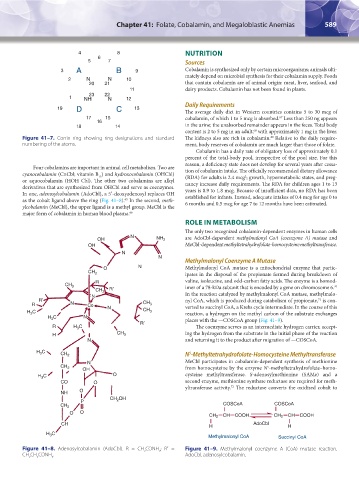
                  Figure 41–7.  Corrin  ring  showing  ring  designations  and  standard   The kidneys also are rich in cobalamin.  Relative to the daily require-
                                                                                                     69
                  numbering of the atoms.                               ment, body reserves of cobalamin are much larger than those of folate.
                                                                            Cobalamin has a daily rate of obligatory loss of approximately 0.1
                                                                        percent of the total-body pool, irrespective of the pool size. For this
                                                                        reason, a deficiency state does not develop for several years after cessa-
                     Four cobalamins are important in animal cell metabolism. Two are   tion of cobalamin intake. The officially recommended dietary allowance
                  cyanocobalamin (CnCbl; vitamin B ) and hydroxocobalamin (OHCbl)   (RDA) for adults is 2.4 mcg ; growth, hypermetabolic states, and preg-
                                                                                            2
                                           12
                  or aquocobalamin (HOH Cbl). The other two cobalamins are alkyl   nancy increase daily requirements. The RDA for children ages 1 to 13
                  derivatives that are synthesized from OHCbl and serve as coenzymes.   years is 0.9 to 1.8 mcg. Because of insufficient data, no RDA has been
                  In one, adenosylcobalamin (AdoCbl), a 5′-deoxyadenosyl replaces OH   established for infants. Instead, adequate intakes of 0.4 mcg for age 0 to
                                                    65
                  as the cobalt ligand above the ring (Fig. 41–8).  In the second, meth-  6 months and 0.5 mcg for age 7 to 12 months have been estimated.
                  ylcobalamin (MeCbl), the upper ligand is a methyl group. MeCbl is the
                  major form of cobalamin in human blood plasma. 66
                                                                        ROLE IN METABOLISM
                                                                        The only two recognized cobalamin-dependent enzymes in human cells
                                                      N                 are AdoCbl-dependent  methylmalonyl CoA (coenzyme A) mutase and
                                           OH                  NH 2
                                        OH                              MeCbl-dependent methyltetrahydrofolate-homocysteine methyltransferase.
                                                   N
                                                               N
                                                                        Methylmalonyl Coenzyme A Mutase
                                             O           N              Methylmalonyl CoA mutase is a mitochondrial enzyme that partic-
                                        CH 2                            ipates in the disposal of the propionate formed during breakdown of
                                          R                             valine, isoleucine, and odd-carbon fatty acids. The enzyme is a homod-
                                CH 3                                    imer of a 78-kDa subunit that is encoded by a gene on chromosome 6.
                                                                                                                          70
                                          CH 3  R′
                                         N                              In the reaction catalyzed by methylmalonyl CoA mutase, methylmalo-
                       R′                                               nyl CoA, which is produced during catabolism of propionate,  is con-
                                                                                                                     71
                     R            N     Co    N           CH 3          verted to succinyl CoA, a Krebs cycle intermediate. In the course of this
                   H C                                    CH 3          reaction, a hydrogen on the methyl carbon of the substrate exchanges
                    3
                          H 3 C       N                                 places with the —COSCoA group (Fig. 41–9).
                                                         R′
                            R      H C                                      The coenzyme serves as an intermediate hydrogen carrier, accept-
                                    3
                            H                     CH 3                  ing the hydrogen from the substrate in the initial phase of the reaction
                                        N                               and returning it to the product after migration of —COSCoA.
                        C
                                                                          5
                      H 3      CH 2                                     N -Methyltetrahydrofolate-Homocysteine Methyltransferase
                                        N                               MeCbl participates in cobalamin-dependent synthesis of methionine
                               CH 2   OH                                from homocysteine by the enzyme N -methyltetrahydrofolate–homo-
                                                                                                    5
                         C                      O                       cysteine methyltransferase.  S-adenosylmethionine (SAMe) and a
                       H 3
                               CO         O                             second enzyme, methionine synthase reductase are required for meth-
                                                                                        72
                                                                        yltransferase activity.  The reductase converts the oxidized cobalt to
                               NH    O
                                               CH OH
                                                 2
                                     P
                               CH 2                                                  COSCoA           COSCoA
                                  O  O
                                                                                CH 2  CH  COOH        CH 2  CH  COOH
                               CH                                                              AdoCbl
                                                                                H                          H
                            C
                          H 3
                                                                                Methylmalonyl CoA       Succinyl CoA
                  Figure 41–8.  Adenosylcobalamin (AdoCbl). R = CH CONH ; R′ =   Figure 41–9.  Methylmalonyl coenzyme A (CoA) mutase reaction.
                                                           2
                                                                2
                  CH CH CONH .                                          AdoCbl, adenosylcobalamin.
                    2  2    2
          Kaushansky_chapter 41_p0583-0616.indd   589                                                                   9/17/15   6:23 PM
   609   610   611   612   613   614   615   616   617   618   619