Page 612 - Williams Hematology ( PDFDrive )
P. 612
586  Part VI:  The Erythrocyte                  Chapter 41:  Folate, Cobalamin, and Megaloblastic Anemias             587


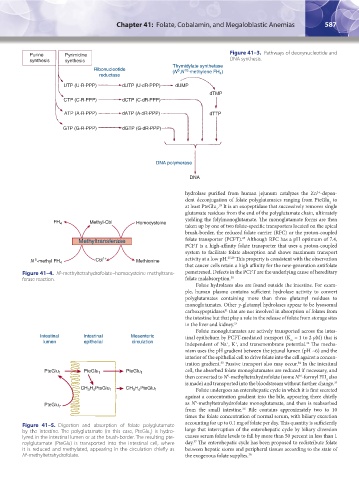
                    Purine      Pyrimidine                                             Figure 41–3.  Pathways of deoxynucleotide and
                    synthesis   synthesis                                              DNA synthesis.
                                                                    Thymidylate synthetase
                                          Ribonucleotide            (N ,N -methylene FH )
                                                                      5
                                                                        10
                                            reductase                               4
                                UTP (U·R·PPP)      dUTP (U·dR·PPP)   dUMP
                                                                                 dTMP
                                CTP (C·R·PPP)      dCTP (C·dR·PPP)

                                ATP (A·R·PPP)      dATP (A·dR·PPP)               dTTP

                               GTP (G·R·PPP)       dGTP (G·dR·PPP)


                                                               DNA polymerase

                                                                          DNA

                                                                                                                     2+
                                                                        hydrolase purified from human jejunum catalyzes the Zn -depen-
                                                                        dent deconjugation of folate polyglutamates ranging from PteGlu  to
                                                                                                                         2
                                                                                    28
                                                                        at least PteGlu .  It is an exopeptidase that successively removes single
                                                                                   7
                                                                        glutamate residues from the end of the polyglutamate chain, ultimately
                                                                        yielding the folylmonoglutamate. The monoglutamate forms are then
                            FH 4        Methyl-Cbl      Homocysteine
                                                                        taken up by one of two folate-specific transporters located on the apical
                                                                        brush-border, the reduced folate carrier (RFC) or the proton-coupled
                                                                                            25
                                     Methyltransferase                  folate transporter (PCFT).  Although RFC has a pH optimum of 7.4,
                                                                        PCFT is a high-affinity folate transporter that uses a proton-coupled
                                                                        system to facilitate folate absorption and shows maximum transport
                      5
                     N -methyl FH 4       Cbl 1+        Methionine      activity at a low pH. 25,29  This property is consistent with the observation
                                                                        that cancer cells retain a high affinity for the new-generation antifolate
                  Figure 41–4.  N -methyltetrahydrofolate–homocysteine methyltrans-  pemetrexed. Defects in the PCFT are the underlying cause of hereditary
                              5
                  ferase reaction.                                      folate malabsorption. 30
                                                                            Folate hydrolases also are found outside the intestine. For exam-
                                                                        ple, human plasma contains sufficient hydrolase activity to convert
                                                                        polyglutamates containing more than three glutamyl residues to
                                                                        monoglutamates. Other γ-glutamyl hydrolases appear to be lysosomal
                                                                        carboxypeptidases  that are not involved in absorption of folates from
                                                                                      31
                                                                        the intestine but that play a role in the release of folate from storage sites
                                                                        in the liver and kidney. 25
                                                                            Folate monoglutamates are actively transported across the intes-
                        Intestinal    Intestinal      Mesenteric        tinal epithelium by PCFT-mediated transport (K  = 1 to 2 μM) that is
                         lumen        epithelial       circulation                                          m
                                                                                      +
                                                                        independent of Na , K , and transmembrane potential.  The mecha-
                                                                                                                 32
                                                                                         +
                                                                        nism uses the pH gradient between the jejunal lumen (pH ~6) and the
                                                                        interior of the epithelial cell to drive folate into the cell against a concen-
                                                                                                              34
                                                                                    33
                                                                        tration gradient.  Passive transport also may occur.  In the intestinal
                         PteGlu 1     PteGlu 1       PteGlu 1           cell, the absorbed folate monoglutamates are reduced if necessary, and
                                                                                                               10
                                                                        then converted to N -methyltetrahydrofolate (some N -formyl FH  also
                                                                                       5
                                                                                                                        4
                                                                        is made) and transported into the bloodstream without further change. 35
                                     CH H PteGlu 1   CH H PteGlu 1          Folate undergoes an enterohepatic cycle in which it is first secreted
                                                       3 4
                                        3 4
                                                                        against a concentration gradient into the bile, appearing there chiefly
                                                                            5
                         PteGlu 7                                       as N -methyltetrahydrofolate monoglutamate, and then is reabsorbed
                                                                        from  the  small  intestine.   Bile  contains  approximately  two  to  10
                                                                                            36
                                                                        times the folate concentration of normal serum, with biliary excretion
                  Figure  41–5.  Digestion and absorption of folate polyglutamate   accounting for up to 0.1 mg of folate per day. This quantity is sufficiently
                  by the intestine.  The polyglutamate (in this case, PteGlu ) is hydro-  large that interruption of the enterohepatic cycle by biliary diversion
                                                            7
                  lyzed in the intestinal lumen or at the brush-border. The resulting pte-  causes serum folate levels to fall by more than 50 percent in less than 1
                                                                           37
                  roylglutamate (PteGlu) is transported into the intestinal cell, where   day.  The enterohepatic cycle has been proposed to redistribute folate
                  it is reduced and methylated, appearing in the circulation chiefly as   between hepatic stores and peripheral tissues according to the state of
                  N -methyltetrahydrofolate.                            the exogenous folate supplies. 38
                   5
          Kaushansky_chapter 41_p0583-0616.indd   587                                                                   9/17/15   6:23 PM
   607   608   609   610   611   612   613   614   615   616   617