


Page 615 - Williams Hematology ( PDFDrive )
P. 615
590 Part VI: The Erythrocyte Chapter 41: Folate, Cobalamin, and Megaloblastic Anemias 591
the readily alkalizable Co , which then accepts a methyl group from METHYLFOLATE TRAP HYPOTHESIS
+
SAMe, a powerful biologic methylating agent, thereby restoring activ- The methylfolate trap hypothesis is based on the fact that the folate-
75
ity of the methyltransferase. In humans, this pathway also serves as a requiring enzyme N -methyltetrahydrofolate–homocysteine meth-
5
5
mechanism critical for converting N -methyltetrahydrofolate to FH yltransferase is also dependent on cobalamin. The hypothesis states
4
required for synthesis of polyglutamates as well as other important that in cobalamin deficiency tissue folates are gradually diverted into
one-carbon adducts of folate. The demethylation of N -methyltetrahy- the N -methyltetrahydrofolate pool because of slowing of the meth-
5
5
drofolate is a prerequisite for attachment of the polyglutamate chain to yltransferase reaction, the only route out of that pool for folate. As
76
newly acquired folate, which is largely taken up by the cell in the form N -methyltetrahydrofolate levels increase, the levels of other forms of
5
5
of N -methyltetrahydrofolate monoglutamate. Nitrous oxide (N O) folate decline, with a consequent fall in the rates of reactions in which
24
2
impairs the methyltransferase by oxidizing cob(I)alamin (a catalytic those forms participate. In particular, because the MTHFR reaction is
intermediate in the methyltransferase reaction) to cob(II)alamin. This irreversible, methylene-FH becomes depleted, the synthesis of dTMP is
reaction depletes MeCbl and produces a cobalamin deficiency-like slowed, and megaloblastic anemia ensues.
4
state.
In its simplest form, the hypothesis predicts that in cobalamin defi-
ciency tissue levels of N -methyltetrahydrofolate are abnormally high
5
Nonenzymatic Metabolism and those of other forms of folate are abnormally low. Although serum
Because cobalamin has the capacity to bind cyanide, it may participate N -methyltetrahydrofolate levels are frequently elevated in cobala-
5
in detoxification of cyanide. Tobacco and certain foods (fruits, beans, min deficiency, tissue folate levels, predominantly polyglutamates,
77
tubers, and nuts) contain cyanide in the form of thiocyanate. Although decline. The decreased level appears to be related to the substrate
78
the evidence is inconclusive, cobalamin is believed to play a role in neu- specificity of the folate-conjugating enzyme. This enzyme works very
tralizing cyanide taken in via these substances. 64 poorly with N -methyltetrahydrofolate; therefore, it is unable to carry
5
out normal γ-glutamylation of newly internalized N -methyltetrahydro-
5
FOLATE–COBALAMIN RELATIONSHIP folate monoglutamate in cobalamin-deficient cells because the freshly
acquired folate cannot be converted into a suitable substrate (i.e., free
In both folate deficiency and cobalamin deficiency, the megaloblastic FH or formyl FH ). Thus, although sequestration of tissue folates in
4
4
anemias are fully corrected by treatment with the appropriate vita- an expanded N -methyltetrahydrofolate pool may account for some of
5
min. The megaloblastic anemia of cobalamin deficiency also is vari- the effects of the blockade in methyltransferase activity, the major prob-
ably corrected by folic acid supplementation even if no cobalamin is lem seems to be a failure to convert newly acquired folate into a form
given, although the remission may be partial and only temporary. Con- that can be retained by the cell. The upshot is development of tissue
versely, the anemia of folate deficiency is generally not helped at all by folate deficiency as the unconjugated folate leaks out (see Fig. 41–10).
cobalamin although partial responses to high doses of cobalamin have The whole process is aggravated by a drop in tissue levels of SAMe as
been reported in some patients with folate deficiency. These clinical the methionine supply is curtailed because of the diminished activity of
73
observations indicate that the megaloblastic anemia in cobalamin defi- the methyltransferase. SAMe, which is necessary for methyltransferase
79
ciency actually results from an abnormality in folate metabolism. The activity, is also a powerful inhibitor of N ,N -methylene FH reductase
24
5
10
4
observation that urinary excretion of formiminoglutamic acid (FIGlu) MTHFR, the enzyme responsible for production of N -methyltetrahy-
80
5
and AICAR, normally regarded as a sign of folate deficiency, is seen drofolate. The relief of this inhibition as SAMe levels fall accelerates the
occasionally in pure cobalamin deficiency provides further evidence flow of folates toward N -methyltetrahydrofolate, further aggravating
74
5
that folate metabolism is deranged by cobalamin deficiency. Two expla- the metabolic imbalance resulting from impairment in methyltransfer-
nations have been proposed to account for the folate responsiveness ase activity.
of cobalamin-deficient megaloblastic anemia: (1) the methylfolate trap This problem could be overcome if N -methyltetrahydro-
5
hypothesis, which is accepted by the majority of authorities, and (2) the folate were converted into a substrate for the conjugating enzyme by
formate starvation hypothesis (Fig. 41–10). another route. In theory, this could be accomplished by reversal of
Cell
MeFH 4 Extracellular membrane MeFH 4
space
Cbl Glu MeFH Cbl FH (CHO)FH Glu (CHO)FH (glu)
MeFH 4 FH 4 FH 4 (glu) n 4 4 4 4 n
Homocys met Homocys met
A B
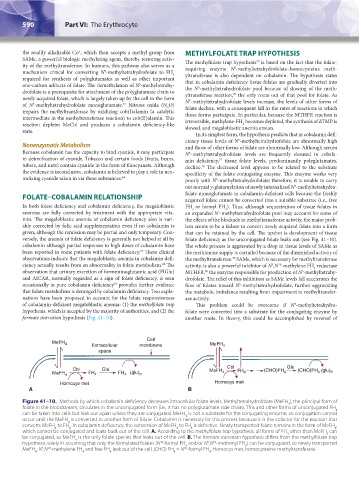
Figure 41–10. Methods by which cobalamin deficiency decreases intracellular folate levels. Methyltetrahydrofolate (MeFH ), the principal form of
4
folate in the bloodstream, circulates in the unconjugated form (i.e., it has no polyglutamate side chain). This and other forms of unconjugated FH
4
can be taken into cells but leak out again unless they are conjugated. MeFH is not a substrate for the conjugating enzyme, so conjugation cannot
4
occur until the MeFH is converted to another form of folate. Cobalamin is necessary for this process because it is the cofactor for the reaction that
4
converts MeFH to FH . In cobalamin deficiency, the conversion of MeFH to FH is defective. Newly transported folate remains in the form of MeFH ,
4
4
4
4
4
which cannot be conjugated and leaks back out of the cell. A. According to the methylfolate trap hypothesis, all forms of FH other than MeFH can
4
4
be conjugated, so MeFH is the only folate species that leaks out of the cell. B. The formate starvation hypothesis differs from the methylfolate trap
4
hypothesis solely in assuming that only the formylated folates (N -formyl FH and/or N ,N -methenyl FH ) can be conjugated, so newly transported
10
10
5
4
4
MeFH , N ,N -methylene FH and free FH leak out of the cell. (CHO) FH = N -formyl FH . Homocys met, homocysteine methyltransferase.
10
10
5
4 4 4 4 4
Kaushansky_chapter 41_p0583-0616.indd 590 9/17/15 6:24 PM

