


Page 613 - Williams Hematology ( PDFDrive )
P. 613
588            Part VI:  The Erythrocyte                                                                                                                     Chapter 41:  Folate, Cobalamin, and Megaloblastic Anemias             589


               METABOLISM                                             protein in granulocytes has been localized to the specific granules, from
               Tritiated folylmonoglutamate ( H-F) administered intravenously is   which it is released when the granulocytes are stimulated.
                                       3
               almost completely removed from the bloodstream in a few minutes.
                                                                 39
               Uptake  involves  two  classes  of  folate-binding proteins :  high-affin-  EXCRETION
                                                         40
               ity folate receptors  that concentrate folate in intracellular vesicles and   Folates  are  both  resorbed  and  secreted  by  the  kidney.  Resorption  is
                            41
               a membrane folate transporter that transports folate from the vesicles   accomplished by a membrane-bound high-affinity folate receptor (K
                                                                                                                        m
               into the cytosol. The high-affinity receptors, which are attached to the   for N -methyltetrahydrofolate = 0.4 nM) located in the brush-borders
                                                                          5
               outer surface of the cell membrane by glycosyl-phosphatidylinositol   of the proximal tubules.  Filtered folate may thus be returned to the
                                                                                        61
               linkages and lack an intracytoplasmic portion,  bind very tightly (K    bloodstream. There is resorption of most, but not all, of the filtered
                                                  42
                                                                  d
               [distribution coefficient] in the nanomolar range) to most physiologic   folate.
               folate monoglutamates,  particularly  N -methyltetrahydrofolate, the   In humans, intact folates and their cleavage products are excreted
                                             5
                                 43
               major circulating folate.  The folate receptors exist in various isoforms   by the kidney at a rate of 2 to 5 mcg/day.  A small percentage of paren-
                                 44
                                                                                                   62
               (of which α and β are the most important). Folate receptor-α, despite   terally administered labeled folate is recoverable in the feces and mainly
               its missing cytoplasmic extension, is effective in mediating endocyto-  represents unreabsorbed folate from the enterohepatic cycle. 63
               sis.  Their very high affinity enables the receptors to take up N -meth-
                                                             5
                  45
               yltetrahydrofolate from the plasma, even at its ambient concentration of
               approximately 10 nM. The membrane folate transporter is a probenecid-   ASSAY OF SERUM FOLATE
               inhibitable organic anion carrier that, among other functions, car-  Folates are measured by chemiluminescent methods using various
               ries reduced folates and methotrexate in and out of the cytoplasm.  Its   folate binders. These assays are identical in principle to the radioligand
                                                               40
               K  for folate is in the micromolar range. Once internalized, the folates   binding assays that they have replaced.
                 m
               are retained by the cells partly through polyglutamylation  as well as
                                                          46
               through tight association with a set of intracellular folate-binding pro-  COBALAMIN
               teins.  Three of these proteins are enzymes involved in methyl group
                   47
               metabolism: sarcosine dehydrogenase and dimethylglycine dehydroge-  CHEMISTRY
               nase  (mitochondrial)  and  glycine  N-methyl transferase (cytosolic).
                               48
                                                                 49
               Why  these  enzymes  bind  folate  so  avidly  or  whether  this  binding   Structure and Nomenclature
               affects overall methyl group metabolism is unknown, although glycine   The cobalamin molecule has two major portions: a porphyrin-like
               N-methyl transferase is speculated to regulate methyl group metabo-  near-planar macrocycle known as corrin, and a nucleotide that lies
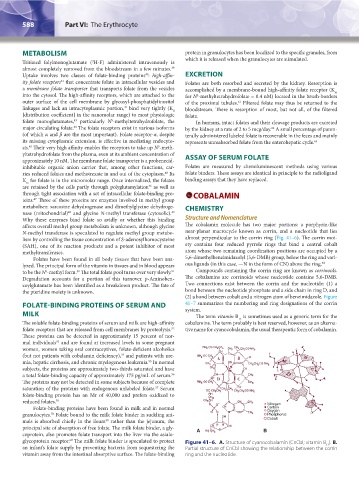
               lism by controlling the tissue concentration of S-adenosylhomocysteine   almost perpendicular to the corrin ring (Fig. 41–6). The corrin moi-
               (SAH), one of its reaction products and a potent inhibitor of most   ety contains four reduced pyrrole rings that bind a central cobalt
               methyltransferases.                                    atom whose two remaining coordination positions are occupied by a
                   Folates have been found in all body tissues that have been ana-  5,6-dimethylbenzimidazolyl (5,6-DMB) group, below the ring and vari-
               lyzed. The principal form of the vitamin in tissues and in blood appears   ous ligands (in this case, —N in the form of CN) above the ring. 64
               to be the N -methyl form.  The total folate pool turns over very slowly.    Compounds containing the corrin ring are known as corrinoids.
                                                                 51
                                  50
                       5
               Degradation accounts for a portion of this turnover.  p-Aminoben-  The cobalamins are corrinoids whose nucleotide contains 5,6-DMB.
               zoylglutamate has been identified as a breakdown product. The fate of   Two connections exist between the corrin and the nucleotide: (1) a
               the pteridine moiety is unknown.                       bond between the nucleotide phosphate and a side chain in ring D, and
                                                                      (2) a bond between cobalt and a nitrogen atom of benzimidazole. Figure
               FOLATE-BINDING PROTEINS OF SERUM AND                   41–7 summarizes the numbering and ring designations of the corrin
                                                                      system.
               MILK                                                       The term vitamin B  is sometimes used as a generic term for the
                                                                                        12
               The soluble folate-binding proteins of serum and milk are high-affinity   cobalamins. The term probably is best reserved, however, as an alterna-
               folate receptors that are released from cell membranes by proteolysis.    tive name for cyanocobalamin, the usual therapeutic form of cobalamin.
                                                                 52
               These proteins can be detected in approximately 15 percent of nor-
               mal individuals  and are found at increased levels in some pregnant
                           53
               women, women taking oral contraceptives, folate-deficient alcoholics
               (but not patients with cobalamin deficiency),  and patients with ure-
                                                54
               mia, hepatic cirrhosis, and chronic myelogenous leukemia.  In normal
                                                          55
               subjects, the proteins are approximately two-thirds saturated and have
               a total folate-binding capacity of approximately 175 pg/mL of serum.
                                                                 56
               The proteins may not be detected in some subjects because of complete
               saturation of the proteins with endogenous unlabeled folate.  Serum
                                                            57
               folate-binding  protein  has  an  Mr  of  40,000  and  prefers  oxidized  to
               reduced folates. 55                                                                Nitrogen
                   Folate-binding proteins have been found in milk and in normal                  Carbon
                                                                                                  Oxygen
               granulocytes.  Folate bound to the milk folate binder in suckling ani-             Phosphorus
                         58
               mals is absorbed chiefly in the ileum  rather than the jejunum, the                Cobalt
                                           59
               principal site of absorption of free folate. The milk folate binder, a gly-
               coprotein, also promotes folate transport into the liver via the asialo-  A      B
               glycoprotein receptor.  The milk folate binder is speculated to protect   Figure 41–6.  A. Structure of cyanocobalamin (CnCbl; vitamin B ). B.
                               60
                                                                                                                     12
               an infant’s folate supply by preventing bacteria from sequestering the   Partial structure of CnCbl showing the relationship between the corrin
               vitamin away from the intestinal absorptive surface. The folate-binding   ring and the nucleotide.
          Kaushansky_chapter 41_p0583-0616.indd   588                                                                   9/17/15   6:23 PM

