


Page 653 - Williams Hematology ( PDFDrive )
P. 653
628            Part VI:  The Erythrocyte                                                                                                                                      Chapter 43:  Iron Deficiency and Overload            629


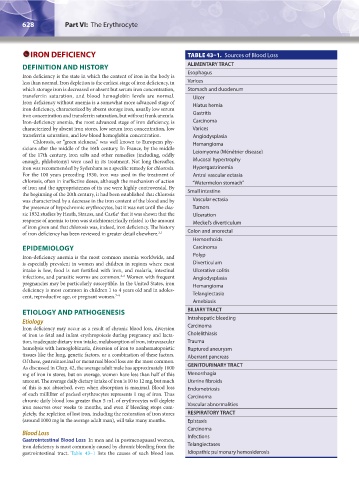
                  IRON DEFICIENCY                                      TABLE 43–1.  Sources of Blood Loss

               DEFINITION AND HISTORY                                  ALIMENTARY TRACT
               Iron deficiency is the state in which the content of iron in the body is   Esophagus
               less than normal. Iron depletion is the earliest stage of iron deficiency, in   Varices
               which storage iron is decreased or absent but serum iron concentration,   Stomach and duodenum
               transferrin  saturation,  and  blood  hemoglobin  levels are  normal.     Ulcer
               Iron deficiency without anemia is a somewhat more advanced stage of     Hiatus hernia
               iron deficiency, characterized by absent storage iron, usually low serum
               iron concentration and transferrin saturation, but without frank anemia.     Gastritis
               Iron-deficiency anemia, the most advanced stage of iron deficiency, is     Carcinoma
               characterized by absent iron stores, low serum iron concentration, low     Varices
               transferrin saturation, and low blood hemoglobin concentration.    Angiodysplasia
                   Chlorosis, or “green sickness,” was well known to European phy-    Hemangioma
               sicians after the middle of the 16th century. In France, by the middle
               of the 17th century, iron salts and other remedies (including, oddly     Leiomyoma (Ménétrier disease)
               enough, phlebotomy) were used in its treatment. Not long thereafter,     Mucosal hypertrophy
               iron was recommended by Sydenham as a specific remedy for chlorosis.     Hypergastrinemia
               For the 100 years preceding 1930, iron was used in the treatment of     Antral vascular ectasia
               chlorosis, often in ineffective doses, although the mechanism of action     “Watermelon stomach”
               of iron and the appropriateness of its use were highly controversial. By
               the beginning of the 20th century, it had been established that chlorosis   Small intestine
               was characterized by a decrease in the iron content of the blood and by     Vascular ectasia
               the presence of hypochromic erythrocytes, but it was not until the clas-    Tumors
               sic 1932 studies by Heath, Strauss, and Castle  that it was shown that the     Ulceration
                                               1
               response of anemia to iron was stoichiometrically related to the amount     Meckel’s diverticulum
               of iron given and that chlorosis was, indeed, iron deficiency. The history
               of iron deficiency has been reviewed in greater detail elsewhere. 2,3  Colon and anorectal
                                                                         Hemorrhoids
               EPIDEMIOLOGY                                              Carcinoma
               Iron-deficiency anemia is the most common anemia worldwide, and     Polyp
               is especially prevalent in women and children in regions where meat     Diverticulum
               intake is low, food is not fortified with iron, and malaria, intestinal     Ulcerative colitis
               infections, and parasitic worms are common.  Women with frequent     Angiodysplasia
                                                4–6
               pregnancies may be particularly susceptible. In the United States, iron     Hemangioma
               deficiency is most common in children 1 to 4 years old and in adoles-
               cent, reproductive age, or pregnant women. 7–9            Telangiectasia
                                                                         Amebiasis
               ETIOLOGY AND PATHOGENESIS                               BILIARY TRACT
                                                                       Intrahepatic bleeding
               Etiology
               Iron deficiency may occur as a result of chronic blood loss, diversion   Carcinoma
               of iron to fetal and infant erythropoiesis during pregnancy and lacta-  Cholelithiasis
               tion, inadequate dietary iron intake, malabsorption of iron, intravascular   Trauma
               hemolysis with hemoglobinuria, diversion of iron to nonhematopoietic   Ruptured aneurysm
               tissues like the lung, genetic factors, or a combination of these factors.   Aberrant pancreas
               Of these, gastrointestinal or menstrual blood loss are the most common.
               As discussed in Chap. 42, the average adult male has approximately 1000   GENITOURINARY TRACT
               mg of iron in stores, but on average, women have less than half of this   Menorrhagia
               amount. The average daily dietary intake of iron is 10 to 12 mg, but much   Uterine fibroids
               of this is not absorbed, even when absorption is maximal. Blood loss   Endometriosis
               of each milliliter of packed erythrocytes represents 1 mg of iron. Thus   Carcinoma
               chronic daily blood loss greater than 5 mL of erythrocytes will deplete
               iron reserves over weeks to months, and even if bleeding stops com-  Vascular abnormalities
               pletely, the repletion of lost iron, including the restoration of iron stores   RESPIRATORY TRACT
               (around 1000 mg in the average adult man), will take many months.  Epistaxis
                                                                       Carcinoma
               Blood Loss
               Gastrointestinal Blood Loss  In men and in postmenopausal women,   Infections
               iron deficiency is most commonly caused by chronic bleeding from the   Telangiectases
               gastrointestinal tract.  Table   43–1 lists the causes of such blood loss.   Idiopathic pulmonary hemosiderosis


          Kaushansky_chapter 43_p0627-0650.indd   628                                                                   9/17/15   6:27 PM

