


Page 649 - Williams Hematology ( PDFDrive )
P. 649
624            Part VI:  The Erythrocyte                                                                                                                                                   Chapter 42:  Iron Metabolism            625


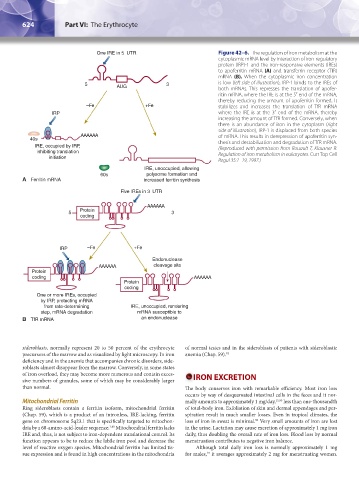
                                        One IRE in 5 UTR                         Figure 42–6.  The regulation of iron metabolism at the
                                                                                 cytoplasmic mRNA level by interaction of iron-regulatory
                                                                                 protein (IRP)-1 and the iron-responsive elements (IREs)
                                                                                 to apoferritin mRNA  (A) and transferrin receptor (TfR)
                                                                                 mRNA  (B).  When the cytoplasmic iron concentration
                                    5          AUG              3                is low (left side of illustration), IRP-1 binds to the IREs of
                                                                                 both  mRNAs. This  represses  the translation  of  apofer-
                                                                                 ritin mRNA, where the IRE is at the 5′ end of the mRNA,
                                                                                 thereby reducing the amount of apoferritin formed. It
                                     –Fe                 +Fe                     stabilizes and increases the translation of  TfR mRNA
                         IRP                                                     where the IRE is at the 3′ end of the mRNA, thereby
                                                                                 increasing the amount of TfR formed. Conversely, when
                                                                                 there is an abundance of iron in the cytoplasm (right
                                                                                 side of illustration), IRP-1 is displaced from both species
                                   AAAAAA                                        of mRNA. This results in derepression of apoferritin syn-
                  40s                                                            thesis and destabilization and degradation of TfR mRNA.
                    IRE, occupied by IRP,                                        (Reproduced with permission from Rouault T, Klausner R:
                    inhibiting translation                                       Regulation of iron metabolism in eukaryotes. Curr Top Cell
                        initiation
                                                                                 Regul 35:1–19, 1997.)
                                                        IRE, unoccupied, allowing
                                          60s            polysome formation and
               A   Ferritin mRNA                        increased ferritin synthesis

                                                Five IREs in 3  UTR

                                                         AAAAAA
                               5   Protein                       3
                                   coding


                            IRP      –Fe             +Fe
                                                           Endonuclease
                                         AAAAAA            cleavage site
                   Protein
                   coding                                                AAAAAA
                                                  Protein
                                                  coding
                    One or more IREs, occupied
                      by IRP, protecting mRNA
                       from rate-determining        IRE, unoccupied, rendering
                      step, mRNA degradation          mRNA susceptible to
               B   TfR mRNA                            an endonuclease


               sideroblasts, normally represent 20 to 50 percent of the erythrocyte   of normal testes and in the sideroblasts of patients with sideroblastic
               precursors of the marrow and as visualized by light microscopy. In iron   anemia (Chap. 59). 92
               deficiency and in the anemia that accompanies chronic disorders, side-
               roblasts almost disappear from the marrow. Conversely, in some states
               of iron overload, they may become more numerous and contain exces-  IRON EXCRETION
               sive numbers of granules, some of which may be considerably larger
               than normal.                                           The body conserves iron with remarkable efficiency. Most iron loss
                                                                      occurs by way of desquamated intestinal cells in the feces and it nor-
               Mitochondrial Ferritin                                 mally amounts to approximately 1 mg/day, 15,93  less than one-thousandth
               Ring sideroblasts contain a ferritin isoform, mitochondrial ferritin   of total-body iron. Exfoliation of skin and dermal appendages and per-
               (Chap. 59), which is a product of an intronless, IRE-lacking, ferritin   spiration result in much smaller losses. Even in tropical climates, the
               gene on chromosome 5q23.1 that is specifically targeted to mitochon-  loss of iron in sweat is minimal.  Very small amounts of iron are lost
                                                                                             90
               dria by a 60-amino-acid-leader sequence.  Mitochondrial ferritin lacks   in the urine. Lactation may cause excretion of approximately 1 mg iron
                                             1,91
               IRE and, thus, is not subject to iron-dependent translational control. Its   daily, thus doubling the overall rate of iron loss. Blood loss by normal
               function appears to be to reduce the labile iron pool and decrease the   menstruation contributes to negative iron balance.
               level of reactive oxygen species. Mitochondrial ferritin has limited tis-  Although total daily iron loss is normally approximately 1 mg
               sue expression and is found in high concentrations in the mitochondria   for males,  it averages approximately 2 mg for menstruating women.
                                                                             15


          Kaushansky_chapter 42_p0617-0626.indd   624                                                                   9/17/15   6:26 PM

