


Page 698 - Williams Hematology ( PDFDrive )
P. 698
672  Part VI:  The Erythrocyte                                Chapter 46:  Erythrocyte Membrane Disorders             673


                                    +
                  influx activates the Na -K  ATPase cation pump, which increases ATP   and this is the primary cause of the chronic hemolysis experienced by
                                  +
                  turnover and glycolysis. Spherocytes are dehydrated, especially cells   HS patients (see Fig. 46–12). The reduced deformability of spherocytes
                  obtained from the splenic pulp, but the underlying mechanism has not   impedes their passage through the interendothelial slits separating the
                  been clearly defined. The acidic environment of the spleen and oxida-  splenic cords of the red pulp from the splenic sinuses. The decrease in
                                                                    –
                                                                  +
                  tive damage by splenic macrophages increase the activity of the K Cl    red cell deformability is primarily related to a loss of surface area and, to
                  cotransporter, which may play a role in dehydration. The hyperactive   a lesser extent, to an increase in internal viscosity as a result of mild cel-
                    +
                      +
                  Na -K  ATPase pump may also contribute as three sodium ions are   lular dehydration. Ex vivo experiments using perfused human spleens
                  extruded in exchange for two potassium ions, and this loss of monova-  and red cells treated with lysophosphatidylcholine to induce spherocy-
                  lent cations is accompanied by the loss of water. Dehydration may also   tosis revealed that the degree of splenic retention correlated with the
                  be related to loss of surface area.                   reduction in the surface-area-to-volume ratio. 99
                                                                            The spleen is a metabolically hostile environment with a decreased
                  Molecular Determinants of Clinical Severity           pH, low concentrations of glucose and ATP, and increased oxidants, all
                  Affected individuals of the same kindred typically experience similar   of which are detrimental to the red cell. Spherocytes are “conditioned”
                  degrees of hemolysis.  However, in  some  families  the  clinical  expres-  during erythrostasis in the spleen and become more osmotically fragile
                  sion is variable and this may be influenced by several factors. Low-   and increasingly spherocytic.  Exposure to macrophages in the spleen
                                                                                             100
                  expression alleles decrease transcription of the gene or influence the   eventually leads to erythrophagocytosis and destruction.
                  expression or incorporation of the protein into the membrane, but there
                  is no phenotypic effect in the heterozygous state because the normal   Inheritance
                  allele compensates for the deleterious effect. However, when inherited   In approximately 75 percent of HS patients, inheritance is autosomal
                  with a mutant allele that causes HS, it exacerbates the clinical expres-  dominant. In the remaining patients, the disorder may be autosomal
                  sion of the disease. Examples of low-expression alleles that influence   recessive or result from  de novo mutations, which is relatively com-
                  HS include band 3 Genas, band 3 Mondego, and two α-spectrin alleles,   mon. 101,102  Mutations in α-spectrin or protein 4.2 are often associated
                  α LELY  and α LEPRA 77,81,91–94                       with recessive HS.
                             .
                     Variable penetrance of the defective gene, a de novo mutation or
                  a mild form of recessively inherited HS may also influence the clini-  Clinical Features
                  cal severity. Double heterozygosity for two mild band 3 mutations can   The clinical manifestations of HS vary widely. The typical clinical pic-
                                  76
                  have an additive effect  and rare cases caused by homozygous defects   ture combines evidence of hemolysis (anemia, jaundice, reticulocytosis,
                  in band 3 result in severe transfusion-dependent hemolytic anemia   gallstones, splenomegaly) with spherocytosis (spherocytes on the blood
                  or fetal death. 91,95,96  Coinheritance of other hematologic disorders or   film and increased osmotic fragility) and a positive family history. Mild,
                  Gilbert syndrome, caused by homozygosity for a polymorphism in the   moderate, and severe forms of HS have been defined according to dif-
                  promoter of the uridine diphosphate-glucuronosyltransferase (UGT1)   ferences in hemoglobin, bilirubin, and reticulocyte counts (Table 46–3),
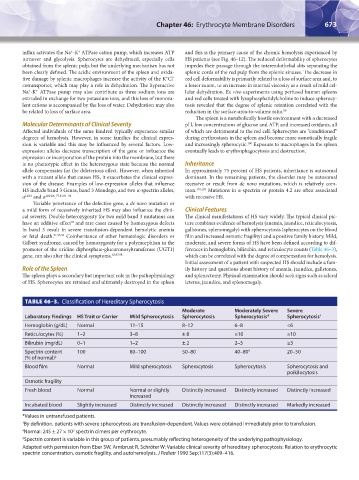
                  gene, can also alter the clinical symptoms. 63,97,98  which can be correlated with the degree of compensation for hemolysis.
                                                                        Initial assessment of a patient with suspected HS should include a fam-
                  Role of the Spleen                                    ily history and questions about history of anemia, jaundice, gallstones,
                  The spleen plays a secondary but important role in the pathophysiology   and splenectomy. Physical examination should seek signs such as scleral
                  of HS. Spherocytes are retained and ultimately destroyed in the spleen   icterus, jaundice, and splenomegaly.


                   TABLE 46–3.  Classification of Hereditary Spherocytosis
                                                                       Moderate          Moderately Severe   Severe
                   Laboratory Findings  HS Trait or Carrier  Mild Spherocytosis  Spherocytosis  Spherocytosis*  Spherocytosis †
                   Hemoglobin (g/dL)  Normal          11–15            8–12              6–8               <6
                   Reticulocytes (%)  1–2             3–8              ± 8               ≥10               ≥10
                   Bilirubin (mg/dL)  0–1             1–2              ± 2               2–3               ≥3
                   Spectrin content    100            80–100           50–80             40–80 §           20–50
                   (% of normal) ‡
                   Blood film       Normal            Mild spherocytosis  Spherocytosis  Spherocytosis     Spherocytosis and
                                                                                                           poikilocytosis
                   Osmotic fragility
                   Fresh blood      Normal            Normal or slightly   Distinctly increased  Distinctly increased  Distinctly increased
                                                      increased
                   Incubated blood  Slightly increased  Distinctly increased  Distinctly increased  Distinctly increased  Markedly increased

                  *Values in untransfused patients.
                  † By definition, patients with severe spherocytosis are transfusion-dependent. Values were obtained immediately prior to transfusion.
                  ‡ Normal: 245 ± 27 × 10  spectrin dimers per erythrocyte.
                                   3
                  § Spectrin content is variable in this group of patients, presumably reflecting heterogeneity of the underlying pathophysiology.
                  Adapted with permission from Eber SW, Armbrust R, Schröter W: Variable clinical severity of hereditary spherocytosis: Relation to erythrocytic
                  spectrin concentration, osmotic fragility, and autohemolysis. J Pediatr 1990 Sep;117(3):409–416.


          Kaushansky_chapter 46_p0661-0688.indd   673                                                                   9/17/15   6:42 PM

