


Page 694 - Williams Hematology ( PDFDrive )
P. 694
668  Part VI:  The Erythrocyte                                Chapter 46:  Erythrocyte Membrane Disorders             669


                                                    Na-K
                                                    pump                           Na-H
                                                                 Na-K-2Cl        Exchange
                                                                Cotransporter
                                                   3Na     2K
                                                                                  H      Na
                                                                2CI       Na-K


                                    CI/HCO 3                                                         H O
                                                                                                      2
                                           Anion exchanger                                Aquaporin 1
                                    CI/HCO 3   band 3                                                H O
                                                                                                      2


                                                                   CI       K
                                                      K                            H       Ca
                                                                    K-CI
                                                                Cotransporter
                                                   Gardos                          Ca Pump
                                                   channel
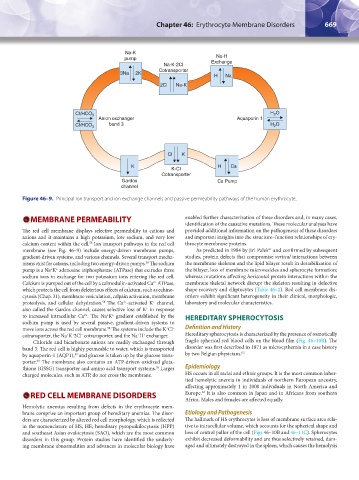
                  Figure 46–9.  Principal ion transport and ion exchange channels and passive permeability pathways of the human erythrocyte.


                     MEMBRANE PERMEABILITY                              enabled further characterization of these disorders and, in many cases,
                                                                        identification of the causative mutations. These molecular analyses have
                  The red cell membrane displays selective permeability to cations and   provided additional information on the pathogenesis of these disorders
                  anions and it maintains a high potassium, low sodium, and very low   and important insights into the structure–function relationships of ery-
                  calcium content within the cell.  Ion transport pathways in the red cell   throcyte membrane proteins.
                                        58
                  membrane (see Fig. 46–9) include energy-driven membrane pumps,   As predicted in 1984 by Jiri Palek  and confirmed by subsequent
                                                                                                    61
                  gradient-driven systems, and various channels. Several transport mecha-  studies, protein defects that compromise vertical interactions between
                  nisms exist for cations, including two energy-driven pumps.  The sodium   the membrane skeleton and the lipid bilayer result in destabilization of
                                                           58
                  pump is a Na K  adenosine triphosphatase (ATPase) that extrudes three   the bilayer, loss of membrane microvesicles and spherocyte formation;
                             +
                           +
                  sodium ions in exchange for two potassium ions entering the red cell.   whereas mutations affecting horizontal protein interactions within the
                  Calcium is pumped out of the cell by a calmodulin-activated Ca  ATPase,   membrane skeletal network disrupt the skeleton resulting in defective
                                                              2+
                  which protects the cell from deleterious effects of calcium, such as echino-  shape recovery and elliptocytes (Table 46–2). Red cell membrane dis-
                  cytosis (Chap. 31), membrane vesiculation, calpain activation, membrane   orders exhibit significant heterogeneity in their clinical, morphologic,
                  proteolysis, and cellular dehydration.  The Ca -activated K  channel,   laboratory and molecular characteristics.
                                                              +
                                                    2+
                                             58
                  also called the Gardos channel, causes selective loss of K  in response
                                                           +
                  to increased intracellular Ca . The Na K  gradient established by the   HEREDITARY SPHEROCYTOSIS
                                              +
                                                +
                                      2+
                  sodium pump is used by several passive, gradient-driven systems to
                  move ions across the red cell membrane.  The systems include the K Cl    Definition and History
                                                                  +
                                                                    –
                                              58
                  cotransporter, the Na K 2Cl  cotransporter, and the Na H  exchanger.  Hereditary spherocytosis is characterized by the presence of osmotically
                                                        +
                                                          +
                                 +
                                  +
                                      –
                     Chloride and bicarbonate anions are readily exchanged through   fragile spherical red blood cells on the blood film (Fig. 46–10B). The
                  band 3. The red cell is highly permeable to water, which is transported   disorder was first described in 1871 as microcythemia in a case history
                  by aquaporin-1 (AQP1),  and glucose is taken up by the glucose trans-  by two Belgian physicians. 62
                                   59
                  porter.  The membrane also contains an ATP-driven oxidized gluta-
                       60
                  thione (GSSG) transporter and amino acid transport systems.  Larger   Epidemiology
                                                               58
                  charged molecules, such as ATP, do not cross the membrane.  HS occurs in all racial and ethnic groups. It is the most common inher-
                                                                        ited hemolytic anemia in individuals of northern European ancestry,
                                                                        affecting approximately 1 in 2000 individuals in North America and
                                                                              63
                     RED CELL MEMBRANE DISORDERS                        Europe.  It is also common in Japan and in Africans from southern
                                                                        Africa. Males and females are affected equally.
                  Hemolytic  anemias resulting from defects in the erythrocyte mem-
                  brane comprise an important group of hereditary anemias. The disor-  Etiology and Pathogenesis
                  ders are characterized by altered red cell morphology, which is reflected   The hallmark of HS erythrocytes is loss of membrane surface area rela-
                  in the nomenclature of HS, HE, hereditary pyropoikilocytosis (HPP)   tive to intracellular volume, which accounts for the spherical shape and
                  and southeast Asian ovalocytosis (SAO), which are the most common   loss of central pallor of the cell (Figs 46–10B and 46–11C). Spherocytes
                  disorders in this group. Protein studies have identified the underly-  exhibit decreased deformability and are thus selectively retained, dam-
                  ing membrane abnormalities and advances in molecular biology have   aged and ultimately destroyed in the spleen, which causes the hemolysis
          Kaushansky_chapter 46_p0661-0688.indd   669                                                                   9/17/15   6:42 PM

