


Page 696 - Williams Hematology ( PDFDrive )
P. 696
670  Part VI:  The Erythrocyte                                Chapter 46:  Erythrocyte Membrane Disorders             671


                   A                                 B                     C                           D


                        E                          F                          F

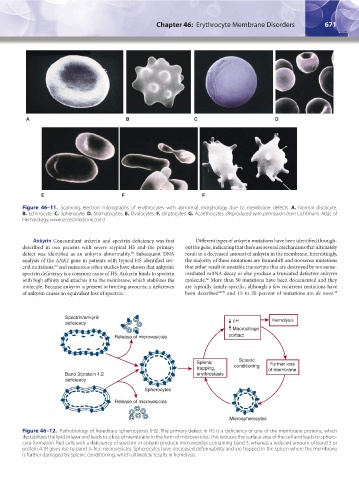
                  Figure  46–11.  Scanning electron micrographs of erythrocytes with abnormal morphology due to membrane defects.  A. Normal discocyte.
                  B. Echinocyte. C. Spherocyte. D. Stomatocytes. E. Ovalocytes. F. Elliptocytes. G. Acanthocytes. (Reproduced with permission from Lichtman’s Atlas of
                  Hematology, www.accessmedicine.com.)


                     Ankyrin Concomitant ankyrin and spectrin deficiency was first   Different types of ankyrin mutations have been identified through-
                  described in  two patients with  severe  atypical  HS and the  primary   out the gene, indicating that there are several mechanisms that ultimately
                  defect was identified as an ankyrin abnormality.  Subsequent DNA   result in a decreased amount of ankyrin in the membrane. Interestingly,
                                                      68
                  analysis of the ANK1 gene in patients with typical HS identified sev-  the majority of these mutations are frameshift and nonsense mutations
                  eral mutations,  and numerous other studies have shown that ankyrin/  that either result in unstable transcripts that are destroyed by nonsense-
                             69
                  spectrin deficiency is a common cause of HS. Ankyrin binds to spectrin   mediated mRNA decay or else produce a truncated defective ankyrin
                  with high affinity and attaches it to the membrane, which stabilizes the   molecule.  More than 50 mutations have been documented and they
                                                                               66
                  molecule. Because ankyrin is present in limiting amounts, a deficiency   are typically family-specific, although a few recurrent mutations have
                  of ankyrin causes an equivalent loss of spectrin.     been  described 69,70  and  15 to  20 percent of  mutations  are  de novo.
                                                                                                                          63

                                Spectrin/ankyrin                                                     Hemolysis
                                deficiency                                              pH
                                                                                        Macrophage
                                                 Release of microvesicles              contact


                                                                                          Splenic
                                                                            Splenic                  Further loss
                                                                            trapping,    conditioning  of membrane
                                Band 3/protein 4.2                          erythrostasis
                                deficiency
                                                           Spherocytes

                                                 Release of microvesicles

                                                                                       Microspherocytes

                  Figure 46–12.  Pathobiology of hereditary spherocytosis (HS). The primary defect in HS is a deficiency of one of the membrane proteins, which
                  destabilizes the lipid bilayer and leads to a loss of membrane in the form of microvesicles. This reduces the surface area of the cell and leads to sphero-
                  cyte formation. Red cells with a deficiency of spectrin or ankyrin produce microvesicles containing band 3, whereas a reduced amount of band 3 or
                  protein 4.1R gives rise to band 3–free microvesicles. Spherocytes have decreased deformability and are trapped in the spleen where the membrane
                  is further damaged by splenic conditioning, which ultimately results in hemolysis.


          Kaushansky_chapter 46_p0661-0688.indd   671                                                                   9/17/15   6:42 PM

