


Page 695 - Williams Hematology ( PDFDrive )
P. 695
670            Part VI:  The Erythrocyte                                                                                                                                  Chapter 46:  Erythrocyte Membrane Disorders              671


                TABLE 46–2.  Erythrocyte Membrane Protein Defects in   experienced by HS patients. The HS red cell membrane is destabilized
                                                                      by a deficiency of critical membrane proteins, including spectrin,
                Inherited Disorders of Red Cell Shape
                                                                      ankyrin, band 3 and protein 4.2, which decreases the vertical interac-
                Protein     Disorder    Comment                       tions between the skeleton and the bilayer, resulting in the release of
                Ankyrin     HS          Most common cause of typical   microvesicles and loss of surface area (Fig. 46–12). It is hypothesized
                                        dominant HS                   that two mechanisms underlie the membrane loss: (1) in cells with spec-
                                                                      trin/ankyrin deficiency, sections of the lipid bilayer and band 3 are not
                Band 3      HS, SAO, NIHF,  “Pincered” HS spherocytes seen
                            HAc         on blood film presplenectomy;   in contact with the skeleton, which will increase the lateral and rota-
                                        SAO results from 9-amino-acid   tional mobility of band 3, allowing lipid microvesicles containing band
                                        deletion                      3 to be generated, and (2) in cells with decreased amounts of band 3/
                                                                      protein 4.2, the stabilizing effect of the transmembrane section of band
                β-Spectrin  HS, HE, HPP,   “Acanthocytic” spherocytes seen   3 on the lipid bilayer is lost, facilitating the formation of band 3-free
                            NIHF        on blood film presplenectomy;           13
                                        location of mutation in β-spectrin   microvesicles.
                                        determines clinical phenotype
                                                                      Red Cell Membrane Protein Defects
                α-Spectrin  HS, HE, HPP,   Location of mutation in α-spectrin   Analysis of HS red cell membrane proteins by several research groups
                            NIHF        determines clinical phenotype;   has revealed quantitative abnormalities of spectrin, ankyrin, band 3,
                                        α-spectrin mutations most com-                                   13,63,64
                                        mon cause of typical HE       and protein 4.2 in 70 to 90 percent of the cases.   This spectrum of
                                                                      defects is found worldwide in all the HS cohorts that have been stud-
                Protein 4.2  HS         Primarily found in Japanese   ied; however, the relative frequency of each defect varies with the geo-
                                        patients
                                                                      graphical area and ethnic group. In the United States, parts of Europe,
                Protein 4.1  HE         Found in certain European and   and in Korea, the most common defect is ankyrin deficiency (30 to 60
                                        Arab populations              percent), 63,65,66  whereas it is relatively uncommon elsewhere in the world
                GPC         HE          Concomitant protein 4.1       (<15 percent). In other parts of Europe 64,67  and in South Africa (unpub-
                                        deficiency is basis of HE in    lished), band 3 deficiency is the main defect. In Japan, almost half of the
                                        GPC defects                   HS cases are caused by a decreased amount of protein 4.2, and in Korea
                                                                      and South Africa, this defect is the second most common, but in other
                GPC, glycophorin C; HAc, hereditary acanthocytosis; HE, hereditary   populations it is rare (<6 percent). 63–65  The underlying gene mutations
                elliptocytosis; HPP, hereditary pyropoikilocytosis; HS, hereditary   have not been investigated in all HS subjects, but the limited research
                spherocytosis; NIHF, nonimmune hydrops fetalis; SAO, southeast   that has been conducted on the defective genes has identified more than
                Asian ovalocytosis.
                                                                      140 different mutations, which are often unique to a family.


               A                                   B                                   C


               D                                   E                                   F
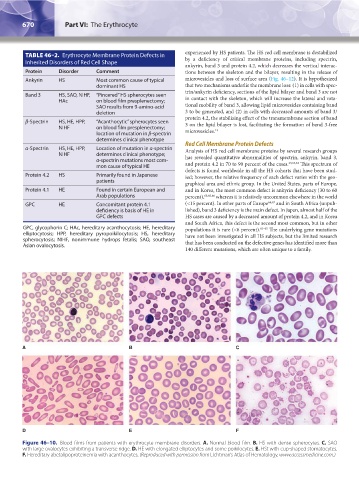
               Figure 46–10.  Blood films from patients with erythrocyte membrane disorders. A. Normal blood film. B. HS with dense spherocytes. C. SAO
               with large ovalocytes exhibiting a transverse ridge. D. HE with elongated elliptocytes and some poikilocytes. E. HSt with cup-shaped stomatocytes.
               F. Hereditary abetalipoproteinemia with acanthocytes. (Reproduced with permission from Lichtman’s Atlas of Hematology, www.accessmedicine.com.)


          Kaushansky_chapter 46_p0661-0688.indd   670                                                                   9/17/15   6:42 PM

