


Page 774 - Williams Hematology ( PDFDrive )
P. 774
748  Part VI:  The Erythrocyte                 Chapter 48:  The Thalassemias: Disorders of Globin Synthesis           749


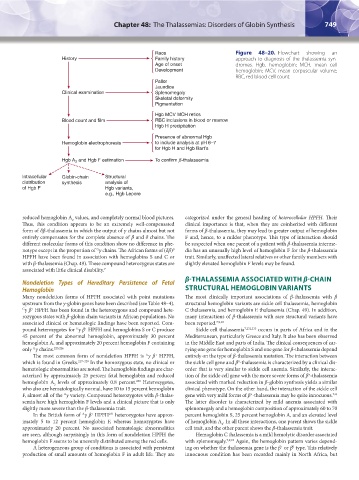
                                                                                         Figure 48–20.  Flowchart  showing  an
                                                                                         approach to diagnosis of the thalassemia syn-
                                                                                         dromes. Hgb, hemoglobin; MCH, mean cell
                                                                                         hemoglobin; MCV, mean corpuscular volume;
                                                                                         RBC, red blood cell count.


                  reduced hemoglobin A  values, and completely normal blood pictures.   categorized under the general heading of  heterocellular HPFH. Their
                                  2
                  Thus, this condition appears to be an extremely well-compensated   clinical  importance  is  that,  when  they  are  coinherited with different
                  form of δβ-thalassemia in which the output of γ chains almost but not   forms of β-thalassemia, they may lead to greater output of hemoglobin
                  entirely compensates for the complete absence of β and δ chains. The   F and, hence, to a milder phenotype. This type of interaction should
                  different molecular forms of this condition show no difference in phe-  be suspected when one parent of a patient with β-thalassemia interme-
                  notype except in the proportion of  γ chains. The African forms of (δβ)    dia has an unusually high level of hemoglobin F for the β-thalassemia
                                           G
                                                                    0
                  HPFH have been found in association with hemoglobins S and C or   trait. Similarly, unaffected lateral relatives or other family members with
                  with β-thalassemia (Chap. 49). These compound heterozygous states are   slightly elevated hemoglobin F levels may be found.
                  associated with little clinical disability. 7
                                                                        β-THALASSEMIA ASSOCIATED WITH β-CHAIN
                  Nondeletion Types of Hereditary Persistence of Fetal
                  Hemoglobin                                            STRUCTURAL HEMOGLOBIN VARIANTS
                  Many  nondeletion  forms  of  HPFH  associated  with  point  mutations   The most clinically important associations of  β-thalassemia with  β
                  upstream from the γ-globin genes have been described (see Table  48–4).   structural hemoglobin variants are sickle cell thalassemia, hemoglobin
                     +
                  G γ β  HPFH has been found in the heterozygous and compound hete-  C thalassemia, and hemoglobin E thalassemia (Chap. 49). In addition,
                  rozygous states with β-globin chain variants in African populations. No   many interactions of β-thalassemia with rare structural variants have
                  associated clinical or hematologic findings have been reported. Com-  been reported. 7,9,10
                  pound heterozygotes for  γ β  HPFH and hemoglobins S or C produce   Sickle cell thalassemia 7,232,233  occurs in parts of Africa and in the
                                    G
                                       +
                  45 percent of the abnormal hemoglobin, approximately 30 percent   Mediterranean, particularly Greece and Italy. It also has been observed
                  hemoglobin A, and approximately 20 percent hemoglobin F containing   in the Middle East and parts of India. The clinical consequences of car-
                  only  γ chains. 225,226                               rying one gene for hemoglobin S and one gene for β-thalassemia depend
                     G
                     The most common form of nondeletion HPFH is  γ  β  HPFH,   entirely on the type of β-thalassemia mutation. The interaction between
                                                              +
                                                           A
                  which is found in Greeks. 227–229  In the homozygous state, no clinical or   the sickle cell gene and β -thalassemia is characterized by a clinical dis-
                                                                                          0
                  hematologic abnormalities are noted. The hemoglobin findings are char-  order that is very similar to sickle cell anemia. Similarly, the interac-
                  acterized by approximately 25 percent fetal hemoglobin and reduced   tion of the sickle cell gene with the more severe forms of β -thalassemia
                                                                                                                  +
                  hemoglobin A  levels of approximately 0.8 percent.  Heterozygotes,   associated with marked reduction in β-globin synthesis yields a similar
                                                        230
                            2
                  who also are hematologically normal, have 10 to 15 percent hemoglobin   clinical phenotype. On the other hand, the interaction of the sickle cell
                  F, almost all of the  γ variety. Compound heterozygotes with β-thalas-  gene with very mild forms of β -thalassemia may be quite innocuous.
                                A
                                                                                                                          233
                                                                                              +
                  semia have high hemoglobin F levels and a clinical picture that is only   The latter disorder is characterized by mild anemia associated with
                  slightly more severe than the β-thalassemia trait.    splenomegaly and a hemoglobin composition of approximately 60 to 70
                     In the British form of  γ β  HPFH  heterozygotes have approx-  percent hemoglobin S, 25 percent hemoglobin A, and an elevated level
                                      A
                                               231
                                         +
                  imately 5 to 12 percent hemoglobin F, whereas homozygotes have   of hemoglobin A . In all these interactions, one parent shows the sickle
                                                                                     2
                  approximately 20 percent. No associated hematologic abnormalities   cell trait, and the other parent shows the β-thalassemia trait.
                  are seen, although surprisingly in this form of nondeletion HPFH the   Hemoglobin C thalassemia is a mild hemolytic disorder associated
                  hemoglobin F seems to be unevenly distributed among the red cells.  with splenomegaly. 7,9,10  Again, the hemoglobin pattern varies depend-
                     A heterogeneous group of conditions is associated with persistent   ing on whether the thalassemia gene is the β  or β  type. This relatively
                                                                                                            0
                                                                                                        +
                  production of small amounts of hemoglobin F in adult life. They are   innocuous condition has been recorded mainly in North Africa, but
          Kaushansky_chapter 48_p0725-0758.indd   749                                                                   9/18/15   2:58 PM

