


Page 769 - Williams Hematology ( PDFDrive )
P. 769
744            Part VI:  The Erythrocyte                                                                                                                    Chapter 48:  The Thalassemias: Disorders of Globin Synthesis           745


                                                                      Osteoporosis is being recognized increasingly and may, at least in part,
                                                                      be a reflection of hypogonadism. 201

                                                                      β-THALASSEMIA INTERMEDIA
                                                                      The clinical phenotype of patients designated as having thalassemia
                                                                      intermedia  is  more  severe  than  the  usual  asymptomatic  thalassemia
                                                                      trait but milder than transfusion-dependent thalassemia major. 7,199,200
                                                                      The syndrome encompasses disorders with a wide spectrum of disabil-
                                                                      ity. At the severe end, patients present with anemia later than patients
                                                                      with the transfusion-dependent forms of homozygous  β-thalassemia
                                                                      and are just able to maintain a hemoglobin level of approximately 6 g/
                                                                      dL without transfusion. However, their growth and development are
                                                                      retarded. The patients become seriously disabled, with marked skeletal
                                                                      deformities, arthritis, and bone pain; progressive splenomegaly; growth
                                                                      retardation; and chronic ulcerations above the ankles. At the other end
                                                                      of the spectrum, patients remain completely asymptomatic until adult
                                                                      life and are transfusion independent, with hemoglobin levels as high as
                                                                      10 to 12 g/dL. All varieties of intermediate severity are observed. Some
                                                                      patients become disabled simply from the effects of hypersplenism.
                                                                      Intensive studies of the molecular pathology of this condition have pro-
                                                                      vided some guidelines about genotype–phenotype relationships that are
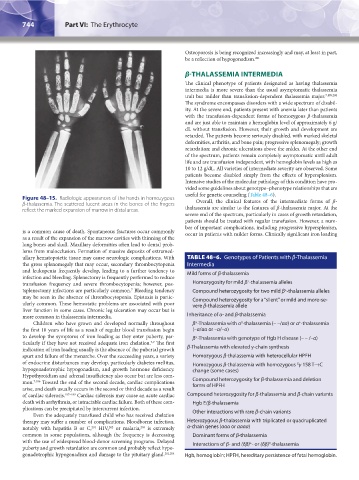
                                                                      useful for genetic counseling (Table 48–6).
               Figure 48–15.  Radiologic appearances of the hands in homozygous   Overall, the clinical features of the intermediate forms of  β-
               β-thalassemia. The scattered lucent areas in the bones of the fingers
               reflect the marked expansion of marrow in distal areas.  thalassemia are similar to the features of β-thalassemia major. At the
                                                                      severe end of the spectrum, particularly in cases of growth retardation,
                                                                      patients should be treated with regular transfusion. However, a num-
                                                                      ber of important complications, including progressive hypersplenism,
               is a common cause of death. Spontaneous fractures occur commonly   occur in patients with milder forms. Clinically significant iron loading
               as a result of the expansion of the marrow cavities with thinning of the
               long bones and skull. Maxillary deformities often lead to dental prob-
               lems from malocclusion. Formation of massive deposits of extramed-
               ullary hematopoietic tissue may cause neurologic complications. With   TABLE 48–6.  Genotypes of Patients with β-Thalassemia
               the gross splenomegaly that may occur, secondary thrombocytopenia   Intermedia
               and leukopenia frequently develop, leading to a further tendency to   Mild forms of β-thalassemia
               infection and bleeding. Splenectomy is frequently performed to reduce
                                                                                           +
               transfusion frequency and severe thrombocytopenia; however, pos-    Homozygosity for mild β -thalassemia alleles
                                                    7
               tsplenectomy infections are particularly common.  Bleeding tendency     Compound heterozygosity for two mild β -thalassemia alleles
                                                                                                       +
               may be seen in the absence of thrombocytopenia. Epistaxis is partic-     Compound heterozygosity for a “silent” or mild and more-se-
               ularly common. These hemostatic problems are associated with poor   vere β-thalassemia allele
               liver function in some cases. Chronic leg ulceration may occur but is
               more common in thalassemia intermedia.                  Inheritance of α- and β-thalassemia
                   Children  who have  grown  and  developed  normally  throughout     β -Thalassemia with α -thalassemia (– –/αα) or α -thalassemia
                                                                                                            +
                                                                                         0
                                                                         +
               the first 10 years of life as a result of regular blood transfusion begin   (–α/αα or –α/–α)
               to develop the symptoms of iron loading as they enter puberty, par-    β -Thalassemia with genotype of Hgb H disease (– – /–α)
                                                                         +
               ticularly if they have not received adequate iron chelation.  The first
                                                          7,9
               indication of iron loading usually is the absence of the pubertal growth   β-Thalassemia with elevated γ-chain synthesis
               spurt and failure of the menarche. Over the succeeding years, a variety     Homozygous β-thalassemia with heterocellular HPFH
               of endocrine disturbances may develop, particularly diabetes mellitus,      Homozygous β-thalassemia with homozygous  γ 158 T→C
                                                                                                           G
               hypogonadotrophic hypogonadism, and growth hormone deficiency.   change (some cases)
               Hypothyroidism and adrenal insufficiency also occur but are less com-
               mon. 7,186  Toward the end of the second decade, cardiac complications      Compound heterozygosity for β-thalassemia and deletion
                                                                        forms of HPFH
               arise, and death usually occurs in the second or third decade as a result
               of cardiac siderosis. 187–189  Cardiac siderosis may cause an acute cardiac   Compound heterozygosity for β-thalassemia and β-chain variants
               death with arrhythmia, or intractable cardiac failure. Both of these com-    Hgb E/β-thalassemia
               plications can be precipitated by intercurrent infection.    Other interactions with rare β-chain variants
                   Even the adequately transfused child who has received chelation
               therapy may suffer a number of complications. Bloodborne infection,   Heterozygous β-thalassemia with triplicated or quadruplicated
               notably with hepatitis B or C,  HIV,  or malaria,  is extremely   α-chain genes (ααα or αααα)
                                                       203
                                            202
                                       201
               common in some populations, although the frequency is decreasing     Dominant forms of β-thalassemia
               with the use of widespread blood-donor screening programs. Delayed     Interactions of β- and (δβ) - or (δβ) -thalassemia
                                                                                                  0
                                                                                            +
               puberty and growth retardation are common and probably reflect hypo-
               gonadotrophic hypogonadism and damage to the pituitary gland. 201,204    Hgb, hemoglobin; HPFH, hereditary persistence of fetal hemoglobin.

          Kaushansky_chapter 48_p0725-0758.indd   744                                                                   9/18/15   2:58 PM

