


Page 773 - Williams Hematology ( PDFDrive )
P. 773
748            Part VI:  The Erythrocyte                                                                                                                    Chapter 48:  The Thalassemias: Disorders of Globin Synthesis           749


               Homozygous State for Nondeletion Types of α-Thalassemia  hemoglobin F levels encountered in juvenile chronic myelogenous leu-
               The homozygous state for nondeletion forms of α-thalassemia involv-  kemia, this disorder may superficially resemble  β-thalassemia. How-
               ing the dominant (α ) globin gene causes a more severe deficit of    ever, the finding of primitive cells in the marrow, the absence of elevated
                               2
               α chains than do the deletion forms of α -thalassemia. In some cases,   hemoglobin A  levels on hemoglobin electrophoresis, the decrease in
                                             +
                                                                                 2
               the homozygous state produces hemoglobin H disease.    carbonic anhydrase in juvenile chronic myelogenous leukemia, and
                   The homozygous state for hemoglobin Constant Spring or other   characteristic in vitro responses of myeloid progenitors in vitro to gran-
               chain-termination mutations is associated with moderately severe   ulocyte-monocyte colony-stimulating factor (Chap. 87) readily differ-
               hemolytic anemia in which, for reasons not explained, no hemoglo-  entiate this disorder from β-thalassemia.
               bin H is present but small amounts of hemoglobin Bart’s persist into
               adult life. The homozygous states for the other nondeletion forms of α -   LESS-COMMON FORMS OF THALASSEMIA
                                                                 +
               thalassemia are associated with hemoglobin H disease. In the homozy-
                                                                         0
               gous state for hemoglobin Constant Spring, the blood picture shows   (δβ) -Thalassemia
               mild thalassemic changes with normal-size red cells. 216,217  The hemo-  The homozygous state for  δβ-thalassemia is clinically milder than
               globin consists of approximately 5 to 6 percent hemoglobin Constant   Cooley anemia and is one form of thalassemia intermedia. 220–222  Only
               Spring, normal hemoglobin A  levels, and trace amounts of hemoglobin   hemoglobin F is present; hemoglobins A and A  are not produced. Het-
                                                                                                        2
                                     2
               Bart’s. The remainder is hemoglobin A.                 erozygous δβ-thalassemia is hematologically similar to β-thalassemia
                                                                           7
                   The heterozygous state for hemoglobin Constant Spring shows no   minor.  The fetal hemoglobin level is higher (range: 5 to 20 percent),
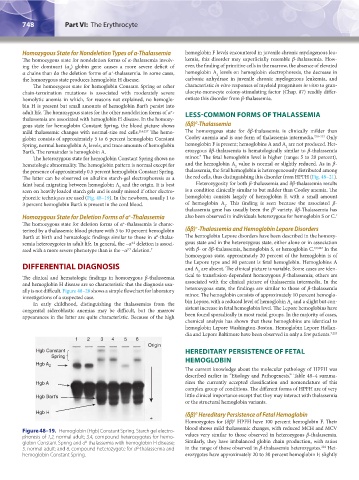
               hematologic abnormality. The hemoglobin pattern is normal except for   and the hemoglobin A  value is normal or slightly reduced. As in β-
                                                                                       2
               the presence of approximately 0.5 percent hemoglobin Constant Spring.   thalassemia, the fetal hemoglobin is heterogeneously distributed among
               The latter can be observed on alkaline starch-gel electrophoresis as a   the red cells, thus distinguishing this disorder from HPFH (Fig. 48–21).
               faint band migrating between hemoglobin A  and the origin. It is best   Heterozygosity for both β-thalassemia and δβ-thalassemia results
                                                2
               seen on heavily loaded starch gels and is easily missed if other electro-  is a condition clinically similar to but milder than Cooley anemia. The
               phoretic techniques are used (Fig. 48–19). In the newborn, usually 1 to   hemoglobin consists  largely  of  hemoglobin  F,  with  a  small  amount
               3 percent hemoglobin Bart’s is present in the cord blood.  of hemoglobin A . This finding is seen because the associated  β-
                                                                                   2
                                                                      thalassemia gene has usually been the β  variety. δβ-Thalassemia has
                                                                                                    0
                                                   +
               Homozygous State for Deletion Forms of α -Thalassemia  also been observed in individuals heterozygous for hemoglobin S or C. 7
               The homozygous state for deletion forms of α -thalassemia is charac-
                                                 +
                                                                         +
               terized by a thalassemic blood picture with 5 to 10 percent hemoglobin   (δβ) -Thalassemia and Hemoglobin Lepore Disorders
               Bart’s at birth and hematologic findings similar to those in α -thalas-  The hemoglobin Lepore disorders have been described in the homozy-
                                                            0
               semia heterozygotes in adult life. In general, the –α  deletion is associ-  gous state and in the heterozygous state, either alone or in association
                                                    4.2
               ated with a more severe phenotype than is the –α  deletion. 7  with β- or δβ-thalassemia, hemoglobin S, or hemoglobin C. 7,9,223  In the
                                                   3.7
                                                                      homozygous state, approximately 20 percent of the hemoglobin is of
               DIFFERENTIAL DIAGNOSIS                                 the Lepore type and 80 percent is fetal hemoglobin. Hemoglobins A
                                                                      and A  are absent. The clinical picture is variable. Some cases are iden-
                                                                          2
               The clinical and hematologic findings in homozygous  β-thalassemia   tical to transfusion-dependent homozygous β-thalassemia; others are
               and hemoglobin H disease are so characteristic that the diagnosis usu-  associated with the clinical picture of thalassemia intermedia. In the
               ally is not difficult. Figure 48–20 shows a simple flowchart for laboratory   heterozygous state, the findings are similar to those of β-thalassemia
               investigations of a suspected case.                    minor. The hemoglobin consists of approximately 10 percent hemoglo-
                   In early childhood, distinguishing the thalassemias from the   bin Lepore, with a reduced level of hemoglobin A  and a slight but con-
                                                                                                         2
               congenital sideroblastic anemias may be difficult, but the marrow   sistent increase in fetal hemoglobin level. The Lepore hemoglobins have
               appearances in the latter are quite characteristic. Because of the high   been found sporadically in most racial groups. In the majority of cases,
                                                                      chemical analysis has shown that these hemoglobins are identical to
                                                                      hemoglobin Lepore Washington-Boston. Hemoglobin Lepore Hollan-
                                                                      dia and Lepore Baltimore have been observed in only a few patients. 7,223
                                 1   2    3  4    5  6
                                                          Origin
                    Hgb Constant                                      HEREDITARY PERSISTENCE OF FETAL
                         Spring                                       HEMOGLOBIN
                    Hgb A 2
                                                                      The current knowledge about the molecular pathology of HPFH was
                                                                      described earlier in “Etiology and Pathogenesis.” Table  48–4 summa-
                    Hgb A                                             rizes the currently accepted classification and nomenclature of this
                                                                      complex group of conditions. The different forms of HPFH are of very
                    Hgb Bart’s                                        little clinical importance except that they may interact with thalassemia
                                                                      or the structural hemoglobin variants.
                    Hgb H                                             (δβ)  Hereditary Persistence of Fetal Hemoglobin
                                                                         0
                                                          +
                                                                      Homozygotes for (δβ)  HPFH have 100 percent hemoglobin F. Their
                                                                                      0
                                                                      blood shows mild thalassemic changes, with reduced MCH and MCV
               Figure 48–19.  Hemoglobin (Hgb) Constant Spring. Starch gel electro-
               phoresis of 1,2, normal adult; 3,4, compound heterozygotes for hemo-  values very similar to those observed in heterozygous β-thalassemia.
               globin Constant Spring and α -thalassemia with hemoglobin H disease;   Similarly, they have imbalanced globin chain production, with ratios
                                     0
                                                                                                                    224
                                                      0
               5, normal adult; and 6, compound heterozygote for α -thalassemia and   in the range of those observed in β-thalassemia heterozygotes.  Het-
               hemoglobin Constant Spring.                            erozygotes have approximately 20 to 30 percent hemoglobin F, slightly


          Kaushansky_chapter 48_p0725-0758.indd   748                                                                   9/18/15   2:58 PM

