


Page 95 - Williams Hematology ( PDFDrive )
P. 95
70  Part II:  The Organization of the Lymphohematopoietic Tissues  Chapter 5:  Structure of the Marrow and the Hematopoietic Microenvironment  71


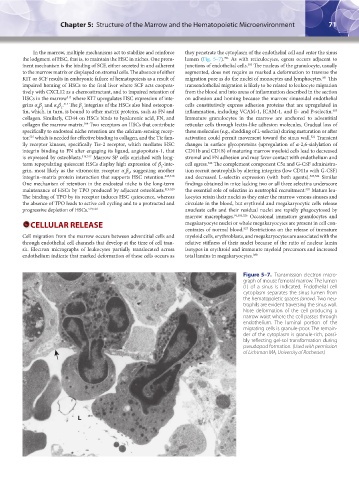
                     In the marrow, multiple mechanisms act to stabilize and reinforce   they penetrate the cytoplasm of the endothelial cell and enter the sinus
                                                                                      391
                  the lodgment of HSC, that is, to maintain the HSC in niches. One prom-  lumen  (Fig. 5–7).  As with reticulocytes, egress occurs adjacent to
                                                                                             383
                  inent mechanism is the binding of SCF, either secreted in and adherent   junctions of endothelial cells.  The nucleus of the granulocyte, usually
                  to the marrow matrix or displayed on stromal cells. The absence of either   segmented, does not require as marked a deformation to traverse the
                                                                                                                      391
                  KIT or SCF results in embryonic failure of hematopoiesis as a result of   migration pore as do the nuclei of monocytes and lymphocytes.  This
                  impaired homing of HSCs to the fetal liver where SCF acts coopera-  transendothelial migration is likely to be related to leukocyte migration
                  tively with CXCL12 as a chemoattractant, and to impaired retention of   from the blood and into areas of inflammation described in the section
                                 513
                  HSCs in the marrow  where KIT upregulates HSC expression of inte-  on adhesion and homing because the marrow sinusoidal endothelial
                                514
                  grins α β  and α β .  The β  integrins of the HSCs also bind osteopon-  cells constitutively express adhesion proteins that are upregulated in
                       4 1
                             5 1
                                      1
                  tin, which, in turn, is bound to other matrix proteins, such as FN and   inflammation, including VCAM-1, ICAM-1, and E- and P-selectin.
                                                                                                                          405
                  collagen. Similarly, CD44 on HSCs binds to hyaluronic acid, FN, and   Immature  granulocytes in the  marrow are anchored  to adventitial
                  collagen the marrow matrix.  Two receptors on HSCs that contribute   reticular cells through lectin-like adhesion molecules. Gradual loss of
                                      164
                  specifically to endosteal niche retention are the calcium-sensing recep-  these molecules (e.g., shedding of L-selectin) during maturation or after
                  tor,  which is needed for effective binding to collagen, and the Tie fam-  activation could permit movement toward the sinus wall.  Transient
                                                                                                                   521
                    515
                  ily receptor kinases, specifically Tie-2 receptor, which mediates HSC   changes in surface glycoproteins (upregulation of α-2,6-sialylation of
                  integrin binding to FN after engaging its ligand, angiopoitein-1, that   CD11b and CD18) of maturing marrow myeloid cells lead to decreased
                  is expressed by osteoblasts. 516,517  Marrow SP cells enriched with long-  stromal and FN adhesion and may favor contact with endothelium and
                  term repopulating quiescent HSCs display high expression of β -inte-  cell egress.  The complement component C5a and G-CSF administra-
                                                                                522
                                                                3
                  grin, most likely as the vitronectin receptor α β , suggesting another   tion recruit neutrophils by altering integrins (low CD11a with G-CSF)
                                                    v 3
                  integrin–matrix protein interaction that supports HSC retention. 445,518    and decreased L-selectin expression (with both agents). 523,524  Similar
                  One mechanism of retention in the endosteal niche is the long-term   findings obtained in mice lacking two or all three selectins underscore
                  maintenance of HSCs by TPO produced by adjacent osteoblasts. 519,520    the essential role of selectins in neutrophil recruitment.  Mature leu-
                                                                                                                 525
                  The binding of TPO by its receptor induces HSC quiescence, whereas   kocytes retain their nuclei as they enter the marrow venous sinuses and
                  the absence of TPO leads to active cell cycling and to a protracted and   circulate in the blood, but erythroid and megakaryocytic cells release
                  progressive depletion of HSCs. 519,520                anucleate cells and their residual nuclei are rapidly phagocytosed by
                                                                        marrow macrophages. 94,384,526  Occasional immature granulocytes and
                     CELLULAR RELEASE                                   megakaryocyte nuclei or whole megakaryocytes are present in cell con-
                                                                                            527
                                                                        centrates of normal blood.  Restrictions on the release of immature
                  Cell migration from the marrow occurs between adventitial cells and   myeloid cells, erythroblasts, and megakaryocytes are associated with the
                  through endothelial cell channels that develop at the time of cell tran-  relative stiffness of their nuclei because of the ratio of nuclear lamin
                  sit. Electron micrographs of leukocytes partially translocated across   isotypes in erythroid and immature myeloid precursors and increased
                  endothelium indicate that marked deformation of these cells occurs as   total lamins in megakaryocytes. 380
                                                                                            Figure 5–7.  Transmission electron micro-
                                                                                            graph of mouse femoral marrow. The lumen
                                                                                            (L) of a sinus is indicated. Endothelial cell
                                                                                            cytoplasm separates the sinus lumen from
                                                                                            the hematopoietic spaces (arrow). Two neu-
                                                                                            trophils are evident traversing the sinus wall.
                                                                                            Note deformation of the cell producing a
                                                                                            narrow waist where the cell passes through
                                                                                            endothelium.  The luminal portion of the
                                                                                            migrating cells is granule-poor. The remain-
                                                                                            der of the cytoplasm is granule-rich, possi-
                                                                                            bly reflecting gel-sol transformation during
                                                                                            pseudopod formation. (Used with permission
                                                                                            of Lichtman MA, University of Rochester.)


                                    L


          Kaushansky_chapter 05_p0051-0084.indd   71                                                                    9/19/15   12:11 AM

