


Page 96 - Williams Hematology ( PDFDrive )
P. 96
72             Part II:  The Organization of the Lymphohematopoietic Tissues                                                              Chapter 5:  Structure of the Marrow and the Hematopoietic Microenvironment                73


                   A number of releasing factors are implicated in the initiation of   Releasing factors for reticulocytes have been difficult to identify.
                                                           530
               marrow granulocyte egress, including G-CSF, 528,529  GM-CSF,  the C3e   Adventitial reticular cell cytoplasm is a barrier to the reticulocytes on
                                                                                                      544
                                    531
               component of  complement,   zymosan-activated plasma-containing   the abluminal surface of the endothelium.  Phlebotomy, phenylhy-
                                 532
               complement fragments,  glucocorticoid hormones,  androgenic ste-  drazine-induced hemolytic anemia, and EPO result in marked reduc-
                                                     533
                                 535
                   534
               roids,  and endotoxin.  Neutrophils residing in the marrow venous   tion of the adventitial cell cover of the sinus, a process that is thought to
                                                           536
               sinusoids are rapidly released into the circulation by IL-8.  In a rat   facilitate cell egress through the endothelium.  Immature reticulocytes
                                                                                                      545
               model  in which releasing factors can be given through the femoral   have much less deformability than more mature ones,  suggesting that
                                                                                                            546
               artery and neutrophils collected from the femoral vein, chemokines   active migration by nascent reticulocytes through the endothelial cells
               CXCL2 (MIP-2) and CXCL1 (KC) that are produced at sites of inflam-  is relatively unlikely, and release is via a passive mechanism. Thus, retic-
               mation induce rapid, selective neutrophil migration from the marrow   ulocytes appear to require a pressure gradient to cross the venous endo-
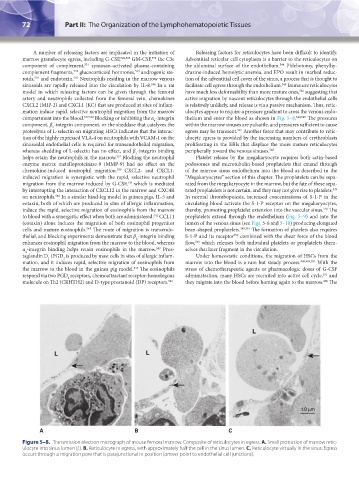
               compartment into the blood. 537,538  Blocking or inhibiting the α -integrin   thelium and enter the blood as shown in Fig. 5–8. 544,545  The pressures
                                                            4
               component, β -integrin component, or the sheddase that catalyzes the   within the marrow sinuses are pulsatile, and pressures sufficient to cause
                         2
               proteolysis of L-selectin on migrating HSCs indicates that the interac-  egress may be transient.  Another force that may contribute to retic-
                                                                                       547
               tion of the highly expressed VLA-4 on neutrophils with VCAM-1 on the   ulocyte egress is provided by the increasing numbers of erythroblasts
               sinusoidal endothelial cells is required for transendothelial migration,   proliferating in the EBIs that displace the more mature reticulocytes
               whereas shedding of L-selectin has no effect, and β -integrin binding   peripherally toward the venous sinuses. 548
                                                     2
                                               537
               helps retain the neutrophils in the marrow.  Blocking the neutrophil   Platelet release by  the  megakaryocyte  requires  both  actin-based
               enzyme matrix metalloproteinase-9 (MMP-9) had no effect on the   podosomes and microtubulin-based proplatelets that extend through
                                               538
               chemokine-induced neutrophil migration.  CXCL2- and CXCL1-   of the marrow sinus endothelium into the blood as described in the
               induced migration is synergistic with the rapid, selective neutrophil   “Megakaryocytes” section of this chapter. The proplatelets can be sepa-
                                                   539
               migration from the marrow induced by G-CSF,  which is mediated   rated from the megakaryocyte in the marrow, but the fate of these sepa-
                                                                                                                       549
               by interrupting the interaction of CXCL12 in the marrow and CXC4R   rated proplatelets is not certain, and they may not give rise to platelets.
               on neutrophils.  In a similar hind-leg model in guinea pigs, IL-5 and   In normal thrombopoiesis, increased concentrations of S-1-P in the
                          540
               eotaxin, both of which are produced in sites of allergic inflammation,   circulating blood activate the S-1-P receptor on the megakaryocytes,
               induce the rapid, selective migration of eosinophils from the marrow   thereby, promoting proplatelet extension into the vascular sinus.  The
                                                                                                                    550
                                                           541
               to blood with a synergistic effect when both are administered.  CCL11   proplatelets extend through the endothelium (Fig. 5–9) and into the
               (eotaxin) alone induces the migration of both eosinophil progenitor   lumen of the venous sinus (see Figs. 5-6 and 5–10) producing elongated
                                     541
               cells and mature eosinophils.  The route of migration is transendo-  bean-shaped proplatelets. 389,391  The formation of platelets also requires
                                                                                      550
               thelial, and blocking experiments demonstrate that β -integrin binding   S-1-P and its receptor  combined with the shear force of the blood
                                                     2
                                                                         549
               enhances eosinophil migration from the marrow to the blood, whereas   flow,  which releases both individual platelets or proplatelets them-
               α -integrin binding helps retain eosinophils in the marrow.  Pros-  selves that later fragment in the circulation.
                                                            542
                4
               taglandin D  (PGD  is produced by mast cells in sites of allergic inflam-  Under homeostatic conditions, the migration of HSCs from the
                             2
                        2
               mation, and it induces rapid, selective migration of eosinophils from   marrow into the blood is a rare but steady process. 408,409,551  With the
               the marrow to the blood in the guinea pig model.  The eosinophils   stress of chemotherapeutic agents or pharmacologic doses of G-CSF
                                                     543
               respond via two PGD  receptors, chemoattractant receptor-homologous   administration, many HSCs are recruited into active cell cycle,  and
                                                                                                                    551
                               2
               molecule on Th2 (CRHTH2) and D-type prostanoid (DP) receptors. 543  they migrate into the blood before homing again to the marrow.  The
                                                                                                                    408
                                                                                             L
                          L                              L


                                                                                                             1.0 µm


                     A                               B                               C
               Figure 5–8.  Transmission electron micrograph of mouse femoral marrow. Composite of reticulocytes in egress. A. Small protrusion of marrow retic-
               ulocyte into sinus lumen (L). B. Reticulocyte in egress, with approximately half the cell in the sinus lumen. C. Reticulocyte virtually in the sinus. Egress
               occurs through a migration pore that is parajunctional in position (arrows point to endothelial cell junctions).


          Kaushansky_chapter 05_p0051-0084.indd   72                                                                    9/19/15   12:11 AM

