


Page 99 - Williams Hematology ( PDFDrive )
P. 99
74  Part II:  The Organization of the Lymphohematopoietic Tissues  Chapter 5:  Structure of the Marrow and the Hematopoietic Microenvironment  75


                  mitochondrial apoptosis pathway in the homeostasis of the hematopoi-  without the involvement of the hematopoietic cytokines. HSC and their
                  etic cells populations in the marrow. 583,584  Antiapoptotic members of the   myeloid and lymphoid progeny have  multiple toll-like receptors (TLRs)
                  Bcl-2 family (Bcl-2, Bcl-X , Mcl-1, and A1) stabilize the mitochondrial   which bind specific bacterial or viral molecules. 596,597  The activation of
                                    L
                  membranes by preventing mitochondrial depolarization by the pore-  TLRs leads to increased myelopoietic proliferation and differentiation,
                                               585
                  forming family members, Bax and Bak.  The antiapoptotic members   especially of the monocyte/macrophage lineage, and differentiation
                  are also opposed by the proapoptotic, regulatory family members that   of lymphoid cells toward the dendritic cell phenotype. 596,598  Although
                  consist of the BH3-only domain, such as Bim, Bid, Nix, and Puma.  increased hematopoietic cytokines are produced by TLR activation, a
                     In HSC and multipotent progenitors, Mcl-1 is required to prevent   direct response to TLR activation in hematopoietic cells changes the
                  apoptosis, and SCF stimulation increases the Mcl-1 expression. 586,587    prevalent myeloid transcription factor from C/EBPα, which mediates
                  In the later stages of single-lineage progenitors, Mcl-1 continues to be   homeostasis by hematopoietic cytokines, to C/EBPβ, which mediates
                  required for survival of neutrophil and B and T lymphocytes, but it is   the emergency responses to TLR activation.  In response to the acti-
                                                                                                        599
                  antagonized by the expression of Bim and Puma in these progenitors,   vation of TLRs, mature neutrophils have decreased apoptosis as a result
                  providing a means to eliminate specific cells, such as autoreactive B and   of increased Mcl-1 and decreased Bad activity.  This may be a result
                                                                                                          600
                                                                   588
                  T lymphocytes. 583,584  A1 is required for normal neutrophil survival.    of direct ligation of TLR receptors on LT-HSC, ST-HSC, and MPP that
                  In the erythroid lineage, Bcl-X  is required to prevent apoptosis at   are then stimulated to secrete cytokines such as IL-6, GM-CSF, and
                                         L
                  the late erythroblast stage,  and the proapoptotic Nix protein is also   TNF-α. 601,602  An alternative path to apoptosis in hematopoietic cells is
                                     589
                         590
                  expressed.   The  sequential  proapoptotic  and  antiapoptotic  stimuli   the activation of specific death-domain receptors for the ligands such as
                  that regulate erythropoiesis demonstrate overlapping and cooperative   FAS ligand, TNF-α, and TRAIL (tumor necrosis factor–related apopto-
                  interactions that affect erythroid cell homeostasis by both survival and   sis-inducing ligand). Although these ligands are most commonly asso-
                  differentiation. Following moderate blood loss, an increased percent-  ciated with pathologic states where they may play a role in the anemias
                                                  552
                  age of HSC enter cell cycle and self-renewal.  In the BFU-E through   of chronic disease, they have also been proposed to have a regulatory
                  CFU-E  stages,  SCF  and  glucocorticoids  act  in  concert to  upregulate   role in normal erythropoiesis. 603
                  proliferation according to the erythropoietic requirements.  How-
                                                              591
                  ever, because CFU-E depends upon EPO, SCF and EPO act together,   REFERENCES
                                                                592
                  enhancing the proliferation and survival, respectively, of CFU-E.  EPO
                  prevents apoptosis of CFU-E through basophilic erythroblast stages by     1.  Neuman E: Ueber die Bedeutung des Knochenmarks für die Blutbildung. Cbl Med Wiss
                  decreasing Fas expression, 374,375  but its upregulation of Bcl-X  prevents   6:689, 1868.
                                                              L
                                                                   589
                  the apoptosis of the late-stage hemoglobin-producing erythroblasts.      2.  Bizzozero G: Sulla funzione ematopoietica del midollo delle ossa. Gazz Med Ital Lomb
                                                                           1:381, 1868.
                  Expression of proapoptotic Nix in very late erythroblasts and reticulo-    3.  Neuman E: Du Role de la möelle des os dans la formation du sang. C R Acad Sci Paris
                  cytes plays a major role in targeting mitochondria for nontoxic elimina-  68:1112, 1869.
                  tion by autophagy. 593,594                              4.  Mosler F: Klinische Symptome und Therapie der medullären Leukämie.  Berl Klin
                                                                           Wochenschr 49:701, 1876.
                     Various mathematical models have been constructed to explain     5.  Arinkin MJ: Die intravitale Untersuchungsmethodik des Knochenmarks. Folia Haema-
                  the production rates for each cell type during homeostasis and during   tol Int Mag Klin Morphol Blutforsch 38:233, 1929.
                  periods of increased and decreased production. A model of homeostatic     6.  Lajatha L: The common ancestral cell,  in Blood Pure and Eloquent, edited by M Win-
                                                                           trobe, p 81. McGraw-Hill, New York, 1980.
                  human marrow has been based upon marrow films and sections relating     7.  Erslev AJ: Feedback circuits in the control of stem cell differentiation.  Am J Pathol
                  differential counts of marrow samples to their content of injected radio-  65:629, 1971.
                  active iron. A number of assumptions and approximations are made,      8.  Trentin JJ: Determination of bone marrow stem cell differentiation by stromal hemo-
                                                                   595
                                                                           poietic inductive microenvironments (HIM). Am J Pathol 65:621, 1971.
                  but the summary data (Table 5–4) agree well with many other obser-    9.  Lemischka IR, Moore KA: Stem cells: Interactive niches. Nature 425:778, 2003.
                  vations on the cellular content and kinetics of normal marrows. Under     10.  Hackney JA, Charbord P, Brunk BP, et al: A molecular profile of a hematopoietic stem
                  pathologic conditions such as infection, inflammation, or hematopoi-  cell niche. Proc Natl Acad Sci U S A 99:13061, 2002.
                  etic  dysplasia, the  proliferation  and  differentiation  of  hematopoietic     11.  Zhang J, Niu C, Ye L, et al: Identification of the haematopoietic stem cell niche and
                                                                           control of the niche size. Nature 425:836, 2003.
                  progenitors may be affected by microbial products, cytokines, and cel-    12.  Calvi LM, Adams GB, Weibrecht KW, et al: Osteoblastic cells regulate the haematopoi-
                  lular interactions that do not have a role in normal hematopoietic devel-  etic stem cell niche. Nature 425:841, 2003.
                  opment. Infections, for example, can lead to increased myelopoiesis     13.  Weissman IL, Anderson DJ, Gage F: Stem and progenitor cells: Origins, phenotypes,
                                                                           lineage commitments, and transdifferentiations. Annu Rev Cell Dev Biol 17:387, 2001.
                                                                          14.  Dao MA, Arevalo J, Nolta JA: Reversibility of CD34 expression on human hemato-
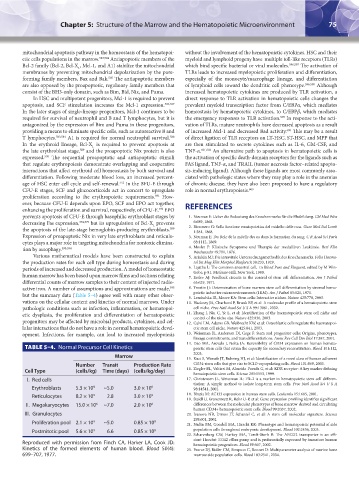
                   TABLE 5–4.  Normal Precursor Cell Kinetics              poietic stem cells that retain the capacity for secondary reconstitution. Blood 101:112,
                                                                           2003.
                                                 Marrow                   15.  Kuci S, Wessels JT, Buhring HJ, et al: Identification of a novel class of human adherent
                                    Number   Transit   Production Rate     CD34-stem cells that give rise to SCID-repopulating cells. Blood 101:869, 2003.
                   Cell Type        (cells/kg)  Time (days) (cells/kg/day)    16.  Ziegler BL, Valtieri M, Almeida-Porada G, et al: KDR receptor: A key marker defining
                                                                           hematopoietic stem cells. Science 285:1553, 1999.
                   I.  Red cells                                          17.  Christensen JL, Weissman IL: Flk-2 is a marker in hematopoietic stem cell differen-
                                                                           tiation: A simple method to isolate long-term stem cells. Proc Natl Acad Sci U S A
                     Erythroblasts  5.3 × 10 9  ~5.0   3.0 × 10 9          98:14541, 2001.
                     Reticulocytes  8.2 × 10 9  2.8    3.0 × 10 9         18.  Bhatia M: AC133 expression in human stem cells. Leukemia 15:1685, 2001.
                                                                          19.  Steidl U, Kronenwett R, Rohr U-P, et al: Gene expression profiling identifies significant
                   II.  Megakaryocytes  15.0 × 10 6  ~7.0  2.0 × 10 6      differences between the molecular phenotypes of bone marrow-derived and circulating
                                                                           human CD34+ hematopoietic stem cells. Blood 99:2037, 2002.
                   III.  Granulocytes                                     20.  Ivanova NB, Dimos JT, Schaniel C, et al: A stem cell molecular signature.  Science
                                                                           298:601, 2002.
                     Proliferation pool 2.1 × 10 9  ~5.0  0.85 × 10 9     21.  Nadin BM, Goodell MA, Hirschi KK: Phenotype and hematopoietic potential of side
                     Postmitotic pool  5.6 × 10 9  6.6  0.85 × 10 9        population cells throughout embryonic development. Blood 102:2436, 2003.
                                                                          22.  Scharenberg CW, Harkey MA, Torok-Storb B: The ABCG2 transporter is an effi-
                                                                           cient Hoechst 33342 efflux pump and is preferentially expressed by immature human
                  Reproduced with permission from Finch CA, Harker LA, Cook JD:   hematopoietic progenitors. Blood 99:507, 2002.
                  Kinetics of the formed elements of human blood.  Blood 50(4):     23.  Pearce DJ, Ridler CM, Simpson C, Bonnet D: Multiparameter analysis of murine bone
                  699–707, 1977.                                           marrow side population cells. Blood 103:2541, 2004.


          Kaushansky_chapter 05_p0051-0084.indd   75                                                                    9/19/15   12:11 AM

