


Page 951 - Williams Hematology ( PDFDrive )
P. 951
926            Part VII:  Neutrophils, Eosinophils, Basophils, and Mast Cells                                                         Chapter 60:  Structure and Composition of Neutrophils, Eosinophils, and Basophils            927


                                                                          The violet-colored granules seen with light microscopy in mature
                                                                      neutrophils on Wright-stained blood films are azurophilic granules
                                                                      whose staining characteristics altered during maturation (Fig. 60–7). There-
                                                                      fore, with light microscopy, the most reliable method for identifying
                                                                      azurophilic granules on blood films is staining the cells for peroxidase.
                                     Myeloblast                       The size of most of the peroxidase-negative granules (approximately 200
                                                                      nm) is at the limit of resolution of the light microscope. The granules
                                                                      cannot be distinguished individually but are responsible for the pink
                                                                      background color of neutrophil cytoplasm during and after the myelo-
                                                                      cyte stage.
                                                                          Peroxidase-negative granules are more numerous than peroxidase-
                                                                      positive granules during the myelocyte stage because peroxidase granule
                                    Promyelocyte                      formation ceases after the promyelocyte stage, the number of oxidase-
                                                                      positive granules per cell is reduced by mitoses, and peroxidase-negative gran-
                                                                      ules continue to be produced by each myelocyte generation. 1
                                                                          The purpose of nuclear segmentation is not known. Fluorescence
                                                                      in situ hybridization with chromosome-specific probes has shown that
                                                                                                                    6
                                                                      chromosomes are randomly distributed among the nuclear lobes.  Some
                                                                      mature neutrophils in women have drumstick- or club-shaped nuclear
                                   Early myelocytes
                                                                      appendages. These appendages contain the inactivated X chromosome.
                                                                      An X-chromosome–specific nucleic acid probe has confirmed the posi-
                                                                      tion of the X chromosomes in the drumstick structure of leukocyte
                                                                      nuclei by in situ hybridization. 7

                                   Late myelocytes
                                                                           NEUTROPHIL GRANULES

                                                                      The diversity of neutrophil granules appears to be linked to the timing
                                                                      of biosynthesis during myelopoiesis. The hypothesis is that the different
                                                                      subsets of granules are the result of differences in the biosynthetic win-
                                                                                                               7
                                   Metamyelocytes                     dows of the various granule proteins during maturation  and not the
                                                                      result of specific sorting between individual granule subsets (Chap. 66).
                                                                      The control of biosynthesis is exerted by transcription factors that con-
                                                                      trol the expression of the genes for the various granule proteins. Several
                                                                      transcription factors identified as important in the timing of granule
                                                                      protein synthesis, including the lineage-specific transcription factor
                                     Band stage
                                                                      GATA-1, the lineage-specific transcription factor PU.1, transcription
                                                                      factor for various hematologic lineages, AML1 (also known as runt-re-
                                                                      lated transcription factor 1 [RUNX1] or core-binding factor subunit
                                                                      alpha-2 [CBFA2]), AML2 (also known as RUNX3), and AML3 (also
                                                                      known as RUNX2 or CBFA1), and regulating factor of gene expres-
                                                                               7–9
                        Neutrophil   Eosinophil    Basophil           sion C/EBPε.  The importance of C/EBPε has been emphasized by the
                                                                      recognition of mutations in this protein in patients with the rare syn-
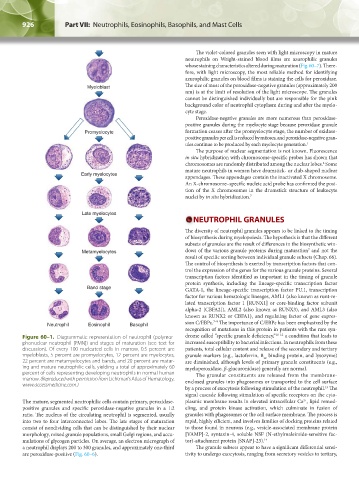
               Figure 60–1.  Diagrammatic representation of neutrophil (polymor-  drome called “specific granule deficiency,” 10–12  a condition that leads to
               phonuclear neutrophil [PMN]) and stages of maturation (see text for   increased susceptibility to bacterial infections. In neutrophils from these
               discussion). Of every 100 nucleated cells in marrow, 0.5 percent are   patients, total cellular content and release of the secondary and tertiary
               myeloblasts, 5 percent are promyelocytes, 12 percent are myelocytes,   granule markers (e.g., lactoferrin, B  binding protein, and lysozyme)
                                                                                                12
               22 percent are metamyelocytes and bands, and 20 percent are matur-  are diminished, although levels of primary granule constituents (e.g.,
               ing and mature neutrophilic cells, yielding a total of approximately 60   myeloperoxidase, β-glucuronidase) generally are normal.
               percent of cells representing developing neutrophils in normal human   The granular constituents are released from the membrane-
               marrow. (Reproduced with permission from Lichtman’s Atlas of Hematology.   enclosed granules into phagosomes or transported to the cell surface
               www.accessmedicine.com.)
                                                                      by a process of exocytosis following stimulation of the neutrophil.  The
                                                                                                                     13
                                                                      signal cascade following stimulation of specific receptors on the cyto-
                                                                                                              2+
               The mature, segmented neutrophilic cells contain primary, peroxidase-   plasmic membrane results in elevated intracellular Ca , lipid remod-
               positive granules and specific peroxidase-negative granules in a 1:2   eling, and protein kinase activation, which culminate in fusion of
               ratio. The nucleus of the circulating neutrophil is segmented, usually   granules with phagosomes or the cell surface membrane. The process is
               into  two  to  four  interconnected  lobes.  The  late  stages  of  maturation   rapid, highly efficient, and involves families of docking proteins related
               consist of nondividing cells that can be distinguished by their nuclear   to those found in neurons (e.g., vesicle-associated membrane protein
               morphology, mixed granule populations, small Golgi regions, and accu-  [VAMP]-2,  syntaxin-4, soluble  NSF  (N-ethylmaleimide-sensitive fac-
               mulations of glycogen particles. On average, an electron micrograph of   tor)-attachment protein [SNAP]-23). 14
               a neutrophil displays 200 to 300 granules, and approximately one-third   The granule subsets appear to have a significant differential sensi-
               are peroxidase-positive (Fig. 60–6).                   tivity to undergo exocytosis, ranging from secretory vesicles to tertiary,


          Kaushansky_chapter 60_p0923-0938.indd   926                                                                   9/18/15   10:34 PM

