


Page 952 - Williams Hematology ( PDFDrive )
P. 952
926  Part VII:  Neutrophils, Eosinophils, Basophils, and Mast Cells  Chapter 60:  Structure and Composition of Neutrophils, Eosinophils, and Basophils  927


                           A                                           B


                           C                                           D
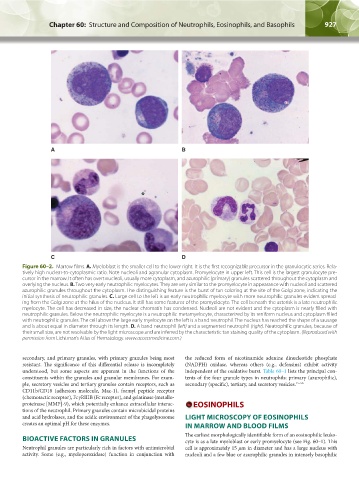
                  Figure 60–2.  Marrow films. A. Myeloblast is the smaller cell to the lower right. It is the first recognizable precursor in the granulocytic series. Rela-
                  tively high nuclear-to-cytoplasmic ratio. Note nucleoli and agranular cytoplasm. Promyelocyte in upper left. This cell is the largest granulocyte pre-
                  cursor in the marrow. It often has overt nucleoli, usually more cytoplasm, and azurophilic (primary) granules scattered throughout the cytoplasm and
                  overlying the nucleus. B. Two very early neutrophilic myelocytes. They are very similar to the promyelocyte in appearance with nucleoli and scattered
                  azurophilic granules throughout the cytoplasm. The distinguishing feature is the burst of tan coloring at the site of the Golgi zone, indicating the
                  initial synthesis of neutrophilic granules. C. Large cell to the left is an early neutrophilic myelocyte with more neutrophilic granules evident spread-
                  ing from the Golgi zone at the hilus of the nucleus. It still has some features of the promyelocyte. The cell beneath the asterisk is a late neutrophilic
                  myelocyte. The cell has decreased in size, the nuclear chromatin has condensed. Nucleoli are not evident and the cytoplasm is nearly filled with
                  neutrophilic granules. Below the neutrophilic myelocyte is a neutrophilic metamyelocyte, characterized by its reniform nucleus and cytoplasm filled
                  with neutrophilic granules. The cell above the large early myelocyte on the left is a band neutrophil. The nucleus has reached the shape of a sausage
                  and is about equal in diameter through its length. D. A band neutrophil (left) and a segmented neutrophil (right). Neutrophilic granules, because of
                  their small size, are not resolvable by the light microscope and are inferred by the characteristic tan staining quality of the cytoplasm. (Reproduced with
                  permission from Lichtman’s Atlas of Hematology. www.accessmedicine.com.)


                  secondary, and primary granules, with primary granules being most   the reduced form of nicotinamide adenine dinucleotide phosphate
                  resistant. The significance of this differential release is incompletely   (NADPH) oxidase, whereas others (e.g., defensins) exhibit activity
                  understood, but some  aspects are apparent in the  functions  of the   independent of the oxidative burst. Table 60–1 lists the principal con-
                  constituents within the granules and granular membranes. For exam-  tents of the four granule types in neutrophils: primary (azurophilic),
                  ple, secretory vesicles and tertiary granules contain receptors, such as   secondary (specific), tertiary, and secretory vesicles. 15–56
                  CD11b/CD18 (adhesion molecule, Mac-1), formyl peptide receptor
                  (chemotactic receptor), FcγRIIIB (Fc receptor), and gelatinase (metallo-
                  proteinase [MMP]-9), which potentially enhance extracellular interac-    EOSINOPHILS
                  tions of the neutrophil. Primary granules contain microbicidal proteins
                  and acid hydrolases, and the acidic environment of the phagolysosome   LIGHT MICROSCOPY OF EOSINOPHILS
                  creates an optimal pH for these enzymes.              IN MARROW AND BLOOD FILMS

                  BIOACTIVE FACTORS IN GRANULES                         The earliest morphologically identifiable form of an eosinophilic leuko-
                                                                        cyte is as a late myeloblast or early promyelocyte (see Fig. 60–1). This
                  Neutrophil granules are particularly rich in factors with antimicrobial   cell is approximately 15 µm in diameter and has a large nucleus with
                  activity. Some (e.g., myeloperoxidase) function in conjunction with   nucleoli and a few blue or azurophilic granules in intensely basophilic


          Kaushansky_chapter 60_p0923-0938.indd   927                                                                   9/18/15   10:34 PM

