


Page 1019 - Clinical Immunology_ Principles and Practice ( PDFDrive )
P. 1019
982          Part seven  Organ-Specific Inflammatory Disease


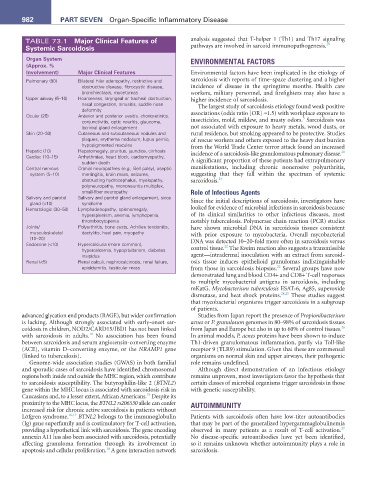
         TABLE 73.1  Major Clinical Features of                analysis suggested that T-helper 1 (Th1) and Th17 signaling
                                                                                                            19
         systemic sarcoidosis                                  pathways are involved in sarcoid immunopathogenesis.
          Organ system                                         ENVIRONMENTAL FACTORS
          (approx. %
          Involvement)     Major Clinical Features             Environmental factors have been implicated in the etiology of
          Pulmonary (90)   Bilateral hilar adenopathy, restrictive and   sarcoidosis with reports of time–space clustering and a higher
                            obstructive disease, fibrocystic disease,   incidence of disease in the springtime months. Health care
                            bronchiectasis, mycetomas          workers, military personnel, and firefighters may also have a
          Upper airway (5–10)  Hoarseness, laryngeal or tracheal obstruction,   higher incidence of sarcoidosis.
                            nasal congestion, sinusitis, saddle nose   The largest study of sarcoidosis etiology found weak positive
                            deformity
          Ocular (25)      Anterior and posterior uveitis, chorioretinitis,   associations (odds ratio [OR] ≈1.5) with workplace exposure to
                                                                                                    3
                            conjunctivitis, optic neuritis, glaucoma,   insecticides, mold, mildew, and musty odors.  Sarcoidosis was
                            lacrimal gland enlargement         not associated with exposure to heavy metals, wood dusts, or
          Skin (20–30)     Cutaneous and subcutaneous nodules and   rural residence, but smoking appeared to be protective. Studies
                            plaques, erythema nodosum, lupus pernio,   of rescue workers and others exposed to the heavy dust burden
                            hypopigmented macules              from the World Trade Center terror attack found an increased
          Hepatic (10)     Hepatomegaly, pruritus, jaundice, cirrhosis  incidence of a sarcoidosis-like granulomatous pulmonary disease.
                                                                                                                 20
          Cardiac (10–15)  Arrhythmias, heart block, cardiomyopathy,
                            sudden death                       A significant proportion of these patients had extrapulmonary
          Central nervous   Cranial neuropathies (e.g., Bell palsy), aseptic   manifestations, including chronic nonerosive polyarthritis,
           system (5–10)    meningitis, brain mass, seizures,   suggesting that they fall within the spectrum of systemic
                            obstructing hydrocephalus, myelopathy,   sarcoidosis. 21
                            polyneuropathy, mononeuritis multiplex,
                            small-fiber neuropathy             Role of Infectious Agents
          Salivary and parotid   Salivary and parotid gland enlargement, sicca
           gland (<10)      syndrome                           Since the initial descriptions of sarcoidosis, investigators have
          Hematologic (30–50)  Lymphadenopathy, splenomegaly,   looked for evidence of microbial infections in sarcoidosis because
                            hypersplenism, anemia, lymphopenia,   of its clinical similarities to other infectious diseases, most
                            thrombocytopenia                   notably tuberculosis. Polymerase chain reaction (PCR) studies
          Joints/          Polyarthritis, bone cysts, Achilles tendonitis,   have shown microbial DNA in sarcoidosis tissues consistent
           musculoskeletal   dactylitis, heel pain, myopathy   with prior exposure to mycobacteria. Overall mycobacterial
           (10–20)
          Endocrine (<10)  Hypercalciuria (more common),       DNA was detected 10–20-fold more often in sarcoidosis versus
                                                                          22
                            hypercalcemia, hypopituitarism, diabetes   control tissue.  The Kveim reaction also suggests a transmissible
                            insipidus                          agent—intradermal inoculation with an extract from sarcoid-
          Renal (<5)       Renal calculi, nephrocalcinosis, renal failure,   osis  tissue  induces  epithelioid  granulomas  indistinguishable
                                                                                            23
                            epididymitis, testicular mass      from those in sarcoidosis biopsies.  Several groups have now
                                                               demonstrated lung and blood CD4+ and CD8+ T-cell responses
                                                               to  multiple  mycobacterial  antigens  in  sarcoidosis,  including
                                                               mKatG, Mycobacterium tuberculosis ESAT-6, Ag85, superoxide
                                                               dismutase, and heat shock proteins. 24,25  These studies suggest
                                                               that mycobacterial organisms trigger sarcoidosis in a subgroup
                                                               of patients.
        advanced glycation end products (RAGE), but wider confirmation   Studies from Japan report the presence of Propionibacterium
        is lacking. Although strongly associated with early-onset sar-  acnes or P. granulosum genomes in 80–98% of sarcoidosis tissues
                                                                                                                 26
        coidosis in children, NOD2/CARD15/IBD1 has not been linked   from Japan and Europe but also in up to 60% of control tissues.
                              14
        with sarcoidosis in adults.  No association has been found   In animal models, P. acnes proteins have been shown to induce
        between sarcoidosis and serum angiotensin-converting enzyme   Th1-driven granulomatous inflammation, partly via Toll-like
        (ACE), vitamin D–converting enzyme, or the  NRAMP1 gene   receptor 9 (TLR9) stimulation. Given that these are commensal
        (linked to tuberculosis).                              organisms on normal skin and upper airways, their pathogenic
           Genome-wide association studies (GWAS) in both familial   role remains undefined.
        and sporadic cases of sarcoidosis have identified chromosomal   Although direct demonstration of an infectious etiology
        regions both inside and outside the MHC region, which contribute   remains unproven, most investigators favor the hypothesis that
        to sarcoidosis susceptibility. The butyrophilin-like 2 (BTNL2)   certain classes of microbial organisms trigger sarcoidosis in those
        gene within the MHC locus is associated with sarcoidosis risk in   with genetic susceptibility.
                                                 15
        Caucasians and, to a lesser extent, African Americans.  Despite its
        proximity to the MHC locus, the BTNL2 rs206530 allele can confer   AUTOIMMUNITY
        increased risk for chronic active sarcoidosis in patients without
        Löfgren syndrome. 16,17  BTNL2 belongs to the immunoglobulin   Patients  with  sarcoidosis  often have low-titer autoantibodies
        (Ig) gene superfamily and is costimulatory for T-cell activation,   that may be part of the generalized hypergammaglobulinemia
                                                                                                                 27
        providing a hypothetical link with sarcoidosis. The gene encoding   observed in many patients as a result of T-cell activation.
        annexin A11 has also been associated with sarcoidosis, potentially   No  disease-specific  autoantibodies  have yet  been  identified,
        affecting  granuloma formation through its  involvement  in   so it remains unknown whether autoimmunity plays a role in
                                    18
        apoptosis and cellular proliferation.  A gene interaction network   sarcoidosis.

