


Page 1023 - Clinical Immunology_ Principles and Practice ( PDFDrive )
P. 1023
986          Part seven  Organ-Specific Inflammatory Disease


                                                               Extrapulmonary Sarcoidosis
                                                               Most patients have clinically important involvement of more
                                                               than one organ, either with or without pulmonary sarcoidosis
                                                               (see Table 73.1).
                                                               Sarcoidosis of the Upper Respiratory Tract
                                                               Sarcoidosis can cause nasal congestion, crusting, epistaxis,
                                                               anosmia, rhinorrhea, sinusitis, or nasal septal perforation; a
                                                               “saddle nose” deformity, palatal perforation, or bone erosion
                                                               may occur. Laryngeal sarcoidosis occurs in 1–5% of patients,
                                                               with hoarseness, dysphonia, dysphagia, dyspnea, or, rarely, stridor
                                                               and acute respiratory failure.
                                                               Ocular Sarcoidosis
                                                               Unilateral or bilateral anterior uveitis is the most common
                                                               manifestation of ocular sarcoidosis, often in association with
                                                               bilateral hilar adenopathy. Chronic uveitis occurs in up to 20%
                                                               patients  with  chronic  sarcoidosis,  more  frequently  in  Black
                                                               populations. Other manifestations include posterior uveitis,
                                                               granulomatous conjunctivitis, severe chorioretinitis, or optic
                                                               neuritis that can cause blindness (Chapter 74).
                                                               Cutaneous Sarcoidosis
                                                               Erythema nodosum, which is a feature of Löfgren syndrome, may
                                                               recur. Chronic skin sarcoidosis usually manifests as nontender,
                                                               nonpruritic plaques and subcutaneous nodules around the hair-
                                                               line, eyelids, ears, nose, mouth, and the extensor surfaces of arms
                                                               and legs. Lupus pernio is a disfiguring form of facial cutaneous
                                                               sarcoidosis, with violaceous plaques and nodules covering the
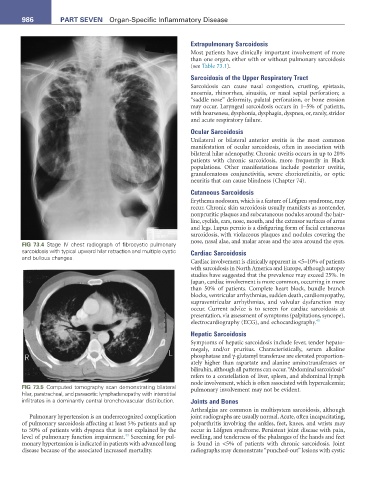
        FIG 73.4  Stage IV chest radiograph of fibrocystic pulmonary   nose, nasal alae, and malar areas and the area around the eyes.
        sarcoidosis with typical upward hilar retraction and multiple cystic   Cardiac Sarcoidosis
        and bullous changes.
                                                               Cardiac involvement is clinically apparent in <5–10% of patients
                                                               with sarcoidosis in North America and Europe, although autopsy
                                                               studies have suggested that the prevalence may exceed 25%. In
                                                               Japan, cardiac involvement is more common, occurring in more
                                                               than  50%  of patients.  Complete  heart  block,  bundle branch
                                                               blocks, ventricular arrhythmias, sudden death, cardiomyopathy,
                                                               supraventricular arrhythmias, and valvular dysfunction may
                                                               occur. Current advice is to screen for cardiac sarcoidosis at
                                                               presentation, via assessment of symptoms (palpitations, syncope),
                                                               electrocardiography (ECG), and echocardiography. 45
                                                               Hepatic Sarcoidosis
                                                               Symptoms of hepatic sarcoidosis include fever, tender hepato-
                                                               megaly, and/or pruritus. Characteristically, serum alkaline
                                                               phosphatase and γ-glutamyl transferase are elevated proportion-
                                                               ately  higher  than  aspartate  and  alanine  aminotransferases  or
                                                               bilirubin, although all patterns can occur. “Abdominal sarcoidosis”
                                                               refers to a constellation of liver, spleen, and abdominal lymph
                                                               node involvement, which is often associated with hypercalcemia;
        FIG 73.5  Computed tomography scan demonstrating bilateral   pulmonary involvement may not be evident.
        hilar, paratracheal, and paraaortic lymphadenopathy with interstitial
        infiltrates in a dominantly central bronchovascular distribution.   Joints and Bones
                                                               Arthralgias are common in multisystem sarcoidosis, although
           Pulmonary hypertension is an underrecognized complication   joint radiographs are usually normal. Acute, often incapacitating,
        of pulmonary sarcoidosis affecting at least 5% patients and up   polyarthritis involving the ankles, feet, knees, and wrists may
        to 50% of patients with dyspnea that is not explained by the   occur in Löfgren syndrome. Persistent joint disease with pain,
                                          44
        level of pulmonary function impairment.  Screening for pul-  swelling, and tenderness of the phalanges of the hands and feet
        monary hypertension is indicated in patients with advanced lung   is found in  <5% of patients with  chronic sarcoidosis.  Joint
        disease because of the associated increased mortality.  radiographs may demonstrate “punched-out” lesions with cystic

