


Page 1020 - Clinical Immunology_ Principles and Practice ( PDFDrive )
P. 1020
CHaPter 73  Sarcoidosis             983


           IMMUNOLOGY/PATHOGENESIS                                anergy. Subsequently, bronchoalveolar lavage (BAL) studies in
                                                                  pulmonary sarcoidosis showed that there were, in fact, enhanced
               KeY COnCePts                                       cell-mediated immune processes at sites of granulomatous
                                                                  inflammation with activated CD4 BAL lymphocytes. These BAL
            Immunopathogenesis of Sarcoidosis                     T cells are CD4  with a CD45RO  “memory” phenotype expressing
                                                                                          +
                                                                             +
                                                                  high levels of activation molecules DR and VLA-1 (very late
            •  Noncaseating epithelioid granulomas
            •  Genetic susceptibility primarily involving major histocompatibility   antigen-1, CD49a). Direct evidence that sarcoidosis is an antigen-
              complex (MHC) genes                                 driven disorder comes from studies of T-cell receptor (TCR)
            •  Oligoclonal expansion of T-cell receptor specific T cells consistent   gene expression. These studies document the expansion of
              with antigen-driven inflammation                    oligoclonal populations of T cells expressing specific α/β or γ/δ
            •  T-helper 1 (Th1) polarization at sites of disease  TCR in BAL, blood, or skin (Kveim biopsy). The most compelling
              •  Decrease  in regulatory  T-cell (Treg) function  contributes to  Th1-  data were derived from HLA-DRB1*03:01-positive Swedish
                mediated inflammation                                                                           +
              •  Potential role of interferon (IFN)-γ–expressing Th17.1 cells  patients who have greatly increased numbers of AV2S3  Th1
                                                                                                        +
              •  Potential role of classical Th17 effector cells  cells in the lung. The expanded oligoclonal αβ  T-cell subsets
            •  Etiology involves microbial triggers               in sarcoidosis often contain shared amino acid motifs in the
              •  Mycobacterial or propionibacterial organisms most commonly   CDR3 region of their Vβ or Vα/Jα genes, consistent with an
                implicated                                        antigen-driven T-cell response. The antigenic specificities of these
            •  Role  of  innate  immunity  in  macrophage  activation  and  granuloma   expanded T-cell clones remain to be identified.
              formation
            •  Progressive accumulation of serum amyloid A (SAA) within granulomas   Th1 Polarization in Sarcoidosis
              may drive chronic disease
              •  Nidus for granuloma formation                    T cells at sites of disease show a highly polarized Th1 cytokine
                                                                                                    29
              •  Feed-forward amplification of local Th1 responses in part through   profile at the time of diagnosis (Fig. 73.2).  BAL studies have
                Toll-like receptor 2 (TLR2)                       demonstrated expression of interferon-γ (IFN-γ) and tumor
                                                                  necrosis factor (TNF) in pulmonary sarcoidosis. Consistent with
                                                                  a polarized type 1 process, Th1-promoting cytokines interleukin-12
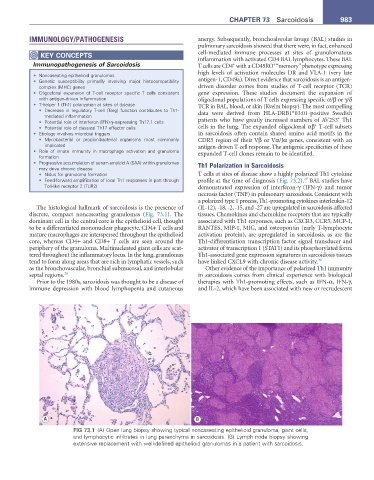
             The histological hallmark of sarcoidosis is the presence of   (IL-12), -18, -2, -15, and -27 are upregulated in sarcoidosis-affected
           discrete, compact noncaseating granulomas (Fig. 73.1). The   tissues. Chemokines and chemokine receptors that are typically
           dominant cell in the central core is the epithelioid cell, thought   associated with Th1 responses, such as CXCR3, CCR5, MCP-1,
           to be a differentiated mononuclear phagocyte. CD4+ T cells and   RANTES, MIP-1, MIG, and osteopontin (early T-lymphocyte
           mature macrophages are interspersed throughout the epithelioid   activation protein), are upregulated in sarcoidosis, as are the
           core, whereas CD4+ and CD8+ T cells are seen around the   Th1-differentiation transcription factor signal transducer and
           periphery of the granuloma. Multinucleated giant cells are scat-  activator of transcription 1 (STAT1) and its phosphorylated form.
           tered throughout the inflammatory locus. In the lung, granulomas   Th1-associated gene expression signatures in sarcoidosis tissues
           tend to form along areas that are rich in lymphatic vessels, such   have linked CXCL9 with chronic disease activity. 30
           as the bronchovascular, bronchial submucosal, and interlobular   Other evidence of the importance of polarized Th1 immunity
           septal regions. 28                                     in sarcoidosis comes from clinical experience with biological
             Prior to the 1980s, sarcoidosis was thought to be a disease of   therapies with Th1-promoting effects, such as IFN-α, IFN-γ,
           immune depression with blood lymphopenia and cutaneous   and IL-2, which have been associated with new or recrudescent


               A                                                 B
                         FIG 73.1  (A) Open lung biopsy showing typical noncaseating epithelioid granuloma, giant cells,
                         and lymphocytic infiltrates in lung parenchyma in sarcoidosis. (B) Lymph node biopsy showing
                         extensive replacement with well-defined epithelioid granulomas in a patient with sarcoidosis.

