


Page 1021 - Clinical Immunology_ Principles and Practice ( PDFDrive )
P. 1021
984          Part seven  Organ-Specific Inflammatory Disease


                                                                         Genetic/epigenetic +
                                                                         Genetic/epigenetic +
                                                  Mycobacterial infection
                                                  Mycobacterial infection  environmental factors
                                                                         environmental factors
                                                                    + +
                                1.  Innate response                2.  Induces hyperpolarized Th1
                                                                   2. Induces hyperpolarized Th1
                                1. Innate response

                                                                     response to pathogenic microbial Ags
                                  induces systemic and                 response to pathogenic microbial Ags
                                  induces systemic and
                                    intracellular SAA                  and SAA misfolding/aggregation
                                  intracellular SAA
                                                                     and SAA misfolding/aggregation
                                                SAA         mKatG
                                                SAA
                                                            mKatG
                                                                    MHC  TCR   SAA receptor
                                                                    MHC
                                                                        TCR
                                                                               SAA receptor
                                                                             T T
                                                             APC
                                                             APC
                                                                        IFNg
                                                   + +           TNFa   IFNg  ? ?
                                                                 TNFa
                                                                      + +
                                                                                  Treg
                                                                            IL10
                                                                            IL10  Treg
                               3.  Misfolded/aggregated SAA “seeds”    4.  SAA induces feed-forward
                               3. Misfolded/aggregated SAA “seeds”
                                                                       4. SAA induces feed-forward
                                   further SAA accumulation and            amplification of local Ag-specific
                                further SAA accumulation and
                                                                        amplification of local Ag-specific
                                   release of soluble SAA peptides       Th1 responses to trapped Ags
                                release of soluble SAA peptides

                                                                        Th1 responses to trapped Ags
                                           Inability to clear
                                           Inability to clear         Clearance ofClearance of
                                       SAA and Ags leads to chronic
                                       SAA and Ags leads to chronic   SAA and AgsSAA and Ags
                                         inflammation and fibrosis   allows remission
                                         inflammation and fibrosis
                                                                     allows remission
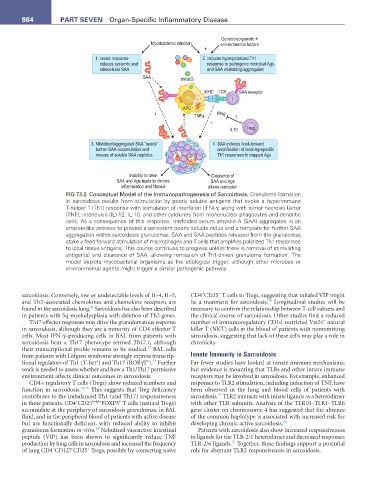
                       FIG 73.2  Conceptual Model of the Immunopathogenesis of Sarcoidosis. Granuloma formation
                       in sarcoidosis results from stimulation by poorly soluble antigens that evoke a hyperimmune
                       T-helper 1 (Th1) response with stimulation of interferon (IFN)-γ, along with tumor necrosis factor
                       (TNF), interleukin (IL)-12, IL-10, and other cytokines from mononuclear phagocytes and dendritic
                       cells. As a consequence of this response, misfolded serum amyloid A (SAA) aggregates in an
                       amyloid-like process to provide a persistent poorly soluble nidus and a template for further SAA
                       aggregation within sarcoidosis granulomas. SAA and SAA peptides released from the granulomas
                       stoke a feed-forward stimulation of macrophages and T cells that amplifies polarized Th1 responses
                       to local tissue antigens. This course continues to progress unless there is removal of stimulating
                       antigen(s)  and clearance  of  SAA,  allowing  remission  of  Th1-driven  granuloma  formation.  The
                       model depicts mycobacterial organisms as the etiological trigger, although other microbes or
                       environmental agents might trigger a similar pathogenic pathway.
                                                                        −
                                                                   +
        sarcoidosis. Conversely, low or undetectable levels of IL-4, IL-5,   CD4 CD25  T cells to Tregs, suggesting that inhaled VIP might
                                                                                         36
        and Th2-associated chemokines and chemokine receptors are   be  a  treatment  for  sarcoidosis.   Longitudinal  studies  will  be
                               31
        found in the sarcoidosis lung.  Sarcoidosis has also been described   necessary to confirm the relationship between T-cell subsets and
        in patients with 5q-myelodysplasia with deletion of Th2 genes.  the clinical course of sarcoidosis. Other studies find a reduced
                                                                                                           +
           Th17 effector responses may drive the granulomatous response   number of immunoregulatory CD1d-restricted Vα24  natural
        in sarcoidosis, although they are a minority of CD4 effector T   killer T (NKT) cells in the blood of patients with nonremitting
        cells. Most IFN-γ–producing cells in BAL from patients with   sarcoidosis, suggesting that lack of these cells may play a role in
        sarcoidosis bear a Th17 phenotype termed  Th17.1, although   chronicity.
                                                 32
        their transcriptional profile remains to be studied.  BAL cells
        from patients with Löfgren syndrome strongly express transcrip-  Innate Immunity in Sarcoidosis
                                 +
                                                 +
                                                   33
        tional regulators of Th1 (T-bet ) and Th17 (RORγT ).  Further   Far fewer studies have looked at innate immune mechanisms,
        work is needed to assess whether and how a Th1/Th17 permissive   but evidence is mounting that TLRs and other innate immune
        environment affects clinical outcomes in sarcoidosis.  receptors may be involved in sarcoidosis. For example, enhanced
           CD4+ regulatory T cells (Tregs) show reduced numbers and   responses to TLR2 stimulation, including induction of TNF, have
        function in sarcoidosis. 34,35  This suggests that Treg deficiency   been observed in the lung and blood cells of patients with
                                                                        37
        contributes to the imbalanced Th1 (and Th17) responsiveness   sarcoidosis.  TLR2 interacts with innate ligands as a heterodimer
                                        +
                          +
        in these patients. CD4 CD25 bright FOXP3  T cells (natural Tregs)   with other TLR subunits. Analysis of the TLR10–TLR1–TLR6
        accumulate at the periphery of sarcoidosis granulomas, in BAL   gene cluster on chromosome 4 has suggested that the absence
        fluid, and in the peripheral blood of patients with active disease   of the common haplotype is associated with increased risk for
        but are functionally deficient, with reduced ability to inhibit   developing chronic active sarcoidosis. 38
                                34
        granuloma formation in vitro.  Nebulized vasoactive intestinal   Patients with sarcoidosis also show increased responsiveness
        peptide (VIP) has been shown to significantly reduce TNF   to ligands for the TLR-2/1 heterodimer and decreased responses
                                                                             37
        production by lung cells in sarcoidosis and increased the frequency   TLR-2/6 ligands.  Together, these findings support a potential
                              +
                  +
                         -
        of lung CD4 CD127 CD25  Tregs, possibly by converting naïve   role for aberrant TLR2 responsiveness in sarcoidosis.

