


Page 1022 - Clinical Immunology_ Principles and Practice ( PDFDrive )
P. 1022
CHaPter 73  Sarcoidosis             985


             A major conceptual challenge in sarcoidosis is understanding
           how pulmonary fibrosis occurs in an environment dominated
           by IFN-γ, which is known to inhibit collagen synthesis. Alter-
           natively activated macrophages (M2) have been histologically
           associated with myofibrosis in biopsy specimens of muscular
                    39
           sarcoidosis.  Although an M2 macrophage phenotype is often
           associated with a Th2 cytokine environment (which has never
           been identified in sarcoidosis, even in late fibrotic disease), a
           fibrosis-promoting M2c macrophage phenotype could be induced
           by IL-10 or CCL18, which are present in sarcoidosis tissues. 40,41
           M2 macrophages can promote fibrocyte recruitment through
           the expression of transforming growth factor (TGF), CCL18,
           and CXCL12; M2 macrophages are also capable of differentiation
           to fibrocyte-like cells that express collagen. It remains unclear
           whether M2-like macrophages result from mechanisms inherent
           to sarcoidosis or from generalized wound-healing responses.
           Serum Amyloid A Aggregation Hypothesis
           Although sarcoidosis is associated with prior exposure to myco-
           bacterial or other microbial organisms, there is no clinical or
           pathological evidence of active infection or reactivation of latent
           microbial infection in sarcoidosis. This holds true in patients after
           years of corticosteroid, immunosuppressive, or anti-TNF therapy.
             The physicochemical properties of the Kveim reagent closely
           resemble those of amyloid or prion proteins. Serum amyloid A
           (SAA) can be detected in epithelioid macrophages in sarcoidosis.
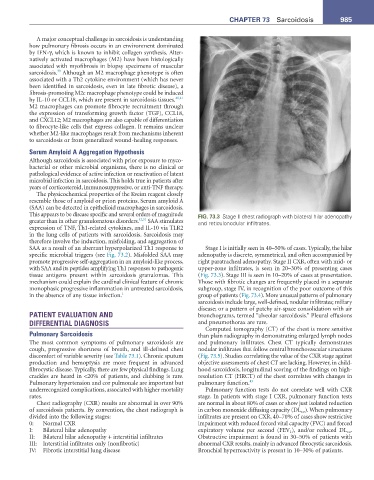
           This appears to be disease specific and several orders of magnitude   FIG. 73.3  Stage II chest radiograph with bilateral hilar adenopathy
           greater than in other granulomatous disorders. 42,51  SAA stimulates   and reticulonodular infiltrates.
           expression of TNF, Th1-related cytokines, and IL-10 via TLR2
           in the lung cells of patients with sarcoidosis. Sarcoidosis may
           therefore involve the induction, misfolding, and aggregation of
           SAA as a result of an aberrant hyperpolarized Th1 response to   Stage I is initially seen in 40–50% of cases. Typically, the hilar
           specific microbial triggers (see Fig. 73.2). Misfolded SAA may   adenopathy is discrete, symmetrical, and often accompanied by
           promote progressive self-aggregation in an amyloid-like process,   right paratracheal adenopathy. Stage II CXR, often with mid- or
           with SAA and its peptides amplifying Th1 responses to pathogenic   upper-zone infiltrates, is seen in 20–30% of presenting cases
           tissue antigens present within sarcoidosis granulomas. This   (Fig. 73.3). Stage III is seen in 10–20% of cases at presentation.
           mechanism could explain the cardinal clinical feature of chronic   Those with fibrotic changes are frequently placed in a separate
           monophasic progressive inflammation in untreated sarcoidosis,   subgroup, stage IV, in recognition of the poor outcome of this
           in the absence of any tissue infection. 1              group of patients (Fig. 73.4). More unusual patterns of pulmonary
                                                                  sarcoidosis include large, well-defined, nodular infiltrates; miliary
                                                                  disease; or a pattern of patchy air-space consolidation with air
           PATIENT EVALUATION AND                                 bronchograms, termed “alveolar sarcoidosis.” Pleural effusions
           DIFFERENTIAL DIAGNOSIS                                 and pneumothorax are rare.
                                                                    Computed tomography (CT) of the chest is more sensitive
           Pulmonary Sarcoidosis                                  than plain radiography in demonstrating enlarged lymph nodes
           The most common symptoms of pulmonary sarcoidosis are   and pulmonary infiltrates. Chest CT typically demonstrates
           cough,  progressive  shortness  of  breath,  and  ill-defined  chest   nodular infiltrates that follow central bronchovascular structures
           discomfort of variable severity (see Table 73.1). Chronic sputum   (Fig. 73.5). Studies correlating the value of the CXR stage against
           production and hemoptysis are more frequent in advanced   objective assessments of chest CT are lacking. However, in child-
           fibrocystic disease. Typically, there are few physical findings. Lung   hood sarcoidosis, longitudinal scoring of the findings on high-
           crackles are heard in <20% of patients, and clubbing is rare.   resolution CT (HRCT) of the chest correlates with changes in
           Pulmonary hypertension and cor pulmonale are important but   pulmonary function. 43
           underrecognized complications, associated with higher mortality   Pulmonary function tests do not correlate well with CXR
           rates.                                                 stage. In patients with stage I CXR, pulmonary function tests
             Chest radiography (CXR) results are abnormal in over 90%   are normal in about 80% of cases or show just isolated reduction
           of sarcoidosis patients. By convention, the chest radiograph is   in carbon monoxide diffusing capacity (DL co ). When pulmonary
           divided into the following stages:                     infiltrates are present on CXR, 40–70% of cases show restrictive
           0:   Normal CXR                                        impairment with reduced forced vital capacity (FVC) and forced
           I:   Bilateral hilar adenopathy                        expiratory volume per second (FEV 1 ), and/or reduced DL co .
           II:   Bilateral hilar adenopathy + interstitial infiltrates  Obstructive impairment is found in 30–50% of patients with
           III:  Interstitial infiltrates only (nonfibrotic)      abnormal CXR results, mainly in advanced fibrocystic sarcoidosis.
           IV:  Fibrotic interstitial lung disease                Bronchial hyperreactivity is present in 10–30% of patients.

