


Page 1026 - Clinical Immunology_ Principles and Practice ( PDFDrive )
P. 1026
CHaPter 73  Sarcoidosis             989


             The intensity of surveillance of sarcoidosis depends on the   ALTERNATIVE CYTOTOXIC THERAPIES
           severity of clinical presentation. When sarcoidosis undergoes
           remission, the disease rarely recurs; exceptions often involve   Corticosteroid-sparing therapies are frequently used for chronic,
           neurological or ocular manifestations. No biomarkers have been   progressive sarcoidosis when corticosteroid adverse effects sig-
           found to be useful in management decisions.            nificantly degrade quality of life. 2,47,48  Low-dose weekly methotrex-
                                                                  ate (10–20 mg/week) is recommended for pulmonary, cardiac,
           TREATMENT                                              ocular (panuveitis), cutaneous, and neurological sarcoidosis
                                                                  requiring higher doses of corticosteroids. Success rates range
                                                                  from 50% to 70%, but it may take ≥6 months to be effective.
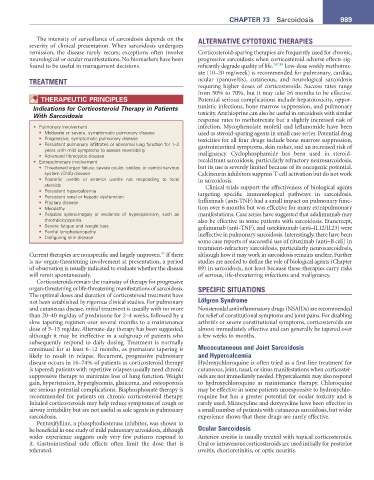
               tHeraPeUtIC PrInCIPLes                             Potential serious complications include hepatotoxicity, oppor-
            Indications for Corticosteroid Therapy in Patients    tunistic infections, bone marrow suppression, and pulmonary
            With Sarcoidosis                                      toxicity. Azathioprine can also be useful in sarcoidosis with similar
                                                                  response rates to methotrexate but a slightly increased risk of
            •  Pulmonary involvement                              infection. Mycophenolate mofetil and leflunomide have been
              •  Moderate or severe, symptomatic pulmonary disease  used as steroid-sparing agents in small case series. Potential drug
              •  Progressive, symptomatic pulmonary disease       toxicities for all four drugs include bone marrow suppression,
              •  Persistent pulmonary infiltrates or abnormal lung function for 1–2   gastrointestinal symptoms, skin rashes, and an increased risk of
                years with mild symptoms to assess reversibility
              •  Advanced fibrocystic disease                     malignancy. Cyclophosphamide has been used in steroid-
            •  Extrapulmonary involvement                         recalcitrant sarcoidosis, particularly refractory neurosarcoidosis,
              •  Threatened organ failure: severe ocular, cardiac, or central nervous   but its use is severely limited because of its oncogenic potential.
                system (CNS) disease                              Calcineurin inhibitors suppress T-cell activation but do not work
              •  Posterior  uveitis or anterior uveitis not  responding to local   in sarcoidosis.
                steroids                                            Clinical trials support the effectiveness of biological agents
              •  Persistent hypercalcemia
              •  Persistent renal or hepatic dysfunction          targeting  specific  immunological  pathways  in  sarcoidosis.
              •  Pituitary disease                                Infliximab (anti-TNF) had a small impact on pulmonary func-
              •  Myopathy                                         tion over 6 months but was effective for many extrapulmonary
              •  Palpable  splenomegaly  or  evidence  of  hypersplenism,  such  as   manifestations. Case series have suggested that adalimumab may
                thrombocytopenia                                  also be effective in some patients with sarcoidosis. Etanercept,
              •  Severe fatigue and weight loss                   golimumab (anti-TNF), and ustekinumab (anti–IL12/IL23) were
              •  Painful lymphadenopathy                          ineffective in pulmonary sarcoidosis. Interestingly, there have been
              •  Disfiguring skin disease
                                                                  some case reports of successful use of rituximab (anti–B cell) in
                                                                  treatment-refractory sarcoidosis, particularly neurosarcoidosis,
                                                      47
           Current therapies are nonspecific and largely unproven.  If there   although how it may work in sarcoidosis remains unclear. Further
           is no organ-threatening involvement at presentation, a period   studies are needed to define the role of biological agents (Chapter
           of observation is usually indicated to evaluate whether the disease   89) in sarcoidosis, not least because these therapies carry risks
           will remit spontaneously.                              of serious, life-threatening infections and malignancy.
             Corticosteroids remain the mainstay of therapy for progressive
           organ-threatening or life-threatening manifestations of sarcoidosis.   SPECIFIC SITUATIONS
           The optimal doses and duration of corticosteroid treatment have
           not been established by rigorous clinical studies. For pulmonary   Löfgren Syndrome
           and cutaneous disease, initial treatment is usually with no more   Nonsteroidal antiinflammatory drugs (NSAIDs) are recommended
           than 20–40 mg/day of prednisone for 2–4 weeks, followed by a   for relief of constitutional symptoms and joint pains. For disabling
           slow tapering regimen over several months to a maintenance   arthritis or severe constitutional symptoms, corticosteroids are
           dose of 5–15 mg/day. Alternate-day therapy has been suggested,   almost immediately effective and can generally be tapered over
           although it may be ineffective in a subgroup of patients who   a few weeks to months.
           subsequently respond to daily dosing. Treatment is normally
           continued for at least 6–12 months, as premature tapering is   Mucocutaneous and Joint Sarcoidosis
           likely  to  result  in  relapse.  Recurrent,  progressive  pulmonary   and Hypercalcemia
           disease occurs in 16–74% of patients as corticosteroid therapy   Hydroxychloroquine is often tried as a first-line treatment for
           is tapered; patients with repetitive relapses usually need chronic   cutaneous, joint, nasal, or sinus manifestations when corticoster-
           suppressive therapy to minimize loss of lung function. Weight   oids are not immediately needed. Hypercalcemia may also respond
           gain, hypertension, hyperglycemia, glaucoma, and osteoporosis   to hydroxychloroquine as maintenance therapy. Chloroquine
           are serious potential complications. Bisphosphonate therapy is   may be effective in some patients unresponsive to hydroxychlo-
           recommended for patients on chronic corticosteroid therapy.   roquine but has a greater potential for ocular toxicity and is
           Inhaled corticosteroids may help reduce symptoms of cough or   rarely used. Minocycline and doxycycline have been effective in
           airway irritability but are not useful as sole agents in pulmonary   a small number of patients with cutaneous sarcoidosis, but wider
           sarcoidosis.                                           experience shows that these drugs are rarely effective.
             Pentoxifylline, a phosphodiesterase inhibitor, was shown to
           be beneficial in one study of mild pulmonary sarcoidosis, although   Ocular Sarcoidosis
           wider experience suggests only very few patients respond to    Anterior uveitis is usually treated with topical corticosteroids.
           it. Gastrointestinal side effects often limit the dose that is   Oral or intravenous corticosteroids are used initially for posterior
           tolerated.                                             uveitis, chorioretinitis, or optic neuritis.

