


Page 1038 - Clinical Immunology_ Principles and Practice ( PDFDrive )
P. 1038
CHaPter 74  Immunological Ocular Disease               1001


           present clinically. The findings from one study, however, do   The cornea is divided into five layers: the epithelium facing
           support screening patients with scleritis with serological tests to   the atmosphere, Bowman membrane, the stroma, Descemet
                   46
           detect RA.  Similarly, systemic lupus erythematosus (SLE) can   membrane, and the endothelium abutting the aqueous humor.
           be associated with scleritis, but one would not diagnose SLE on   Opacification of the stroma is known as  interstitial keratitis.
           the basis of a positive ANA result, scleritis, and the absence of   Congenital syphilis and other infections, such as herpes simplex,
           other findings to suggest SLE.  An erythrocyte sedimentation   are important causes of the latter. Cogan syndrome is defined
           rate (ESR) can sometimes be helpful in ensuring that a systemic   as an autoimmune disease of the eighth nerve combined with
                                                                                                              47
           process is not present. Other laboratory tests are largely dictated   interstitial keratitis, presumably on an autoimmune basis.  Some
           by the medication that is chosen to treat the scleritis.  ophthalmologists also recognize autoimmune eighth-nerve disease
                                                                  associated with other forms of ocular inflammation, such as
           KERATITIS                                              uveitis, as examples of Cogan syndrome. The pathogenesis of
                                                                  Cogan syndrome is presumed to be a vasculitis, and many patients
           The cornea is the anteriorly situated window to the eye. Normally,   will  have  evidence  for  vasculitis  elsewhere  in  the  body.  The
           it should be clear. It can become opacified as a result of trauma,   treatment usually requires aggressive use of systemic immunosup-
           exposure to toxins, infection, dryness, calcium deposition, or   pressive medications.
           genetic diseases, such as corneal dystrophies. The three main
           immune-mediated diseases that affect the cornea are peripheral   CORNEAL TRANSPLANTATION AND
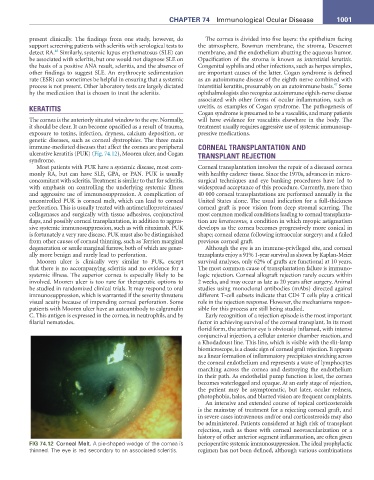
           ulcerative keratitis (PUK) (Fig. 74.12), Mooren ulcer, and Cogan   TRANSPLANT REJECTION
           syndrome.
             Most patients with PUK have a systemic disease, most com-  Corneal transplantation involves the repair of a diseased cornea
           monly RA, but can have SLE, GPA, or PAN. PUK is usually   with healthy cadaver tissue. Since the 1970s, advances in micro-
           concomitant with scleritis. Treatment is similar to that for scleritis,   surgical techniques and eye banking procedures have led to
           with  emphasis  on  controlling  the  underlying  systemic  illness   widespread acceptance of this procedure. Currently, more than
           and aggressive use of immunosuppression. A complication of   40 000 corneal transplantations are performed annually in the
           uncontrolled PUK is corneal melt, which can lead to corneal   United States alone. The usual indication for a full-thickness
           perforation. This is usually treated with antimetalloproteinases/  corneal graft is poor vision from deep stromal scarring. The
           collagenases and surgically with tissue adhesives, conjunctival   most common medical conditions leading to corneal transplanta-
           flaps, and possibly corneal transplantation, in addition to aggres-  tion are keratoconus, a condition in which myopic astigmatism
           sive systemic immunosuppression, such as with rituximab. PUK   develops as the cornea becomes progressively more conical in
           is fortunately a very rare disease. PUK must also be distinguished   shape; corneal edema following intraocular surgery; and a failed
           from other causes of corneal thinning, such as Terrien marginal   previous corneal graft.
           degeneration or senile marginal furrow, both of which are gener-  Although the eye is an immune-privileged site, and corneal
           ally more benign and rarely lead to perforation.       transplants enjoy a 91% 1-year survival as shown by Kaplan-Meier
             Mooren ulcer is clinically very similar to PUK, except   survival analyses, only 62% of grafts are functional at 10 years.
           that there is no accompanying scleritis and no evidence for a   The most common cause of transplantation failure is immuno-
           systemic illness. The superior cornea is especially likely to be   logic rejection. Corneal allograft rejection rarely occurs within
           involved. Mooren ulcer is too rare for therapeutic options to   2 weeks, and may occur as late as 20 years after surgery. Animal
           be studied in randomized clinical trials. It may respond to oral   studies using monoclonal antibodies (mAbs) directed against
           immunosuppression, which is warranted if the severity threatens   different T-cell subsets indicate that CD4 T cells play a critical
           visual acuity because of impending corneal perforation. Some   role in the rejection response. However, the mechanisms respon-
           patients with Mooren ulcer have an autoantibody to calgranulin   sible for this process are still being studied.
           C. This antigen is expressed in the cornea, in neutrophils, and by     Early recognition of a rejection episode is the most important
           filarial nematodes.                                    factor in achieving survival of the corneal transplant. In its most
                                                                  florid form, the anterior eye is obviously inflamed, with intense
                                                                  conjunctival injection, a cellular anterior chamber reaction, and
                                                                  a Khodadoust line. This line, which is visible with the slit-lamp
                                                                  biomicroscope, is a classic sign of corneal graft rejection. It appears
                                                                  as a linear formation of inflammatory precipitates stretching across
                                                                  the corneal endothelium and represents a wave of lymphocytes
                                                                  marching across the cornea and destroying the endothelium
                                                                  in their path. As endothelial pump function is lost, the cornea
                                                                  becomes waterlogged and opaque. At an early stage of rejection,
                                                                  the patient may be asymptomatic, but later, ocular redness,
                                                                  photophobia, halos, and blurred vision are frequent complaints.
                                                                    An intensive and extended course of topical corticosteroids
                                                                  is the mainstay of treatment for a rejecting corneal graft, and
                                                                  in severe cases intravenous and/or oral corticosteroids may also
                                                                  be administered. Patients considered at high risk of transplant
                                                                  rejection, such as those with corneal neovascularization or a
                                                                  history of other anterior segment inflammation, are often given
           FIG 74.12  Corneal Melt. A pie-shaped wedge of the cornea is   perioperative systemic immunosuppression. The ideal prophylactic
           thinned. The eye is red secondary to an associated scleritis.   regimen has not been defined, although various combinations

