


Page 1035 - Clinical Immunology_ Principles and Practice ( PDFDrive )
P. 1035
998          Part seven  Organ-Specific Inflammatory Disease


                   29
        have arthritis ; and 7% of patients with psoriasis and arthritis
        have uveitis. The diagnosis of psoriatic arthritis is made clinically
        with the typical findings of cutaneous changes (erythematous,
        hyperkeratotic rash) and joint disease. Patients with sacroiliac
        disease and psoriatic arthritis are especially likely to develop
        uveitis.
        Sarcoidosis-Associated Uveitis
        Ocular disease is the initial manifestation of sarcoidosis (Chapter
        73) in 20% of patients. The systemic illness begins as ocular
        inflammation almost as often as it initially presents as pulmonary
        disease. Of the patients with sarcoidosis, 25–50% exhibit ocular
        inflammation during the course of the illness. In most series,
        sarcoidosis accounts for 3–10% of all patients with uveitis, second
        to spondyloarthropathy as the most common systemic illness
        associated with uveitis in North  America and Europe. The
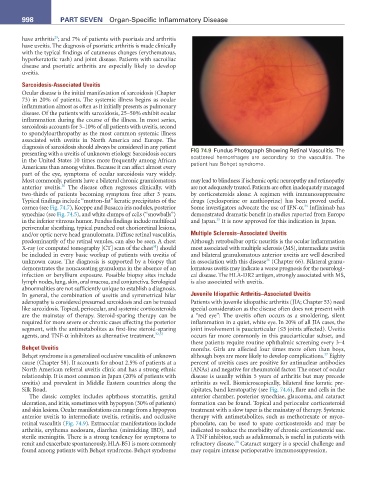
        diagnosis of sarcoidosis should always be considered in any patient   FIG 74.9  Fundus Photograph Showing Retinal Vasculitis. The
        presenting with a uveitis of unknown etiology. Sarcoidosis occurs   scattered hemorrhages are secondary to the vasculitis. The
        in the United States 10 times more frequently among African   patient has Behçet syndrome.
        Americans than among whites. Because it can affect almost every
        part of the eye, symptoms of ocular sarcoidosis vary widely.
        Most commonly, patients have a bilateral chronic granulomatous   may lead to blindness if ischemic optic neuropathy and retinopathy
                     30
        anterior uveitis.  The disease often regresses clinically, with   are not adequately treated. Patients are often inadequately managed
        two-thirds of patients becoming symptom free after 3 years.   by corticosteroids alone:  A regimen with immunosuppressive
        Typical findings include “mutton-fat” keratic precipitates of the   drugs (cyclosporine or azathioprine) has been proved useful.
                                                                                                     34
        cornea (see Fig. 74.7), Koeppe and Busacca iris nodules, posterior   Some investigators advocate the use of IFN-α.  Infliximab has
        synechiae (see Fig. 74.5), and white clumps of cells (“snowballs”)   demonstrated dramatic benefit in studies reported from Europe
                                                                        35
        in the inferior vitreous humor. Fundus findings include multifocal   and Japan.  It is now approved for this indication in Japan.
        perivenular sheathing, typical punched out chorioretinal lesions,
        and/or optic nerve head granulomata. Diffuse retinal vasculitis,   Multiple Sclerosis–Associated Uveitis
        predominantly of the retinal venules, can also be seen. A chest   Although retrobulbar optic neuritis is the ocular inflammation
                                                   31
        X-ray (or computed tomography [CT] scan of the chest ) should   most associated with multiple sclerosis (MS), intermediate uveitis
        be included in every basic workup of patients with uveitis of   and bilateral granulomatous anterior uveitis are well described
                                                                                        36
        unknown cause. The diagnosis is supported by a biopsy that   in association with this disease  (Chapter 66). Bilateral granu-
        demonstrates the noncaseating granuloma in the absence of an   lomatous uveitis may indicate a worse prognosis for the neurologi-
        infection or beryllium exposure. Possible biopsy sites include   cal disease. The HLA-DR2 antigen, strongly associated with MS,
        lymph nodes, lung, skin, oral mucosa, and conjunctiva. Serological   is also associated with uveitis.
        abnormalities are not sufficiently unique to establish a diagnosis.
        In general, the combination of uveitis and symmetrical hilar   Juvenile Idiopathic Arthritis–Associated Uveitis
        adenopathy is considered presumed sarcoidosis and can be treated   Patients with juvenile idiopathic arthritis (JIA; Chapter 53) need
        like sarcoidosis. Topical, periocular, and systemic corticosteroids   special consideration as the disease often does not present with
        are the mainstay of therapy. Steroid-sparing therapy can be   a “red eye”: The uveitis often occurs as a smoldering, silent
        required for more severe or chronic cases affecting the posterior   inflammation in a quiet, white eye. In 20% of all JIA cases, the
        segment, with the antimetabolites as first-line steroid-sparing   joint involvement is pauciarticular (≤5 joints affected). Uveitis
        agents, and TNF-α inhibitors as alternative treatment. 32,33  occurs far more commonly in this pauciarticular subset, and
                                                               these patients require routine ophthalmic screening every 3–4
        Behçet Uveitis                                         months. Girls are affected four times more often than boys,
                                                                                                           37
        Behçet syndrome is a generalized occlusive vasculitis of unknown   although boys are more likely to develop complications.  Eighty
        cause (Chapter 58). It accounts for about 2.5% of patients at a   percent of uveitis cases are positive for antinuclear antibodies
        North American referral uveitis clinic and has a strong ethnic   (ANAs) and negative for rheumatoid factor. The onset of ocular
        relationship. It is most common in Japan (20% of patients with   disease is usually within 5 years of arthritis but may precede
        uveitis) and prevalent in Middle Eastern countries along the   arthritis as well. Biomicroscopically, bilateral fine keratic pre-
        Silk Road.                                             cipitates, band keratopathy (see Fig. 74.6), flare and cells in the
           The classic complex includes aphthous stomatitis, genital   anterior chamber, posterior synechiae, glaucoma, and cataract
        ulceration, and iritis, sometimes with hypopyon (30% of patients)   formation can be found. Topical and periocular corticosteroid
        and skin lesions. Ocular manifestations can range from a hypopyon   treatment with a slow taper is the mainstay of therapy. Systemic
        anterior uveitis to intermediate uveitis, retinitis, and occlusive   therapy with antimetabolites, such as methotrexate or myco-
        retinal vasculitis (Fig. 74.9). Extraocular manifestations include   phenolate, can be used to spare corticosteroids and may be
        arthritis, erythema nodosum, diarrhea (mimicking IBD), and   indicated to reduce the morbidity of chronic corticosteroid use.
        sterile meningitis. There is a strong tendency for symptoms to   A TNF inhibitor, such as adalimumab, is useful in patients with
                                                                              38
        remit and exacerbate spontaneously. HLA-B51 is more commonly   refractory disease.  Cataract surgery is a special challenge and
        found among patients with Behçet syndrome. Behçet syndrome   may require intense perioperative immunosuppression.

