


Page 1034 - Clinical Immunology_ Principles and Practice ( PDFDrive )
P. 1034
CHaPter 74  Immunological Ocular Disease                997


           Prevention and Patient Management
           Uveitis can be the first sign of systemic disease (e.g., sarcoidosis,
           syphilis,  or  central  nervous  system  [CNS]  lymphoma).  It  is
           essential to identify the cause of uveitis as accurately as possible.
           A targeted approach is preferable, with a limited workup guided
           by the type and severity of uveitis and the presence of systemic
           findings. The history is of great importance. The minimal workup
           for uveitis of unknown etiology requires an extensive and careful
           review of systems, a syphilis serology, and a chest X-ray. 15
             Most practitioners use a stepladder approach to treat uveitis.
           The first step is corticosteroids for all patients with noninfectious
           uveitis (topical, especially for anterior uveitis, regional injection,
           or systemic administration). A surgically implantable intravitreal
           device to release fluocinolone for approximately 2.5 years is an
           option that  is limited by cost and  complications,  which can
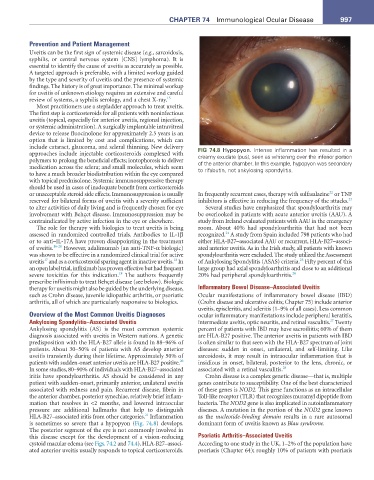
           include cataract, glaucoma, and scleral thinning. New delivery   FIG 74.8  Hypopyon. Intense inflammation has resulted in a
           approaches include injectable corticosteroids complexed with   creamy exudate (pus), seen as whitening over the inferior portion
           polymers to prolong the beneficial effects; iontophoresis to deliver   of the anterior chamber. In this example, hypopyon was secondary
           medication across the sclera; and small molecules, which seem   to rifabutin, not ankylosing spondylitis.
           to have a much broader biodistribution within the eye compared
           with topical prednisolone. Systemic immunosuppressive therapy
           should be used in cases of inadequate benefit from corticosteroids
                                                                                                             22
           or unacceptable steroid side effects. Immunosuppression is usually   In frequently recurrent cases, therapy with sulfasalazine  or TNF
           reserved for bilateral forms of uveitis with a severity sufficient   inhibitors is effective in reducing the frequency of the attacks. 23
           to alter activities of daily living and is frequently chosen for eye   Several studies have emphasized that spondyloarthritis may
           involvement with Behçet disease. Immunosuppression may be   be overlooked in patients with acute anterior uveitis (AAU). A
           contraindicated by active infection in the eye or elsewhere.  study from Ireland evaluated patients with AAU in the emergency
             The role for therapy with biologics to treat uveitis is being   room.  About 40% had spondyloarthritis that had not been
                                                                           24
           assessed in randomized controlled trials. Antibodies to IL-1β   recognized.  A study from Spain included 798 patients who had
           or to anti–IL-17A have proven disappointing in the treatment   either HLA-B27–associated AAU or recurrent, HLA-B27–associ-
           of uveitis. 16-20  However, adalimumab (an anti-TNF-α biologic)   ated anterior uveitis. As in the Irish study, all patients with known
           was shown to be effective in a randomized clinical trial for active   spondyloarthritis were excluded. The study utilized the Assessment
                                                          18
                                                                                                   25
               17
           uveitis  and as a corticosteroid sparing agent in inactive uveitis.  In   of Ankylosing Spondylitis (ASAS) criteria.  Fifty percent of this
           an open label trial, infliximab has proven effective but had frequent   large group had axial spondyloarthritis and close to an additional
                                        19
           severe  toxicities  for  this  indication.   The  authors  frequently   20% had peripheral spondyloarthritis. 26
           prescribe infliximab to treat Behçet disease (see below). Biologic
           therapy for uveitis might also be guided by the underlying disease,   Inflammatory Bowel Disease–Associated Uveitis
           such as Crohn disease, juvenile idiopathic arthritis, or psoriatic   Ocular manifestations of inflammatory bowel disease (IBD)
           arthritis, all of which are particularly responsive to biologics.  (Crohn disease and ulcerative colitis; Chapter 75) include anterior
                                                                  uveitis, episcleritis, and scleritis (1–9% of all cases). Less common
           Overview of the Most Common Uveitis Diagnoses          ocular inflammatory manifestations include peripheral keratitis,
           Ankylosing Spondylitis–Associated Uveitis              intermediate uveitis, optic neuritis, and retinal vasculitis.  Twenty
                                                                                                             27
           Ankylosing  spondylitis  (AS)  is  the  most  common  systemic   percent of patients with IBD may have sacroiliitis; 60% of them
           diagnosis associated with uveitis in Western nations. A genetic   are HLA-B27 positive. The anterior uveitis in patients with IBD
           predisposition with the HLA-B27 allele is found in 88–96% of   is often similar to that seen with the HLA-B27 spectrum of joint
           patients. About 30–50% of patients with AS develop anterior   diseases: sudden in onset, unilateral, and self-limiting. Like
           uveitis transiently during their lifetime. Approximately 50% of   sarcoidosis, it may result in intraocular inflammation that is
                                                            20
           patients with sudden-onset anterior uveitis are HLA-B27 positive.    insidious in onset, bilateral, posterior to the lens, chronic, or
           In some studies, 80–90% of individuals with HLA-B27–associated   associated with a retinal vasculitis. 28
           iritis have spondyloarthritis. AS should be considered in any   Crohn disease is a complex genetic disease—that is, multiple
           patient with sudden-onset, primarily anterior, unilateral uveitis   genes contribute to susceptibility. One of the best characterized
           associated with redness and pain. Recurrent disease, fibrin in   of these genes is NOD2. This gene functions as an intracellular
           the anterior chamber, posterior synechiae, relatively brief inflam-  Toll-like receptor (TLR) that recognizes muramyl dipeptide from
           mation that resolves in  <2 months, and lowered intraocular   bacteria. The NOD2 gene is also implicated in autoinflammatory
           pressure are additional hallmarks that help to distinguish   diseases. A mutation in the portion of the NOD2 gene known
                                                21
           HLA-B27–associated iritis from other categories.  Inflammation   as the  nucleotide-binding domain results in a rare autosomal
           is sometimes so severe that a hypopyon (Fig. 74.8) develops.   dominant form of uveitis known as Blau syndrome.
           The posterior segment of the eye is not commonly involved in
           this disease except for the development of a vision-reducing   Psoriatic Arthritis–Associated Uveitis
           cystoid macular edema (see Figs. 74.2 and 74.4). HLA-B27–associ-  According to one study in the UK, 1–2% of the population have
           ated anterior uveitis usually responds to topical corticosteroids.   psoriasis (Chapter 64); roughly 10% of patients with psoriasis

