


Page 1037 - Clinical Immunology_ Principles and Practice ( PDFDrive )
P. 1037
1000         Part seven  Organ-Specific Inflammatory Disease


        manifestation of infection, such as herpes zoster ophthalmicus,   In choosing to treat with oral corticosteroid or an immunosup-
        syphilis, Lyme disease, tuberculosis, or other bacterial and fungal   pressive, the clinician will, of course, weigh the risk/benefit ratio.
        infections.                                            The rationale for aggressive therapy is much stronger if the disease
                                                               is bilateral and is affecting activities of daily living, because of
        Immunology and Pathology                               pain or reduction in acuity.
        Biopsy of the sclera entails some risk. Accordingly, many of the
        published histological observations are based on end-stage or
        extremely severe disease. In one pathology study of 55 examples    CLInICaL PearL
        of necrotizing scleritis, the histology was divided into four types:   Although noninfectious scleritis may be considered a vasculitis of the
        zonal necrotizing granulomatous scleritis; nonzonal diffuse   deep episcleral vessels, oral nonsteroidal antiinflammatory drugs (NSAIDs)
        scleritis; necrotizing scleritis with microabscesses; and sarcoidal   are effective in its treatment, and when the disease is refractory, oral
                            41
        granulomatous scleritis.  Eighty-five percent of patients with   corticosteroids, antimetabolites, or biologics can be quite effective.
        zonal necrotizing granulomatous pathology had a systemic disease,
        usually rheumatoid arthritis. The pathology associated with RA
        was not distinct from other systemic diseases, such as GPA. None   Evaluation and Differential Diagnosis
        of 19 patients with nonzonal diffuse scleral inflammation had   Patients with scleritis generally have characteristic findings that
        a systemic disease. Just over half the patients with microabscesses   allow an accurate diagnosis; scleritis can usually be readily
        had an identifiable infection as the cause of scleritis. Only one   distinguished from other causes of a red, painful eye. The most
        patient had “sarcoidal granulomatous inflammation,” and that   difficult distinction is between scleritis and episcleritis. The
        patient had sarcoidosis.                               differences between scleritis and episcleritis are highlighted in
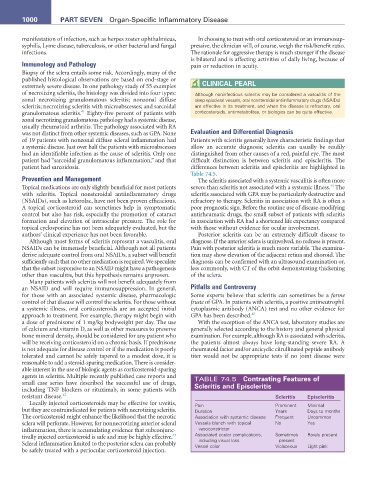
                                                               Table 74.5.
        Prevention and Management                                 The scleritis associated with a systemic vasculitis is often more
                                                                                                             44
        Topical medications are only slightly beneficial for most patients   severe than scleritis not associated with a systemic illness.  The
        with  scleritis.  Topical  nonsteroidal  antiinflammatory  drugs   scleritis associated with GPA may be particularly destructive and
        (NSAIDs), such as ketorolac, have not been proven efficacious.   refractory to therapy. Scleritis in association with RA is often a
        A topical corticosteroid can sometimes help in symptomatic   poor prognostic sign. Before the routine use of disease-modifying
        control but also has risk, especially the promotion of cataract   antirheumatic drugs, the small subset of patients with scleritis
        formation and elevation of intraocular pressure. The role for   in association with RA had a shortened life expectancy compared
        topical cyclosporine has not been adequately evaluated, but the   with those without evidence for ocular involvement.
        authors’ clinical experience has not been favorable.      Posterior scleritis can be an extremely difficult disease to
           Although most forms of scleritis represent a vasculitis, oral   diagnose. If the anterior sclera is uninvolved, no redness is present.
        NSAIDs can be immensely beneficial. Although not all patients   Pain with posterior scleritis is much more variable. The examina-
        derive adequate control from oral NSAIDs, a subset will benefit   tion may show elevation of the adjacent retina and choroid. The
        sufficiently such that no other medication is required. We speculate   diagnosis can be confirmed with an ultrasound examination or,
        that the subset responsive to an NSAID might have a pathogenesis   less commonly, with CT of the orbit demonstrating thickening
        other than vasculitis, but this hypothesis remains unproven.  of the sclera.
           Many patients with scleritis will not benefit adequately from
        an NSAID and will require immunosuppression. In  general,   Pitfalls and Controversy
        for those with an associated systemic disease, pharmacologic   Some experts believe that scleritis can sometimes be a forme
        control of that disease will control the scleritis. For those without   fruste of GPA. In patients with scleritis, a positive antineutrophil
        a systemic illness, oral corticosteroids are an accepted initial   cytoplasmic antibody (ANCA) test and no other evidence for
        approach to treatment. For example, therapy might begin with   GPA has been described. 45
        a dose of prednisone of 1 mg/kg bodyweight per day. The use   With the exception of the ANCA test, laboratory studies are
        of calcium and vitamin D, as well as other measures to preserve   generally selected according to the history and general physical
        bone mineral density, should be considered for any patient who   examination. For example, although RA is associated with scleritis,
        will be receiving corticosteroid on a chronic basis. If prednisone   the patients almost always have long-standing severe RA.  A
        is not adequate for disease control or if the medication is poorly   rheumatoid factor and/or anticyclic citrullinated peptide antibody
        tolerated and cannot be safely tapered to a modest dose, it is   titer would not be appropriate tests if no joint disease were
        reasonable to add a steroid-sparing medication. There is consider-
        able interest in the use of biologic agents as corticosteroid-sparing
        agents in scleritis. Multiple recently published case reports and   TABLE 74.5  Contrasting Features of
        small case series have described the successful use of drugs,   scleritis and episcleritis
        including  TNF  blockers or  rituximab, in  some  patients  with
        resistant disease. 42                                                              scleritis  episcleritis
           Locally injected corticosteroids may be effective for uveitis,   Pain           Prominent  Minimal
        but they are contraindicated for patients with necrotizing scleritis.   Duration   Years      Days to months
        The corticosteroid might enhance the likelihood that the necrotic   Association with systemic disease  Frequent  Uncommon
        sclera will perforate. However, for nonnecrotizing anterior scleral   Vessels blanch with topical   No  Yes
        inflammation, there is accumulating evidence that subconjunc-  vasoconstrictor
                                                         43
        tivally injected corticosteroid is safe and may be highly effective.    Associated ocular complications,   Sometimes   Rarely present
                                                                  including visual loss
                                                                                            present
        Scleral inflammation limited to the posterior sclera can probably   Vessel color   Violaceous  Light pink
        be safely treated with a periocular corticosteroid injection.

