


Page 1072 - Clinical Immunology_ Principles and Practice ( PDFDrive )
P. 1072
ChaPTEr 77  Immunotherapy of Cancer               1037


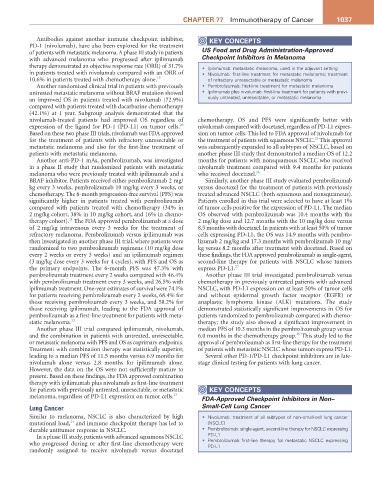
             Antibodies  against  another  immune  checkpoint  inhibitor,    KEY CONCEPTS
           PD-1 (nivolumab), have also been explored for the treatment
           of patients with metastatic melanoma. A phase III study in patients   US Food and Drug Administration-Approved
           with advanced melanoma who progressed after ipilimumab   Checkpoint Inhibitors in Melanoma
           therapy demonstrated an objective response rate (ORR) of 31.7%   •  Ipilimumab: metastatic melanoma, used in the adjuvant setting
           in patients treated with nivolumab compared with an ORR of   •  Nivolumab: first-line treatment for metastatic melanoma; treatment
           10.6% in patients treated with chemotherapy alone. 19     of refractory unresectable or metastatic melanoma
             Another randomized clinical trial in patients with previously   •  Pembrolizumab: first-line treatment for metastatic melanoma
           untreated metastatic melanoma without BRAF mutation showed   •  Ipilimumab plus nivolumab: first-line treatment for patients with previ-
           an improved OS in patients treated with nivolumab (72.9%)   ously untreated, unresectable, or metastatic melanoma
           compared with patients treated with dacarbazine chemotherapy
           (42.1%) at 1 year. Subgroup analysis demonstrated that the
           nivolumab-treated patients had improved OS regardless of   chemotherapy. OS and PFS were significantly better with
                                                            20
           expression of the ligand for PD-1 (PD-L1) on tumor cells.    nivolumab compared with docetaxel, regardless of PD-L1 expres-
           Based on these two phase III trials, nivolumab was FDA approved   sion on tumor cells. This led to FDA approval of nivolumab for
                                                                                                        25
           for the treatment of patients with refractory unresectable or   the treatment of patients with squamous NSCLC.  This approval
           metastatic melanoma and also for the first-line treatment of   was subsequently expanded to all subtypes of NSCLC, based on
           patients with metastatic melanoma.                     another phase III study that demonstrated a median OS of 12.2
             Another anti-PD-1 mAs, pembrolizumab, was investigated   months for patients with nonsquamous NSCLC who received
           in a phase II study that randomized patients with metastatic   nivolumab treatment compared with 9.4 months for patients
           melanoma who were previously treated with ipilimumab and a   who received docetaxel. 26
           BRAF inhibitor. Patients received either pembrolizumab 2 mg/  Similarly, another phase III study evaluated pembrolizumab
           kg every 3 weeks, pembrolizumab 10 mg/kg every 3 weeks, or   versus docetaxel for the treatment of patients with previously
           chemotherapy. The 6-month progression-free survival (PFS) was   treated advanced NSCLC (both squamous and nonsquamous).
           significantly higher in patients treated with pembrolizumab   Patients enrolled in this trial were selected to have at least 1%
           compared  with  patients  treated  with  chemotherapy  (34%  in   of tumor cells positive for the expression of PD-L1. The median
           2 mg/kg cohort, 38% in 10 mg/kg cohort, and 16% in chemo-  OS observed with pembrolizumab was 10.4 months with the
                        21
           therapy cohort).  The FDA approved pembrolizumab at a dose   2 mg/kg dose and 12.7 months with the 10 mg/kg dose versus
           of 2 mg/kg intravenous every 3 weeks for the treatment of   8.5 months with docetaxel. In patients with at least 50% of tumor
           refractory melanoma. Pembrolizumab versus ipilimumab was   cells expressing PD-L1, the OS was 14.9 months with pembro-
           then investigated in another phase III trial, where patients were   lizumab 2 mg/kg and 17.3 months with pembrolizumab 10 mg/
           randomized to two pembrolizumab regimens (10 mg/kg dose   kg versus 8.2 months after treatment with docetaxel. Based on
           every 2 weeks or every 3 weeks) and an ipilimumab regimen   these findings, the FDA approved pembrolizumab as single-agent,
           (3 mg/kg dose every 3 weeks for 4 cycles), with PFS and OS as   second-line therapy for patients with NSCLC whose tumors
           the primary endpoints. The 6-month PFS was 47.3% with   express PD-L1. 27
           pembrolizumab treatment every 2 weeks compared with 46.4%   Another phase III trial investigated pembrolizumab versus
           with pembrolizumab treatment every 3 weeks, and 26.5% with   chemotherapy in previously untreated patients with advanced
           ipilimumab treatment. One-year estimates of survival were 74.1%   NSCLC, with PD-L1 expression on at least 50% of tumor cells
           for patients receiving pembrolizumab every 2 weeks, 68.4% for   and without epidermal growth factor receptor (EGFR) or
           those receiving pembrolizumab every 3 weeks, and 58.2% for   anaplastic lymphoma  kinase  (ALK)  mutations.  The  study
           those receiving ipilimumab, leading to the FDA approval of   demonstrated statistically significant improvements in OS for
           pembrolizumab as a first-line treatment for patients with meta-  patients randomized to pembrolizumab compared with chemo-
           static melanoma. 22                                    therapy; the study also showed a significant improvement in
             Another phase III trial compared ipilimumab, nivolumab,   median PFS of 10.3 months in the pembrolizumab group versus
                                                                                                  28
           and the combination in patients with untreated, unresectable,   6.0 months in the chemotherapy group.  This study led to the
           or metastatic melanoma with PFS and OS as coprimary endpoints.   approval of pembrolizumab as first-line therapy for the treatment
           Treatment with combination therapy was statistically superior,   of patients with metastatic NSCLC whose tumors express PD-L1.
           leading to a median PFS of 11.5 months versus 6.9 months for   Several other PD-1/PD-L1 checkpoint inhibitors are in late-
           nivolumab alone versus 2.8 months for ipilimumab alone.   stage clinical testing for patients with lung cancer.
           However, the data on the OS were not sufficiently mature to
           present. Based on these findings, the FDA approved combination
           therapy with ipilimumab plus nivolumab as first-line treatment
           for patients with previously untreated, unresectable, or metastatic    KEY CONCEPTS
           melanoma, regardless of PD-L1 expression on tumor cells. 23  FDA-Approved Checkpoint Inhibitors in Non–
           Lung Cancer                                             Small-Cell Lung Cancer
           Similar to melanoma, NSCLC is also characterized by high   •  Nivolumab: treatment of all subtypes of non–small-cell lung cancer
                        24
           mutational load,  and immune checkpoint therapy has led to   (NSCLC)
           durable antitumor response in NSCLC.                    •  Pembrolizumab: single-agent, second-line therapy for NSCLC expressing
             In a phase III study, patients with advanced squamous NSCLC   PD-L1
           who progressed during or after first-line chemotherapy were   •  Pembrolizumab first-line therapy for metastatic NSCLC expressing
                                                                     PD-L1
           randomly assigned to receive nivolumab versus docetaxel

