


Page 1071 - Clinical Immunology_ Principles and Practice ( PDFDrive )
P. 1071
1036         ParT EighT  Immunology of Neoplasia


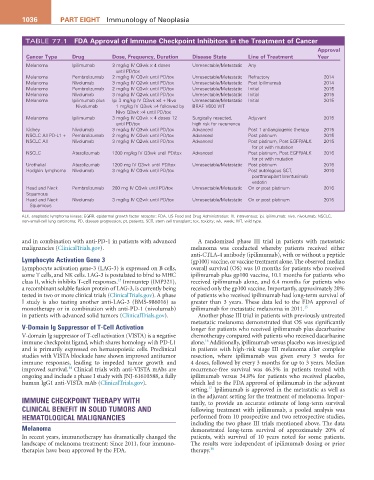
         TABLE 77.1  FDa approval of immune Checkpoint inhibitors in the Treatment of Cancer
                                                                                                         approval
          Cancer Type    Drug         Dose, Frequency, Duration  Disease State    Line of Treatment      Year
          Melanoma       Ipilimumab   3 mg/kg IV Q3wk × 4 doses    Unresectable/Metastatic  Any
                                       until PD/tox
          Melanoma       Pembrolizumab  2 mg/kg IV Q3wk until PD/tox  Unresectable/Metastatic  Refractory  2014
          Melanoma       Nivolumab    3 mg/kg IV Q2wk until PD/tox  Unresectable/Metastatic  Post ipilimumab  2014
          Melanoma       Pembrolizumab  2 mg/kg IV Q3wk until PD/tox  Unresectable/Metastatic  Initial     2015
          Melanoma       Nivolumab    3 mg/kg IV Q2wk until PD/tox  Unresectable/Metastatic  Initial       2015
          Melanoma       Ipilimumab plus   Ipi 3 mg/kg IV Q3wk ×4 + Nivo   Unresectable/Metastatic  Initial  2015
                          Nivolumab    1 mg/kg IV Q3wk ×4 followed by   BRAF V600 WT
                                       Nivo Q3wk ×4 until PD/tox
          Melanoma       Ipilimumab   3 mg/kg IV Q3wk × 4 doses 12   Surgically resected,  Adjuvant        2015
                                       until PD/tox             high risk for recurrence
          Kidney         Nivolumab    3 mg/kg IV Q3wk until PD/tox  Advanced      Post 1 antiangiogenic therapy  2015
          NSCLC All PD-L1 +  Pembrolizumab  2 mg/kg IV Q3wk until PD/tox  Advanced  Post platinum          2015
          NSCLC All      Nivolumab    3 mg/kg IV Q2wk until PD/tox  Advanced      Post platinum, Post EGFR/ALK   2015
                                                                                   for pt with mutation
          NSCLC          Atezolizumab  1200 mg/kg IV Q3wk until PD/tox  Advanced  Post platinum, Post EGFR/ALK   2016
                                                                                   for pt with mutation
          Urothelial     Atezolizumab  1200 mg IV Q3wk until PD/tox  Unresectable/Metastatic  Post platinum  2016
          Hodgkin lymphoma  Nivolumab  3 mg/kg IV Q3wk until PD/tox               Post autologous SCT,     2016
                                                                                   posttransplant brentuximab
                                                                                   vedotin
          Head and Neck  Pembrolizumab  200 mg IV Q3wk until PD/tox  Unresectable/Metastatic  On or post platinum  2016
          Squamous
          Head and Neck   Nivolumab   3 mg/kg IV Q2wk until PD/tox  Unresectable/Metastatic  On or post platinum  2016
           Squamous

        ALK, anaplastic lymphoma kinase; EGFR, epidermal growth factor receptor; FDA, US Food and Drug Administration; IV, intravenous; ipi, ipilimumab; nivo, nivolumab; NSCLC,
        non–small-cell lung carcinoma; PD, disease progression; pt, patients; SCT, stem cell transplant; tox, toxicity; wk, week; WT, wild type.


        and in combination with anti-PD-1 in patients with advanced   A randomized phase III trial in patients with metastatic
        malignancies (ClinicalTrials.gov).                     melanoma was conducted whereby patients received either
                                                               anti-CTLA-4 antibody (ipilimumab), with or without a peptide
        Lymphocyte Activation Gene 3                           (gp100) vaccine, or vaccine treatment alone. The observed median
        Lymphocyte activation gene-3 (LAG-3) is expressed on B cells,   overall survival (OS) was 10 months for patients who received
        some T cells, and NK cells. LAG-3 is postulated to bind to MHC   ipilimumab plus gp100 vaccine, 10.1 months for patients who
                                        13
        class II, which inhibits T-cell responses.  Immuntep (IMP321),   received ipilimumab alone, and 6.4 months for patients who
        a recombinant soluble fusion protein of LAG-3, is currently being   received only the gp100 vaccine. Importantly, approximately 20%
        tested in two or more clinical trials (ClinicalTrials.gov). A phase   of patients who received ipilimumab had long-term survival of
        I  study is  also  testing  another  anti-LAG-3  (BMS-986016)  as   greater than 3 years. These data led to the FDA approval of
        monotherapy or in combination with anti-PD-1 (nivolumab)   ipilimumab for metastatic melanoma in 2011. 15
        in patients with advanced solid tumors (ClinicalTrials.gov).  Another phase III trial in patients with previously untreated
                                                               metastatic melanoma demonstrated that OS was significantly
        V-Domain Ig Suppressor of T-Cell Activation            longer for patients who received ipilimumab plus dacarbazine
        V-domain Ig suppressor of T-cell activation (VISTA) is a negative   chemotherapy compared with patients who received dacarbazine
                                                                    16
        immune checkpoint ligand, which shares homology with PD-L1   alone.  Additionally, ipilimumab versus placebo was investigated
        and is primarily expressed on hematopoietic cells. Preclinical   in patients with high-risk stage III melanoma after complete
        studies with VISTA blockade have shown improved antitumor   resection, where ipilimumab was given every 3 weeks for
        immune responses, leading to impeded tumor growth and   4 doses, followed by every 3 months for up to 3 years. Median
                       14
        improved survival.  Clinical trials with anti-VISTA mAbs are   recurrence-free survival was 46.5% in patients treated with
        ongoing and include a phase I study with JNJ-61610588, a fully   ipilimumab versus 34.8% for patients who received placebo,
        human IgG1 anti-VISTA mAb (ClinicalTrials.gov).        which led to the FDA approval of ipilimumab in the adjuvant
                                                                     17
                                                               setting.  Ipilimumab is approved in the metastatic as well as
        IMMUNE CHECKPOINT THERAPY WITH                         in the adjuvant setting for the treatment of melanoma. Impor-
                                                               tantly, to provide an accurate estimate of long-term survival
        CLINICAL BENEFIT IN SOLID TUMORS AND                   following  treatment  with  ipilimumab,  a  pooled  analysis  was
        HEMATOLOGICAL MALIGNANCIES                             performed from 10 prospective and two retrospective studies,
                                                               including the two phase III trials mentioned above. The data
        Melanoma                                               demonstrated long-term survival of approximately 20% of
        In recent years, immunotherapy has dramatically changed the   patients, with survival of 10 years noted for some patients.
        landscape of melanoma treatment: Since 2011, four immuno-  The results were independent of ipilimumab dosing or prior
        therapies have been approved by the FDA.               therapy. 18

