


Page 1086 - Clinical Immunology_ Principles and Practice ( PDFDrive )
P. 1086
1050         ParT EighT  Immunology of Neoplasia


                                                               often contains a translocation that fuses the E2A(TCF3) gene
        Immunological and Molecular Classification of ALL      on chromosome 19 with the PBX1 gene on chromosome 1.
        Immunological Classification                              Leukemic cells that express both cytoplasmic and surface Ig
        ALL subtypes are typically identified by their immunophenotype.   heavy chains have been designated transitional preB-cell ALL.
        They are positioned by the lymphoid developmental stage at   The surface µ chains on these leukemic cells are noncovalently
        which the leukemic cell appears to have been arrested (Table 78.1).  associated with surrogate light chain (VpreB λ5[λ14.1]), CD79a,
                                                               and CD79b.
        B-Cell Precursor Leukemias
        B-cell precursor ALLs are the most common childhood leukemias.
        ProB-cell ALL is characterized by expression of CD19 and CD34    CLiNiCaL PEarLS
        without CD10. This is the most common leukemia of infants   Mature Versus Precursor B-Cell Acute
        that  contains  rearrangements  of  the  MLL(KMT2A)  gene  on   Lymphoblastic Leukemia (ALL)
        chromosome 11q23. It is associated with a poor outcome.
           Leukemic blast cells of early preB-cell ALL resemble normal   Since the treatment of mature B-cell leukemia (the leukemic form of
        B-lymphoid  cell  precursors.  They  express  CD19,  CD22,  and   Burkitt lymphoma) is vastly different from the treatment of B-cell precursor
                                                                 ALL, it is critical to distinguish between the two. Burkitt leukemia is
        CD79a. CD10 and terminal deoxynucleotidyl transferase (TdT)   characterized by mature B-cell phenotype and by the presence of
        are detectable in 90% of cases. CD34 is detected in >75% of   chromosomal translocations involving the cMyc gene (Chapter 79).
        cases. Early preB-cell ALL is the most prevalent type of ALL and
        is thus often called “common ALL” (cALL).
           In  preB-cell ALL lymphoblasts accumulate cytoplasmic   Mature B-cell ALL is the leukemic form of Burkitt lymphoma
        immunoglobulin (Ig) heavy chains but have no detectable surface   (Chapter 79). As treatment is dramatically different from that
        Igs. This subtype also expresses CD19, CD22, and CD79a. It   for B-cell precursor ALL, this subtype must be specifically ruled
                                                               out as part of the immunophenotypic evaluation of ALL. Mature
                                                               B-cell ALL cells express surface Ig µ heavy chains in association
                                                               with  either  κ  or  λ  light  chains. In  most  cases,  cells  have  L3
                                        2  hit                 morphology and express CD19, CD22, and CD20. CD10 and
                                         nd
                  st
                 1  hit             mutation in cell of   ALL  CD23 are frequently expressed, whereas CD34 is absent.
                                    transformed clone
                                                               T-Cell ALL
                                                               T-cell ALL is more prevalent in less affluent countries, which is
                                                               likely a reflection of a lower incidence of the common B-lineage
                                                               early childhood peak. In affluent countries, T-cell ALL occurs in
                                latent period                  10–15% of children with ALL. It is also more common in adults.
                                                               In many treatment protocols, T-cell ALL is considered to have
                                                               a less favorable prognosis compared with B-cell precursor ALL.
                                                                  In T-cell ALL, the cells express surface CD7 and cytoplasmic
          -9 months               Birth       3 years          CD3 (cCD3) antigens. More than 90% of the T lymphoblasts
        Fig 78.1  A Model for the Development of Childhood Acute   express CD2, CD5, and TdT. Three stages of immunophenotypic
                                                                                                    +
                                                                                                           +
        Lymphoblastic Leukemia (ALL). The first acquired genomic   differentiation can be determined: early (CD7 , cCD3 , surface
                                                                                                                 −
                                                                         −
                                                                                  −
                                                                                                     +
                                                                   −
        hit (e.g., chromosomal translocation or change in chromosomal   CD3 , CD4 , and CD8 ), intermediate (cCD3 , surface CD3 ,
                                                                                                             −
                                                                   +
                                                                                  +
                                                                                                       +
                                                                         +
        copy number) occurs during fetal hematopoiesis and results in   CD4 , CD8 , and CD1 ), and late (surface CD3 , CD1 , and
                                                                        +
                                                                                +
        clonal proliferation of a preleukemic clone. This event is common,   either CD4  or CD8 ). However, immunophenotype does not
        occurring in up to one in every 20 children. Additional genetic   conform to any of these maturation stages in as many as 25%
        aberrations occurring after birth are required for the development   of T-lineage  ALL cases. T-cell receptor (TCR) proteins are
        of ALL. These events are rare and estimated to occur in about   heterogeneously expressed in T-lineage ALL. In approximately
                                              5
        1% of children born with a preleukemic clone.          two-thirds of cases, membrane CD3 and TCR proteins are absent.
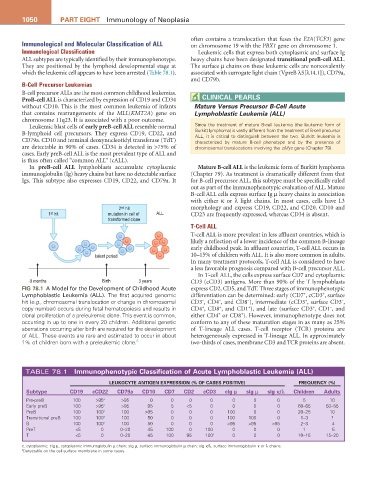
         TABLE 78.1  immunophenotypic Classification of acute Lymphoblastic Leukemia (aLL)
                                     LEUKOCYTE aNTigEN EXPrESSiON (% OF CaSES POSiTiVE)            FrEQUENCY (%)
          Subtype       CD19   cCD22   CD79a    CD10   CD7   CD2    cCD3   cig µ  sig µ  sig κ/λ  Children  adults
          Pre-preB       100    >95 a    >95      0      0     0      0      0      0       0       5        10
          Early preB     100    >95 a    >95     95      5    <5      0      0      0       0      60–65    50–55
          PreB           100    100 a    100    >95      0     0      0    100      0       0      20–25     10
          Transitional preB  100  100 a  100     50      0     0      0    100    100       0      1–3       ?
          B              100    100 a    100     50      0     0      0    >95    >95     >95      2–3        4
          PreT            <5      0     0–20     45    100     0    100      0      0       0       1         5
          T               <5      0     0–20     45    100    95    100 a    0      0       0      10–15    15–20
        c, cytoplasmic; cIg µ, cytoplasmic immunoglobulin µ chain; sIg µ, surface immunoglobulin µ chain; sIg κ/λ, surface immunoglobulin κ or λ chains.
        a Detectable on the cell-surface membrane in some cases.

