


Page 1087 - Clinical Immunology_ Principles and Practice ( PDFDrive )
P. 1087
ChaPTEr 78  Lymphoid Leukemias               1051


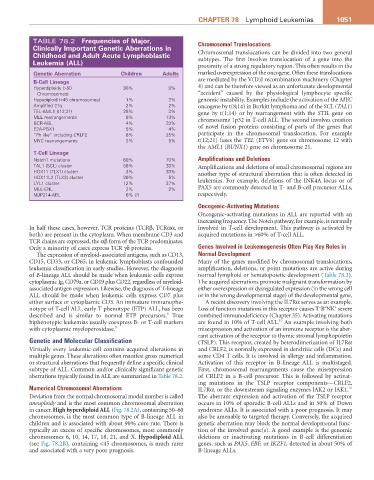
            TABLE 78.2  Frequencies of Major,                     Chromosomal Translocations
            Clinically important genetic aberrations in
            Childhood and adult acute Lymphoblastic               Chromosomal translocations can be divided into two general
                                                                  subtypes. The first involves translocation of a gene into the
            Leukemia (aLL)                                        proximity of a strong regulatory region. This often results in the
            genetic aberration           Children     adults      marked overexpression of the oncogene. Often these translocations
            B-Cell Lineage                                        are mediated by the V(D)J recombination machinery (Chapter
            Hyperdiploidy (>50           30%            9%        4) and can be therefore viewed as an unfortunate developmental
             Chromosomes)                                         “accident” caused by the physiological lymphocyte specific
            Hypodiploid (<45 chromosomes)  1%           2%        genomic instability. Examples include the activation of the MYC
            Amplified 21q                 2%            2%        oncogene by t(8;14) in Burkitt lymphoma and of the SCL (TAL1)
            TEL-AML1 (t12;21)            25%            3%        gene by t(1;14) or by rearrangement with the  STIL gene on
            MLL rearrangements            9%           13%        chromosome 1p32 in T-cell ALL. The second involves creation
            BCR-ABL                       4%           33%
            E2A-PBX1                      5%            4%        of novel fusion proteins consisting of parts of the genes that
            “Ph like” including CRLF2     8%           25%        participate in  the  chromosomal  translocation. For  example
            MYC rearrangements            2%            5%        t(12;21) fuses the TEL (ETV6) gene on chromosome 12 with
                                                                  the AML1 (RUNX1) gene on chromosome 21.
            T-Cell Lineage
            Notch1 mutations             60%           70%        Amplifications and Deletions
            TAL1 (SCL) cluster           58%           33%        Amplifications and deletions of small chromosomal regions are
            HOX11 (TLX1) cluster          3%           33%        another type of structural aberration that is often detected in
            HOX11L2 (TLX3) cluster       20%            5%
            LYL1 cluster                 12%           37%        leukemias.  For example, deletions of the  INK4A  locus or  of
            MLL-ENL                       2%            2%        PAX5 are commonly detected in T- and B-cell precursor ALLs,
            NUP214-ABL                    6% (?)                  respectively.
                                                                  Oncogenic-Activating Mutations
                                                                  Oncogenic-activating mutations in ALL are reported with an
                                                                  increasing frequency. The Notch pathway, for example, is normally
           In half these cases, however, TCR proteins (TCRβ, TCRαα, or   involved in T-cell development. This pathway is activated by
           both) are present in the cytoplasm. When membrane CD3 and   acquired mutations in >60% of T-cell ALL.
           TCR chains are expressed, the αβ form of the TCR predominates.
           Only a minority of cases express TCR γδ proteins.      Genes Involved in Leukemogenesis Often Play Key Roles in
             The expression of myeloid-associated antigens, such as CD13,   Normal Development
           CD15, CD33, or CD65, in leukemic lymphoblasts confounded   Many of the genes modified by chromosomal translocations,
           leukemia classification in early studies. However, the diagnosis   amplification, deletions, or point mutations are active during
           of B-lineage ALL should be made when leukemic cells express   normal lymphoid or hematopoietic development (Table 78.3).
           cytoplasmic Ig, CD79a, or CD19 plus CD22, regardless of myeloid-  The acquired aberrations promote malignant transformation by
           associated antigen expression. Likewise, the diagnosis of T-lineage   either overexpression or dysregulated expression (in the wrong cell
           ALL should be made when leukemic cells express CD7 plus   or in the wrong developmental stage) of the developmental gene.
           either surface or cytoplasmic CD3. An immature immunophe-  A recent discovery involving the IL7Rα serves as an example.
                                                                                                              +
                                                                                                         − +
           notype of T-cell ALL, early T phenotype (ETP) ALL, has been   Loss of function mutations in this receptor causes T B NK  severe
                                                        8
           described and is similar to normal ETP precursors.  True   combined immunodeficiency (Chapter 35). Activating mutations
                                                                                            10
           biphenotypic leukemias usually coexpress B- or T-cell markers   are found in 10% of T-cell ALL.  An example involving both
           with cytoplasmic myeloperoxidase. 9                    misexpression and activation of an immune receptor is the aber-
                                                                  rant activation of the receptor to thymic stromal lymphopoietin
           Genetic and Molecular Classification                   (TSLP). This receptor, created by heterodimerization of IL7Rα
           Virtually  every  leukemic  cell  contains  acquired  alterations  in   and CRLF2, is normally expressed in dendritic cells (DCs) and
           multiple genes. These alterations often manifest gross numerical   some CD4 T cells. It is involved in allergy and inflammation.
           or structural aberrations that frequently define a specific clinical   Activation of this receptor in B-lineage  ALL is multistaged.
           subtype of ALL. Common and/or clinically significant genetic   First, chromosomal rearrangements cause the misexpression
           aberrations typically found in ALL are summarized in Table 78.2.  of CRLF2 in a B-cell precursor. This is followed by activat-
                                                                  ing mutations in the TSLP receptor components—CRLF2,
           Numerical Chromosomal Aberrations                      IL7Rα, or the downstream signaling enzymes JAK2 or JAK1.
                                                                                                                   10
           Deviation from the normal chromosomal modal number is called   The aberrant expression and activation of the TSLP receptor
           aneuploidy and is the most common chromosomal aberration   occurs in 10% of sporadic B-cell ALLs and in 50% of Down
           in cancer. High hyperdiploid ALL (Fig. 78.2A), containing 50–60   syndrome ALLs. It is associated with a poor prognosis. It may
           chromosomes, is the most common type of B-lineage ALL in   also be amenable to targeted therapy. Conversely, the acquired
           children and is associated with about 90% cure rate. There is   genetic aberration may block the normal developmental func-
           typically an excess of specific chromosomes, most commonly   tion of the involved gene(s). A good example is the genomic
           chromosomes 6, 10, 14, 17, 18, 21, and X. Hypodiploid ALL   deletions or inactivating mutations in B-cell differentiation
           (see Fig. 78.2B), containing <45 chromosomes, is much rarer   genes, such as PAX5, EBF, or IKZF1, detected in about 50% of
           and associated with a very poor prognosis.             B-lineage ALLs.

