


Page 1090 - Clinical Immunology_ Principles and Practice ( PDFDrive )
P. 1090
1054         ParT EighT  Immunology of Neoplasia


                                                                      15
           Traditionally, CNS leukemia has been defined as the presence   analysis.  In most centers, karyotype by classic cytogenetics (see
        of at least five leukocytes per microliter of cerebrospinal fluid   Fig. 78.2) is performed. However, because of the lack of meta-
        (CSF) and the detection of leukemic blast cells, by the presence   phases, the yield of karyotypic analysis of ALL in multicenter
        of cranial nerve palsy, or by retinal involvement, as detected by   protocols is often <70%. Furthermore, normal karyotypes are
        ophthalmoscopy. Although overt CNS leukemia is relatively rare,   sometimes derived from the normal cells in bone marrow rather
        submicroscopic CNS involvement is present at diagnosis in at   than the leukemia blasts. This drawback can be overcome by
        least half the patients in the absence of any neurological symp-  interphase fluorescent in-situ hybridization (FISH), a technique
        toms. Thus CNS-directed therapy is routinely included in ALL   that does not require metaphases. All clinically relevant structural
        therapy.                                               and numerical chromosomal aberrations can be detected with
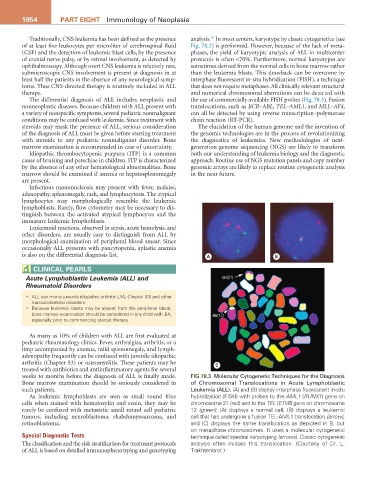
           The differential diagnosis of  ALL includes neoplastic and   the use of commercially available FISH probes (Fig. 78.3). Fusion
        nonneoplastic diseases. Because children with ALL present with   translocations, such as BCR–ABL, TEL–AML1, and MLL–AF4,
        a variety of nonspecific symptoms, several pediatric nonmalignant   can all be detected by using reverse transcription–polymerase
        conditions may be confused with leukemia. Since treatment with   chain reaction (RT-PCR).
        steroids may mask the presence of ALL, serious consideration   The elucidation of the human genome and the invention of
        of the diagnosis of ALL must be given before starting treatment   the genomic technologies are in the process of revolutionizing
        with steroids to any pediatric nonmalignant disorder. Bone   the diagnostics of leukemias. New methodologies of next-
        marrow examination is recommended in case of uncertainty.  generation genome sequencing (NGS) are likely to transform
           Idiopathic thrombocytopenic purpura (ITP) is a common   both our understanding of leukemia biology and the diagnostic
        cause of bruising and petechiae in children. ITP is characterized   approach. Routine use of NGS mutation panels and copy number
        by the absence of any other hematological abnormalities. Bone   genomic arrays are likely to replace routine cytogenetic analysis
        marrow should be examined if anemia or hepatosplenomegaly   in the near future.
        are present.
           Infectious mononucleosis may present with fever, malaise,
        adenopathy, splenomegaly, rash, and lymphocytosis. The atypical
        lymphocytes may morphologically resemble the leukemic
        lymphoblasts. Rarely, flow cytometry may be necessary to dis-
        tinguish between the activated atypical lymphocytes and the
        immature leukemic lymphoblasts.
           Leukemoid reactions, observed in sepsis, acute hemolysis, and
        other disorders, are usually  easy to distinguish  from  ALL  by
        morphological examination of peripheral blood smear. Since
        occasionally ALL presents with pancytopenia, aplastic anemia
        is also on the differential diagnosis list.                  A                     B

            CLiNiCaL PEarLS
         Acute Lymphoblastic Leukemia (ALL) and                           der(21)
         Rheumatoid Disorders

          •  ALL can mimic juvenile idiopathic arthritis (JIA; Chapter 53) and other
           musculoskeletal disorders.
          •  Because leukemic blasts may be absent from the peripheral blood,
           bone marrow examination should be considered in any child with JIA,   der(12)
           especially prior to commencing steroid therapy.

           As many as 10% of children with ALL are first evaluated at
        pediatric rheumatology clinics. Fever, arthralgias, arthritis, or a
        limp accompanied by anemia, mild splenomegaly, and lymph-
        adenopathy frequently can be confused with juvenile idiopathic
        arthritis (Chapter 53) or osteomyelitis. These patients may be   C
        treated with antibiotics and antiinflammatory agents for several
        weeks to months before the diagnosis of ALL is finally made.   Fig 78.3  Molecular Cytogenetic Techniques for the Diagnosis
        Bone marrow examination should be seriously considered in   of Chromosomal Translocations in Acute Lymphoblastic
        such patients.                                         Leukemia (ALL). (A) and (B) display interphase fluorescent in-situ
           As leukemic lymphoblasts are seen as small round blue   hybridization (FISH) with probes to the AML1 (RUNX1) gene on
        cells when stained with hematoxylin and eosin, they may be   chromosome 21 (red) and to the TEL (ETV6) gene on chromosome
        rarely be confused with metastatic small round cell pediatric   12 (green). (A) displays a normal cell, (B) displays a leukemic
        tumors,  including  neuroblastoma,  rhabdomyosarcoma, and   cell that has undergone a fusion TEL-AML1 translocation (arrow),
        retinoblastoma.                                        and (C) displays the same translocation as depicted in B, but
                                                               on metaphase chromosomes. It uses a molecular cytogenetic
        Special Diagnostic Tests                               technique called spectral karyotyping (arrows). Classic cytogenetic
        The classification and the risk stratification for treatment protocols   analysis  often  misses  this  translocation.  (Courtesy  of Dr.  L.
        of ALL is based on detailed immunophenotyping and genotyping   Trakhtenbrot.)

