


Page 1116 - Clinical Immunology_ Principles and Practice ( PDFDrive )
P. 1116
1080         Part eight  Immunology of Neoplasia


        MGUS, clonal lymphoplasmacytic cells must constitute <10%    to idiopathic Bence-Jones proteinuria, light chain MM,  AL
        infiltration.                                          amyloidosis, or LCDD.
           Conventional cytogenetics are normal in patients with MGUS   Patients with MGUS progress to a symptomatic plasma cell
        due to technical limitations, a low proliferative rate, and the   proliferative disorder or lymphoproliferative disorder at a rate
        small number of plasma cells within the bone marrow samples.   of 1% per year. However, not all persons with MGUS have the
        However, studies using more sensitive methods have shown that   same risk of disease progression. The risk of progression to a
        chromosomal abnormalities are very common in the clonal cells   more serious disease ranges widely from 0.6–3.4%/year based
        found in MGUS.  Analysis by interphase fluorescent  in situ   on the initial value of serum monoclonal protein as well as from
                                                                                                            4
        hybridization (FISH) demonstrate chromosomal aneuploidy, in   0.25–2.9%/year according to a risk stratification model.  Three
        particular hyperdiploidy, in approximately 50% of patients with   adverse risk factors have been combined to create a risk stratifica-
        MGUS. 1                                                tion model that is useful in predicting progression of MGUS
                                                                                                       5
                                                               (non-IgM and IgM) to MM or a related malignancy : The findings
        Diagnosis                                              that generate a less favorable outcome include serum monoclonal
        Diagnostic criteria for each of the individual types of MGUS   protein level ≥1.5 g/dL, non-IgG MGUS, and abnormal serum
        are determined by the International Myeloma Working Group   free light chain ratio (kappa/lambda free light chain ratio <0.26
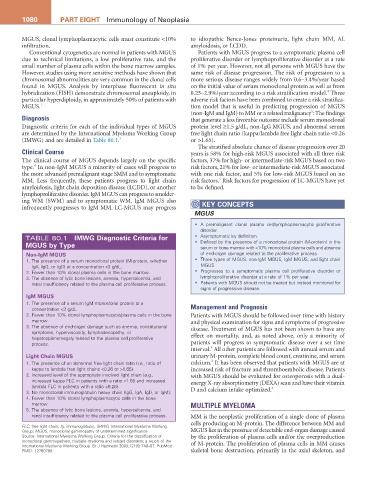
        (IMWG) and are detailed in Table 80.1. 3               or >1.65).
                                                                  The stratified absolute chance of disease progression over 20
        Clinical Course                                        years is 58% for high-risk MGUS associated with all three risk
        The clinical course of MGUS depends largely on the specific   factors, 37% for high- or intermediate-risk MGUS based on two
            4
        type.  In non-IgM MGUS a minority of cases will progress to   risk factors, 21% for low- or intermediate-risk MGUS associated
        the more advanced premalignant stage SMM and to symptomatic   with one risk factor, and 5% for low-risk MGUS based on no
                                                                         5
        MM.  Less  frequently,  these  patients  progress  to  light  chain   risk factors.  Risk factors for progression of LC-MGUS have yet
        amyloidosis, light chain deposition disease (LCDD), or another   to be defined.
        lymphoproliferative disorder. IgM MGUS can progress to smolder-
        ing WM (SWM) and to symptomatic WM. IgM MGUS also          KeY CONCePtS
        infrequently progresses to IgM MM. LC-MGUS may progress
                                                                 MGUS
                                                                 •  A premalignant clonal plasma cell/lymphoplasmacytic proliferative
                                                                   disorder.
         TABLE 80.1  iMWg Diagnostic Criteria for                •  Asymptomatic by definition.
         MgUS by type                                            •  Defined by the presence of a monoclonal protein (M-protein) in the
                                                                   serum or bone marrow with <10% monoclonal plasma cells and absence
          Non-igM MgUS                                             of end-organ damage related to the proliferative process.
          1. The presence of a serum monoclonal protein (M-protein, whether   •  Three types of MGUS: non-IgM MGUS, IgM MGUS, and light chain
           IgA, IgG, or IgD) at a concentration <3 g/dL.           MGUS.
          2. Fewer than 10% clonal plasma cells in the bone marrow.  •  Progresses to a symptomatic plasma cell proliferative disorder or
          3. The absence of lytic bone lesions, anemia, hypercalcemia, and   lymphoproliferative disorder at a rate of 1% per year.
           renal insufficiency related to the plasma cell proliferative process.  •  Patients with MGUS should not be treated but instead monitored for
                                                                   signs of progressive disease.
          igM MgUS
          1. The presence of a serum IgM monoclonal protein at a
           concentration <3 g/dL.                              Management and Prognosis
          2. Fewer than 10% clonal lymphoplasmacytic/plasma cells in the bone   Patients with MGUS should be followed over time with history
           marrow.                                             and physical examination for signs and symptoms of progressive
          3. The absence of end-organ damage such as anemia, constitutional   disease. Treatment of MGUS has not been shown to have any
           symptoms, hyperviscosity, lymphadenopathy, or
           hepatosplenomegaly related to the plasma cell proliferative   effect on mortality, and, as noted above, only a minority of
           process.                                            patients will progress to symptomatic disease over a set time
                                                                      4
                                                               interval.  All other patients are followed with annual serum and
          Light Chain MgUS                                     urinary M-protein, complete blood count, creatinine, and serum
                                                                      4
          1. The presence of an abnormal free light chain ratio (i.e., ratio of   calcium.  It has been observed that patients with MGUS are at
           kappa to lambda free light chains <0.26 or >1.65).  increased risk of fracture and thromboembolic disease. Patients
          2. Increased level of the appropriate involved light chain (e.g.,   with MGUS should be evaluated for osteoporosis with a dual-
           increased kappa FLC in patients with a ratio >1.65 and increased   energy X-ray absorptiometry (DEXA) scan and have their vitamin
           lambda FLC in patients with a ratio <0.26).                                    4
          3. No monoclonal immunoglobulin heavy chain (IgG, IgA, IgD, or IgM).  D and calcium intake optimized.
          4. Fewer than 10% clonal lymphoplasmacytic cells in the bone
           marrow.                                             MULTIPLE MYELOMA
          5. The absence of lytic bone lesions, anemia, hypercalcemia, and
           renal insufficiency related to the plasma cell proliferative process.  MM is the neoplastic proliferation of a single clone of plasma
                                                               cells producing an M-protein. The difference between MM and
        FLC, free light chain; Ig, immunoglobulin; IMWG, International Myeloma Working
        Group; MGUS, monoclonal gammopathy of undetermined significance.  MGUS lies in the presence of detectable end-organ damage caused
        Source: International Myeloma Working Group. Criteria for the classification of   by the proliferation of plasma cells and/or the overproduction
        monoclonal gammopathies, multiple myeloma and related disorders: a report of the   of M-protein. The proliferation of plasma cells in MM causes
        International Myeloma Working Group. Br J Haematol 2003;121(5):749–57. PubMed
        PMID: 12780789.                                        skeletal bone destruction, primarily in the axial skeleton, and

